


























Views
Downloads
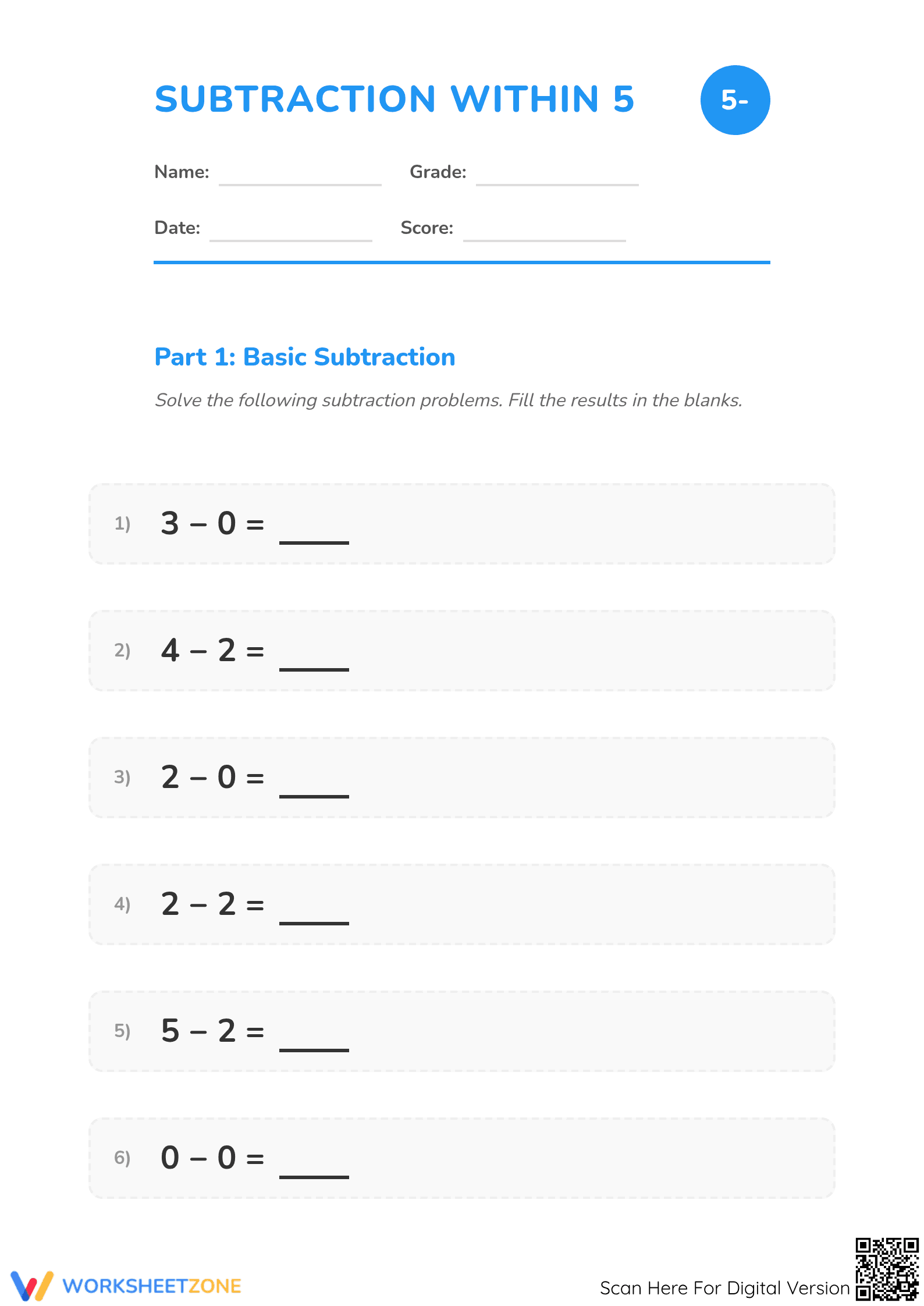


Subtraction Within 5 Worksheet | Grade K Math Printable
Paste this activity's link or code into your existing LMS (Google Classroom, Canvas, Teams, Schoology, Moodle, etc.).
Students can open and work on the activity right away, with no student login required.
You'll still be able to track student progress and results from your teacher account.
This foundational subtraction worksheet helps early learners master basic math facts by working directly with numbers up to five. By completing these targeted exercises, students develop essential numerical fluency and build the confidence needed to tackle more advanced mathematical concepts as they progress through their early education.
At a Glance
- Grade: K · Subject: Math
- Standard:
CCSS.MATH.CONTENT.K.OA.A.5— Fluently subtract within 5- Skill Focus: Basic Subtraction
- Format: 4 pages · 24 problems · Answer key included · PDF
- Best For: Independent practice and math centers
- Time: 15–20 minutes
This comprehensive four-page resource includes 24 distinct subtraction problems divided into three clear sections. Students begin with basic numerical equations, move into additional practice challenges, and finish with visual subtraction tasks featuring dot models. A complete answer key is provided to ensure quick and accurate grading for educators.
Skill Progression
- Guided practice: The first 12 problems focus on straightforward numerical subtraction, allowing students to establish a baseline understanding of minus operations.
- Supported practice: The next 8 problems offer additional repetition to solidify memory recall and build automaticity with facts under five.
- Independent practice: The final 4 problems introduce visual dot models, requiring students to cross out items and write the corresponding answer independently.
This structured approach follows a gradual-release model, ensuring early learners build competence step-by-step.
Standards Alignment
This resource is directly aligned to CCSS.MATH.CONTENT.K.OA.A.5, which requires students to fluently add and subtract within 5. By focusing exclusively on this numerical range, the material ensures targeted skill development. Both standard codes can be copied directly into lesson plans, IEP goals, or district curriculum mapping tools.
How to Use It
Deploy this worksheet during morning work routines or as a dedicated math center activity following direct instruction on subtraction concepts. It typically takes students 15 to 20 minutes to complete all four pages. As a formative assessment tip, observe how students interact with the visual dot models in Part 3; if they struggle to cross out the correct number of dots, they may need additional hands-on practice with physical manipulatives before returning to written equations.
Who It's For
This material is designed primarily for Kindergarten students building early math fluency, though it serves as excellent review for first graders needing foundational reinforcement. For students requiring extra support, provide counting blocks or a number line to accompany the equations. This worksheet pairs perfectly with introductory subtraction anchor charts or interactive whiteboard lessons.
Developing early mathematical automaticity is a critical predictor of long-term academic success in elementary education. This resource directly supports CCSS.MATH.CONTENT.K.OA.A.5, helping students fluently subtract within 5. According to a recent EdReports 2024 analysis, instructional materials that isolate specific numerical ranges and provide repeated, structured practice significantly improve early childhood math outcomes. When young learners are given the opportunity to interact with both standard numerical equations and visual dot models, their conceptual understanding deepens considerably. This targeted practice reduces cognitive load, allowing students to focus entirely on the mechanics of the subtraction operation rather than complex number values. By integrating these foundational exercises into daily classroom routines, educators can ensure their students build the robust mathematical framework required for future algebraic thinking and advanced problem-solving tasks.


