


























Views
Plays
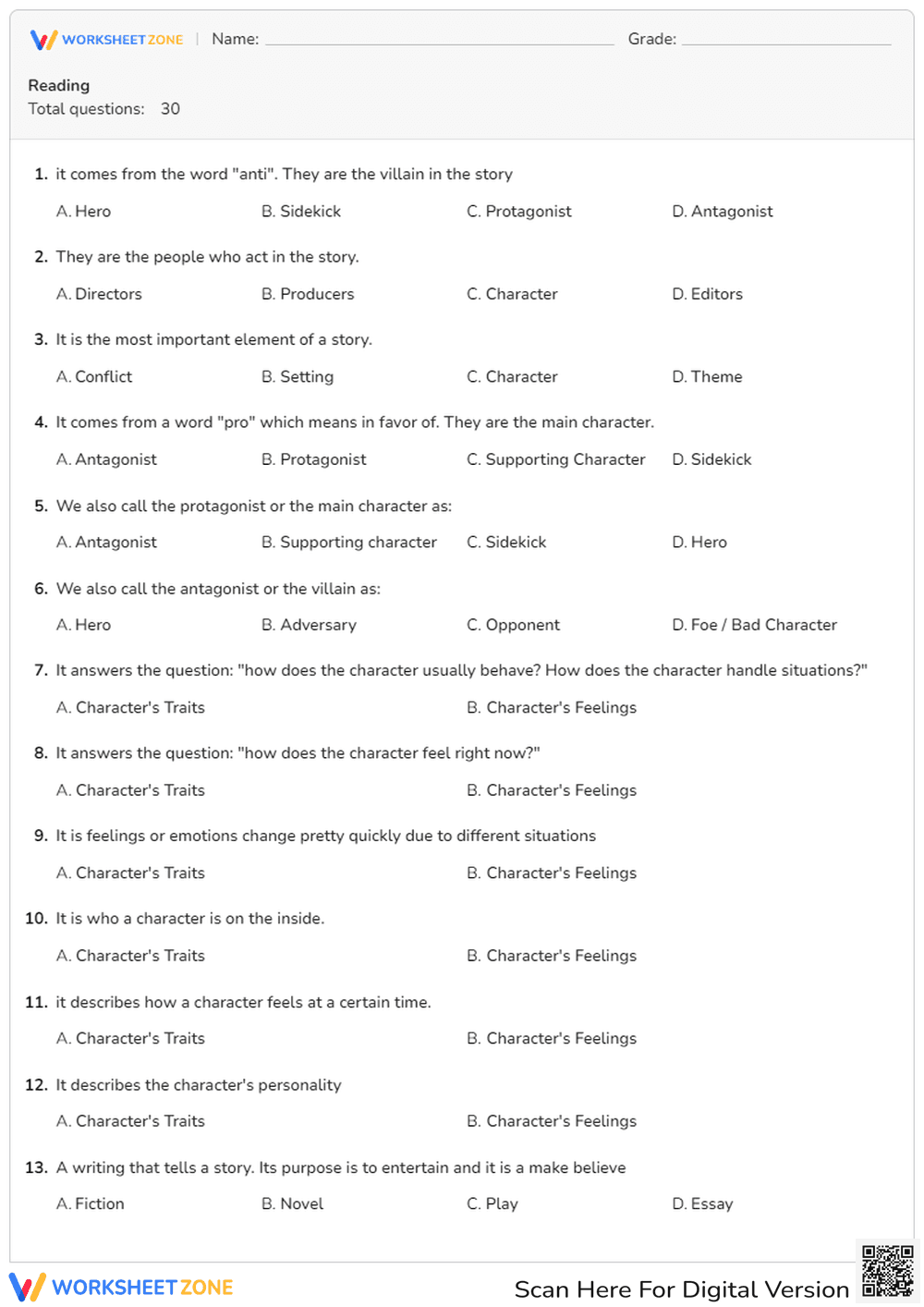


Essential Story Elements & Literary Terms Quiz | Grade 7-8
Paste this activity's link or code into your existing LMS (Google Classroom, Canvas, Teams, Schoology, Moodle, etc.).
Students can open and work on the activity right away, with no student login required.
You'll still be able to track student progress and results from your teacher account.
This Grade 7-8 ELA quiz provides a comprehensive assessment of narrative text structures and literary terminology. Students demonstrate mastery by identifying character roles, plot stages, and thematic elements across 30 targeted questions. It ensures learners can distinguish between complex concepts like character traits and temporary feelings while identifying various fiction sub-genres.
At a Glance
- Grade: 7-8 · Subject: ELA Reading
- Standard:
CCSS.ELA-LITERACY.RL.7.3— Analyze how particular elements of a story or drama interact- Skill Focus: Literary Terms & Story Elements
- Format: 3 pages · 30 problems · Answer key included · PDF
- Best For: Summative assessment or unit review
- Time: 25–35 minutes
What's Inside
The three-page PDF contains 30 items, including traditional multiple-choice questions and multiple-select options for complex topics like plot parts and transition words. It features a clear layout with dedicated spaces for student names and grades. The content spans characterization (protagonist/antagonist), setting, plot sequencing, and specific literary genres such as fables and legends.
Zero-Prep Workflow
- Print: Select the three-page PDF and print enough copies for your roster in under 1 minute.
- Distribute: Hand out the quiz as a quiet, independent assessment with zero teacher setup required.
- Review: Use the included answer key to grade or facilitate a peer-review session in approximately 5 minutes.
Total teacher preparation time for this assessment is under two minutes, making it an ideal choice for busy classroom schedules or emergency sub plans.
Standards Alignment
The primary focus is `CCSS.ELA-LITERACY.RL.7.3`, which requires students to analyze how story elements interact. It also supports `CCSS.ELA-LITERACY.L.7.6` by reinforcing domain-specific vocabulary. Both standard codes can be copied directly into lesson plans, IEP goals, or district curriculum mapping tools.
How to Use It
Use this as a summative assessment at the end of a fiction unit to gauge student understanding of narrative mechanics. Alternatively, assign it as a pre-test before starting a novel study to identify gaps in literary vocabulary. During the session, observe if students struggle more with abstract concepts like "theme" versus concrete elements like "setting." Completion typically takes 30 minutes.
Who It's For
This worksheet is ideal for middle school students in general education or ICT settings. It provides excellent support for English Language Learners (ELLs) through clear definitions and structured choices. Pair this quiz with a short story anthology or a literary terms anchor chart for a complete instructional cycle.
According to the RAND AIRS 2024 report, frequent low-stakes assessments of domain-specific vocabulary are critical for reading comprehension in the middle grades. This worksheet aligns with the Fisher & Frey (2014) gradual release of responsibility model by providing a structured environment for students to demonstrate independent mastery of CCSS.ELA-LITERACY.RL.7.3. By isolating story elements such as plot, characterization, and theme, the quiz allows educators to pinpoint specific areas where students may require additional scaffolding. Research from EdReports 2024 emphasizes that high-quality instructional materials must explicitly connect literary terms to their functional roles within a text. This 30-question resource fulfills that requirement by moving beyond simple definitions to require the application of knowledge regarding narrative structure and character dynamics. It serves as a reliable tool for tracking student progress toward state-level proficiency benchmarks in English Language Arts.


