


























Views
Downloads



Springtime Planting Reading Worksheet | Grade 1-3 Essential
Paste this activity's link or code into your existing LMS (Google Classroom, Canvas, Teams, Schoology, Moodle, etc.).
Students can open and work on the activity right away, with no student login required.
You'll still be able to track student progress and results from your teacher account.
This Grade 1-3 reading comprehension worksheet helps students master informational text analysis through a seasonal lens. By engaging with the "Springtime Planting" story, learners develop the ability to extract key details and connect vocabulary to real-world context. Students will demonstrate their understanding through multiple-choice questions, a creative writing prompt, and a vocabulary matching exercise.
At a Glance
- Grade: 1-3 · Subject: ELA
- Standard:
CCSS.ELA-LITERACY.RI.1.1— Ask and answer questions about key details in a text- Skill Focus: Informational Text Comprehension
- Format: 3 pages · 9 tasks · Answer key included · PDF
- Best For: Seasonal literacy centers and sub plans
- Time: 20–30 minutes
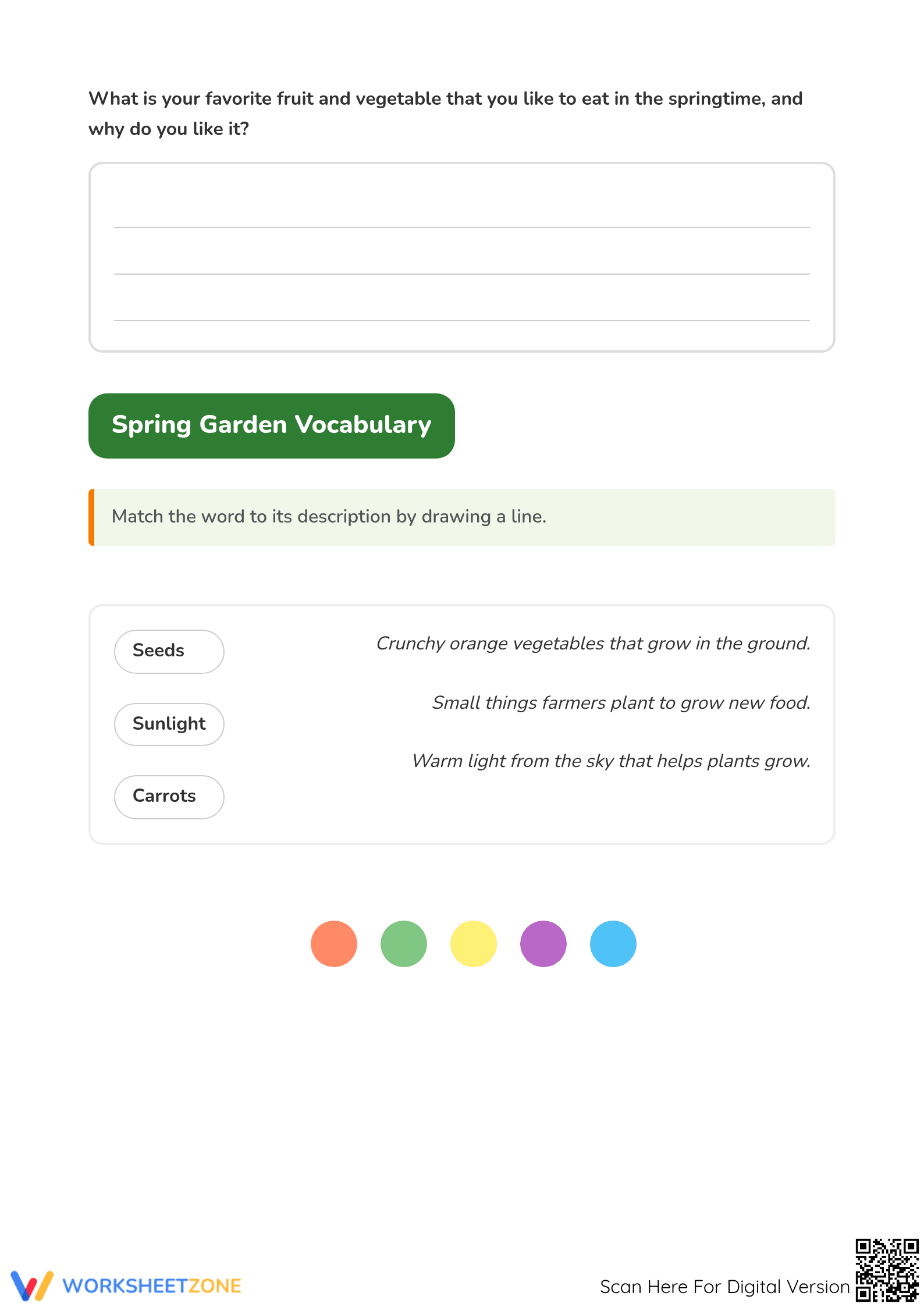
Inside this 3-page PDF, you will find a structured progression of literacy tasks. The first page introduces a high-interest passage about spring farming, followed by the first comprehension check. The second page expands into four additional multiple-choice questions and a "Share Your Thoughts" section for personal response. The final page features a vocabulary matching activity to reinforce domain-specific words like seeds, sunlight, and carrots. A complete answer key is provided for rapid grading.
Zero-Prep Workflow
- Print: Select the 3-page PDF and print enough copies for your class in under 30 seconds.
- Distribute: Hand out the packets as a standalone morning work activity or a literacy center rotation.
- Review: Use the included answer key to provide immediate feedback or conduct a peer-review session in 5 minutes.
This resource is designed for maximum teacher efficiency, requiring less than 2 minutes of total preparation time, making it an ideal choice for emergency sub plans or busy seasonal transitions.
Standards Alignment: This resource is primarily aligned to `CCSS.ELA-LITERACY.RI.1.1`, which requires students to ask and answer questions about key details in a text. It also supports vocabulary acquisition and personal narrative writing. Both standard codes can be copied directly into lesson plans, IEP goals, or district curriculum mapping tools.
How to Use It: Assign this worksheet during your morning meeting or as a formative assessment after a science lesson on plant life cycles. To differentiate, read the passage aloud for Grade 1 students while allowing Grade 3 students to work independently. Expect a completion time of 20 to 30 minutes depending on the student's reading fluency.
Who It's For: This packet is tailored for early elementary students in Grades 1, 2, and 3. It works exceptionally well for English Language Learners (ELL) due to the clear vocabulary support and can be paired with a spring-themed anchor chart or a classroom seed-planting demonstration.
According to the RAND AIRS 2024 report, high-quality instructional materials that integrate seasonal themes with core literacy standards significantly improve student engagement and retention of informational text structures. This worksheet addresses CCSS.ELA-LITERACY.RI.1.1 by requiring students to locate specific evidence within a text to answer 5 distinct comprehension questions. By combining multiple-choice tasks with a vocabulary matching component, the resource ensures that students are not just identifying facts but also building the linguistic foundation necessary for Grade 3 reading proficiency. Research from Fisher & Frey (2014) emphasizes that scaffolding informational text with familiar topics, such as gardening and fresh foods, allows younger readers to focus on the cognitive demands of evidence-based answering rather than struggling with abstract concepts. This 3-page resource provides the necessary structure for independent practice while maintaining the rigor required for state-level ELA assessments.


