


























Views
Plays
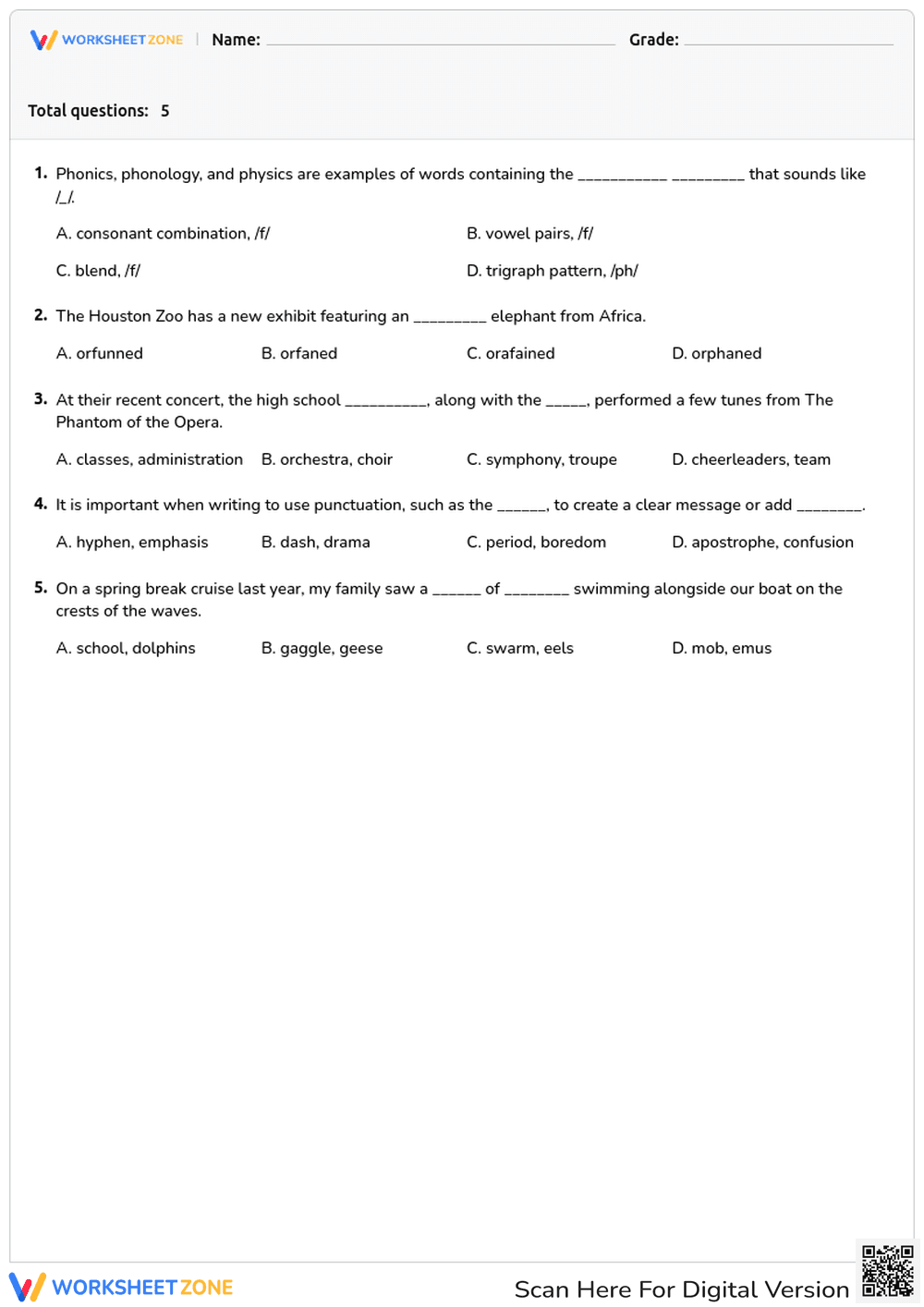

Greek Spelling Patterns Worksheet | Grade 3 Essential
Paste this activity's link or code into your existing LMS (Google Classroom, Canvas, Teams, Schoology, Moodle, etc.).
Students can open and work on the activity right away, with no student login required.
You'll still be able to track student progress and results from your teacher account.
Strengthen student orthographic awareness with this focused worksheet on spelling patterns inherited from Greek. By engaging with high-frequency words containing specific phoneme-grapheme correspondences, students move beyond rote memorization toward a deeper understanding of English word origins. This resource ensures learners can accurately identify and apply complex spelling rules in their daily writing and reading tasks.
At a Glance
- Grade: 3 · Subject: ELA
- Standard:
CCSS.ELA-LITERACY.L.3.2.F— Use spelling patterns and generalizations in writing words- Skill Focus: Greek-origin phonics (ph, ch, y)
- Format: 1 page · 5 problems · Answer key included · PDF
- Best For: Quick assessment or morning work
- Time: 10–15 minutes
What's Inside
This single-page PDF features 5 carefully crafted multiple-choice questions that challenge students to select the correct spelling or usage of words with Greek roots. The worksheet includes context-rich sentences involving vocabulary such as "orchestra," "hyphen," "emphasis," and "dolphins." Each question is designed to test both the recognition of the spelling pattern and the student's ability to integrate that word into a logical sentence structure.
Zero-Prep Workflow
- Print (30 seconds): Simply download the PDF and send it to your printer; no formatting or resizing is required for standard letter paper.
- Distribute (1 minute): Hand out the sheets as a bell-ringer activity or a quick check for understanding following a lesson on Greek roots.
- Review (2 minutes): Use the included answer key for rapid grading or lead a whole-class discussion to explain the logic behind each Greek spelling convention.
Standards Alignment
This resource is directly aligned with CCSS.ELA-LITERACY.L.3.2.F, which requires students to use spelling patterns and generalizations (e.g., word families, position-based spellings, syllable patterns, ending rules, and meaningful word parts) in writing words. It also supports vocabulary acquisition by introducing academic language found in music, science, and grammar. Both standard codes can be copied directly into lesson plans, IEP goals, or district curriculum mapping tools.
How to Use It
This worksheet is most effective when used during the "You Do" phase of a gradual release lesson on word study. Assign it as a formative assessment after introducing the /f/ sound spelled as "ph" to see which students have mastered the concept. For a quick observation tip, watch for students who struggle with the multi-syllabic nature of words like "orphaned" or "orchestra," as this may indicate a need for further syllable division practice. Expect completion within 10 to 15 minutes.
Who It's For
While designed for Grade 3 students, this worksheet is also highly effective for Grade 4 review or for ESL/ELL learners who are navigating the complexities of English orthography. It pairs naturally with a Greek and Latin roots anchor chart or a direct instruction lesson on phonics generalizations. The clear layout and multiple-choice format provide necessary scaffolding for students who require more structure in their independent work.
Research emphasizes that explicit instruction in orthographic patterns, particularly those from Greek roots, significantly improves reading fluency and decoding skills. This worksheet targets CCSS.ELA-LITERACY.L.3.2.F by requiring students to identify and apply complex spelling patterns like 'ph' and 'ch' in words like orchestra and choir. By placing these words within meaningful sentence contexts, the resource bridges the gap between isolated phonics practice and functional literacy. Systematic exposure to these high-frequency words reduces cognitive load during independent writing tasks, allowing students to focus on composition. Educators can utilize this assessment to pinpoint specific gaps in phonological awareness, ensuring Grade 3 learners develop foundational linguistic tools for academic success.


