


























Views
Downloads
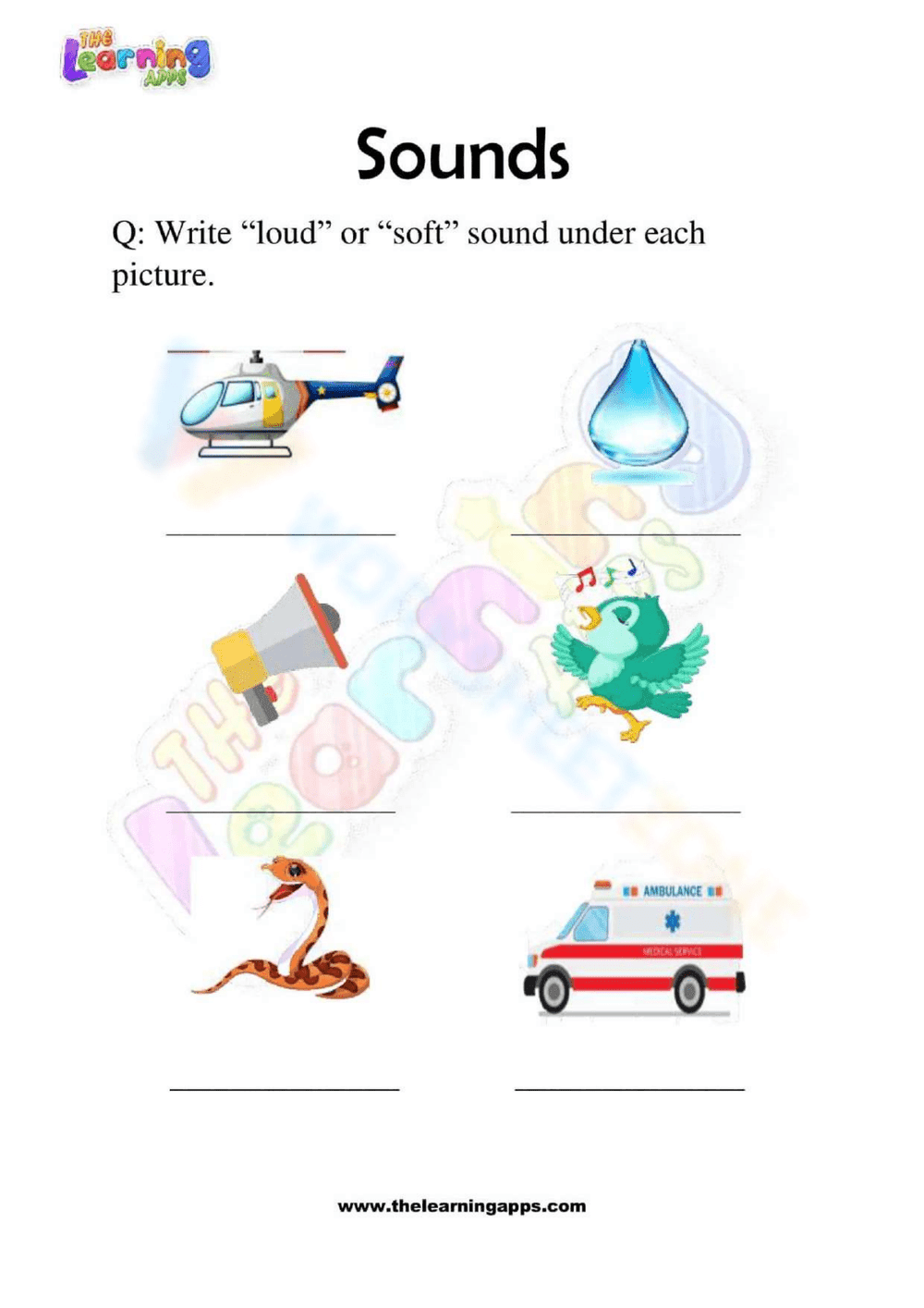

Loud and Soft Sounds Worksheet | Grade 1 Essential
Paste this activity's link or code into your existing LMS (Google Classroom, Canvas, Teams, Schoology, Moodle, etc.).
Students can open and work on the activity right away, with no student login required.
You'll still be able to track student progress and results from your teacher account.
This Grade 1 science worksheet helps students distinguish between high and low volume by classifying everyday objects. By observing visual cues like helicopters and water drops, learners develop the vocabulary needed to describe auditory properties. It provides a clear, immediate way to assess a child's understanding of sound intensity in the physical world.
At a Glance
- Grade: 1 · Subject: Science
- Standard:
1-PS4-1— Identify properties of sound and how they are perceived- Skill Focus: Volume classification (Loud vs. Soft)
- Format: 1 page · 6 problems · Answer key included · PDF
- Best For: Quick formative assessment or science centers
- Time: 5–10 minutes
The worksheet features a clean, one-page layout containing six high-quality illustrations of common sound-producing objects. Students are prompted to write either "loud" or "soft" on the provided lines beneath each image. The selection includes a mix of mechanical sounds and natural sounds, ensuring a broad application of the concept.
This resource is designed for immediate classroom implementation with a total teacher prep time of under 2 minutes. Simply print the single-page PDF and distribute it to students during your energy and sound unit. Because the instructions are concise and the visual cues are intuitive, it functions perfectly as a silent independent activity or a reliable sub-plan filler.
This activity aligns with 1-PS4-1, focusing on the observable properties of sound. While the standard emphasizes vibration, understanding volume is a prerequisite for describing how different vibrations result in different auditory experiences. Both standard codes can be copied directly into lesson plans, IEP goals, or district curriculum mapping tools.
Use this as an "exit ticket" after a direct instruction lesson on the five senses or physical science. It allows teachers to quickly scan for misconceptions—such as a student labeling a snake as "loud." Alternatively, place it in a science center alongside actual sound-making objects to bridge the gap between abstract pictures and concrete auditory experiences. Expect completion in 5 to 10 minutes.
This is ideal for first-grade students beginning their exploration of physical science, but it also serves as an excellent vocabulary builder for English Language Learners (ELLs). The heavy reliance on visual icons makes it accessible for early readers. Pair this with a "Sound Walk" around the school building to reinforce the loud/soft distinction in a real-world context.
Research from Fisher & Frey (2014) emphasizes the importance of visual scaffolding in early science education to help students categorize abstract concepts like sound volume. By using familiar icons such as ambulances and birds, this worksheet reduces cognitive load, allowing Grade 1 learners to focus specifically on the linguistic application of "loud" and "soft." According to the NAEP science framework, early mastery of physical properties sets the foundation for more complex wave mechanics in later grades. This 6-task resource provides the necessary repetition to move students from recognition to classification. Standard 1-PS4-1 requires students to relate sound to physical actions; identifying volume is the first step in that evidentiary chain. Using this printable ensures that 100% of students can participate regardless of their current reading level, supporting inclusive classroom environments and data-driven instruction.


