


























Views
Downloads
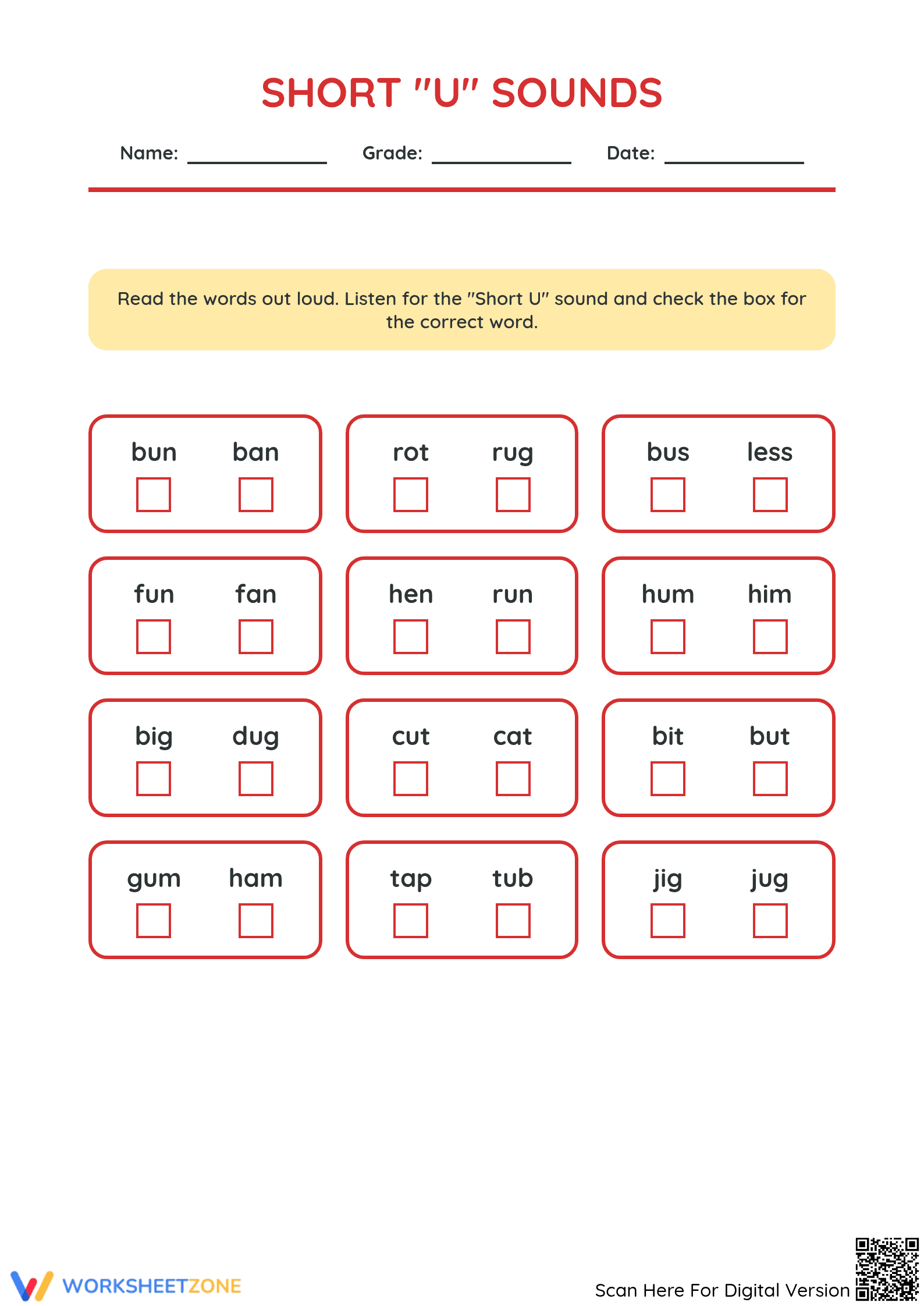


Short U Sounds Worksheet | Grade 1 Essential Phonics
Paste this activity's link or code into your existing LMS (Google Classroom, Canvas, Teams, Schoology, Moodle, etc.).
Students can open and work on the activity right away, with no student login required.
You'll still be able to track student progress and results from your teacher account.
This Grade 1 phonics worksheet provides targeted practice for the short "u" vowel sound, helping students distinguish between similar-sounding CVC words. By isolating the medial vowel sound, learners strengthen their decoding skills and phonemic awareness. This resource ensures students can accurately identify and produce the "u" sound in common vocabulary.
At a Glance
- Grade: 1 · Subject: ELA Phonics
- Standard:
CCSS.ELA-LITERACY.RF.1.2.C— Isolate and pronounce initial, medial vowel, and final sounds in spoken single-syllable words- Skill Focus: Short U vowel identification
- Format: 2 pages · 17 problems · Answer key included · PDF
- Best For: Independent phonics practice and assessment
- Time: 15–20 minutes
The resource contains two distinct pages designed to build vowel mastery. The first page presents 12 word pairs where students must listen for and select the word containing the short "u" sound (e.g., distinguishing "rug" from "rot"). The second page features 5 cloze-style sentences that require students to apply their knowledge by filling in the blanks with appropriate short "u" words. A full answer key is provided for quick grading.
This worksheet is designed for a zero-prep classroom workflow. Teachers can print the two-page PDF in under 30 seconds. Distribution takes less than a minute, and because the instructions are self-explanatory, students can begin working immediately. Reviewing the 17 tasks with the included answer key takes approximately 2 minutes, making this an ideal resource for morning work or emergency sub plans.
This activity is directly aligned with CCSS.ELA-LITERACY.RF.1.2.C, which focuses on isolating and pronouncing medial vowel sounds in single-syllable words. It also supports RF.K.2.D by reinforcing sound isolation. Both standard codes can be copied directly into lesson plans, IEP goals, or district curriculum mapping tools.
Use this worksheet during the independent practice phase of a gradual release lesson on vowels. It serves as an excellent formative assessment after a whole-group sorting activity. Teachers should observe if students are subvocalizing the words to hear the vowel difference. Expect completion within 15 to 20 minutes depending on reading fluency.
This resource is tailored for Grade 1 students but is also highly effective for Kindergarteners ready for CVC blending or Grade 2 students requiring intervention. It pairs naturally with an anchor chart displaying short "u" word families like -ug, -un, and -ut.
According to Fisher & Frey (2014), the gradual release of responsibility is most effective when students are provided with structured opportunities to practice discrete phonemic skills independently. This worksheet facilitates that transition by moving from simple identification to contextual application in sentences. By focusing on the CCSS.ELA-LITERACY.RF.1.2.C standard, the material ensures that students develop the necessary auditory discrimination to succeed in later decoding tasks. Research indicates that consistent exposure to CVC word patterns significantly improves reading fluency in early elementary learners. This 17-task set provides the repetition needed for neural mapping of the short "u" sound. Educators can use the results to identify specific students who struggle with medial vowel substitution, allowing for targeted small-group intervention. This resource serves as a reliable tool for documenting progress toward foundational literacy benchmarks.


