


























Views
Downloads
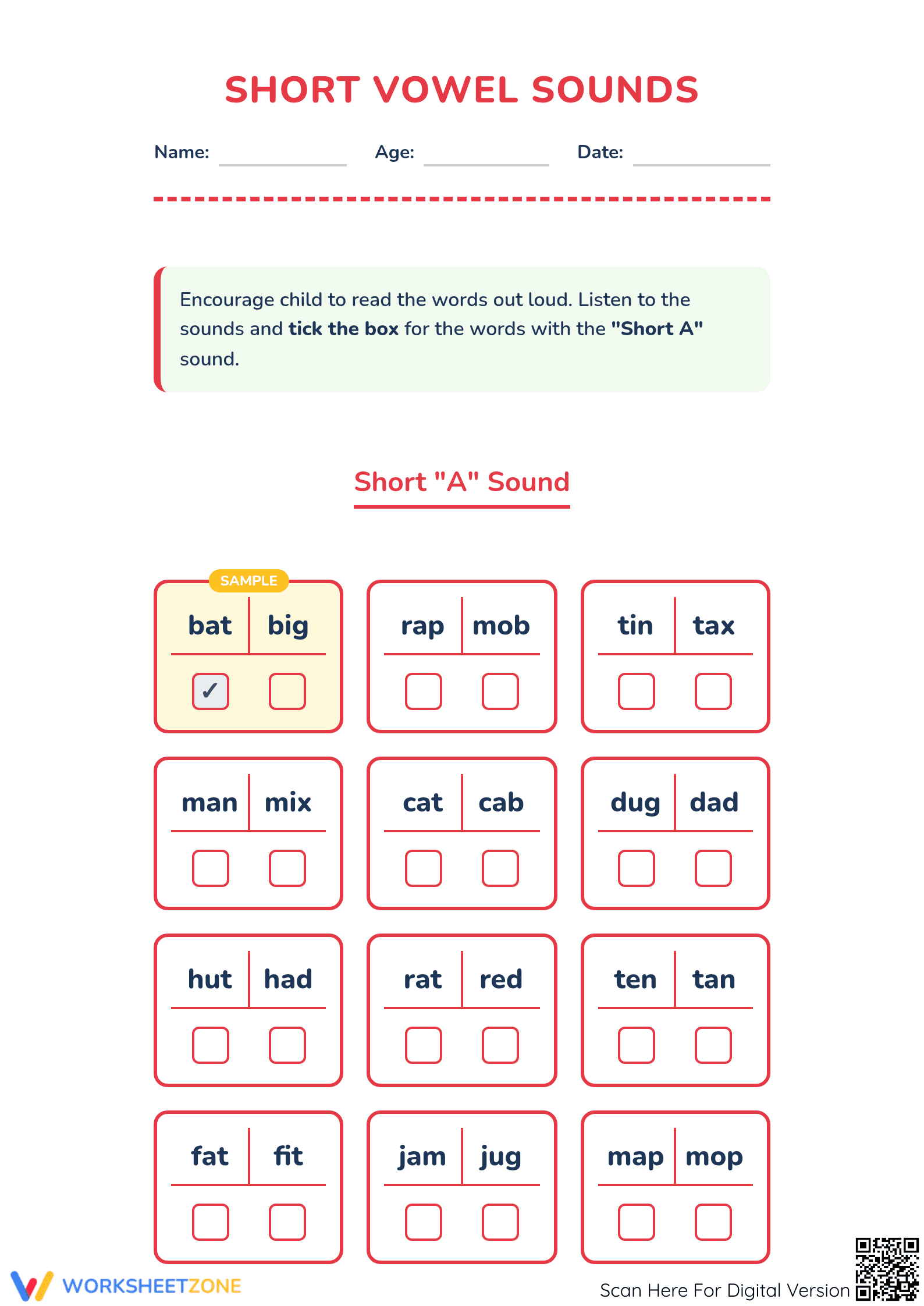

Short A Sound Phonics Worksheet | Grade 1 Essential
Paste this activity's link or code into your existing LMS (Google Classroom, Canvas, Teams, Schoology, Moodle, etc.).
Students can open and work on the activity right away, with no student login required.
You'll still be able to track student progress and results from your teacher account.
This Grade 1 phonics worksheet helps students master the short 'a' vowel sound through auditory discrimination and visual recognition. By comparing word pairs, learners isolate specific phonemes to build foundational reading fluency. It provides a clear, structured path for early readers to distinguish between similar-sounding CVC words and improve their decoding accuracy.
At a Glance
- Grade: 1 · Subject: Phonics
- Standard:
RF.K.3.B— Associate long and short sounds with common spellings for the five major vowels- Skill Focus: Short 'a' vowel identification
- Format: 1 page · 12 problems · Answer key included · PDF
- Best For: Independent phonics practice or morning work
- Time: 10–15 minutes
Inside this resource, you will find a single-page activity featuring 12 distinct word pairs. Each pair challenges the student to read two words aloud and select the one containing the short 'a' sound. The layout includes a clear sample problem, a dedicated space for student identification, and a comprehensive answer key for quick grading and immediate feedback.
The zero-prep workflow is designed for maximum efficiency. First, print the single-page PDF (30 seconds). Next, distribute the sheets to your students during phonics block or as a transition activity (1 minute). Finally, use the included answer key to review student work or allow for self-correction (30 seconds). Total teacher preparation time is under 2 minutes, making it an ideal sub-plan addition.
This worksheet aligns with CCSS.ELA-LITERACY.RF.K.3.B, which requires students to associate the long and short sounds with common spellings for the five major vowels. It also supports RF.1.2.C by encouraging the isolation and pronunciation of initial, medial vowel, and final sounds in spoken single-syllable words. Both standard codes can be copied directly into lesson plans, IEP goals, or district curriculum mapping tools.
Use this worksheet as a formative assessment after a direct instruction lesson on CVC words. It is particularly effective during small-group literacy rotations where the teacher can listen to students read the pairs aloud to check for correct pronunciation. Expect students to complete the 12 tasks in approximately 10 to 15 minutes, depending on their current decoding speed.
This resource is ideal for Kindergarten and Grade 1 students, as well as Grade 2 learners requiring remedial phonics support. It pairs naturally with letter-tile activities or short vowel anchor charts. The visual simplicity makes it accessible for English Language Learners (ELL) who are practicing basic English phonology and vowel discrimination in a low-stakes environment.
According to the RAND AIRS 2024 report on foundational literacy, systematic phonics instruction that emphasizes phoneme-grapheme correspondence is critical for early reading success. This worksheet targets the RF.K.3.B standard by requiring students to discriminate the short 'a' sound within CVC word structures. By engaging in 12 specific identification tasks, students reinforce their ability to isolate medial vowels, a key predictor of future reading fluency. Research from Fisher & Frey (2014) suggests that such targeted, independent practice helps solidify the "You Do" phase of the gradual release of responsibility model. This resource provides the necessary repetition for students to move from guided decoding to automatic recognition of vowel patterns. Educators can utilize this data-driven approach to ensure that 100% of their students meet the benchmark for vowel sound mastery before progressing to complex blends or long vowel patterns.


