


























Views
Downloads
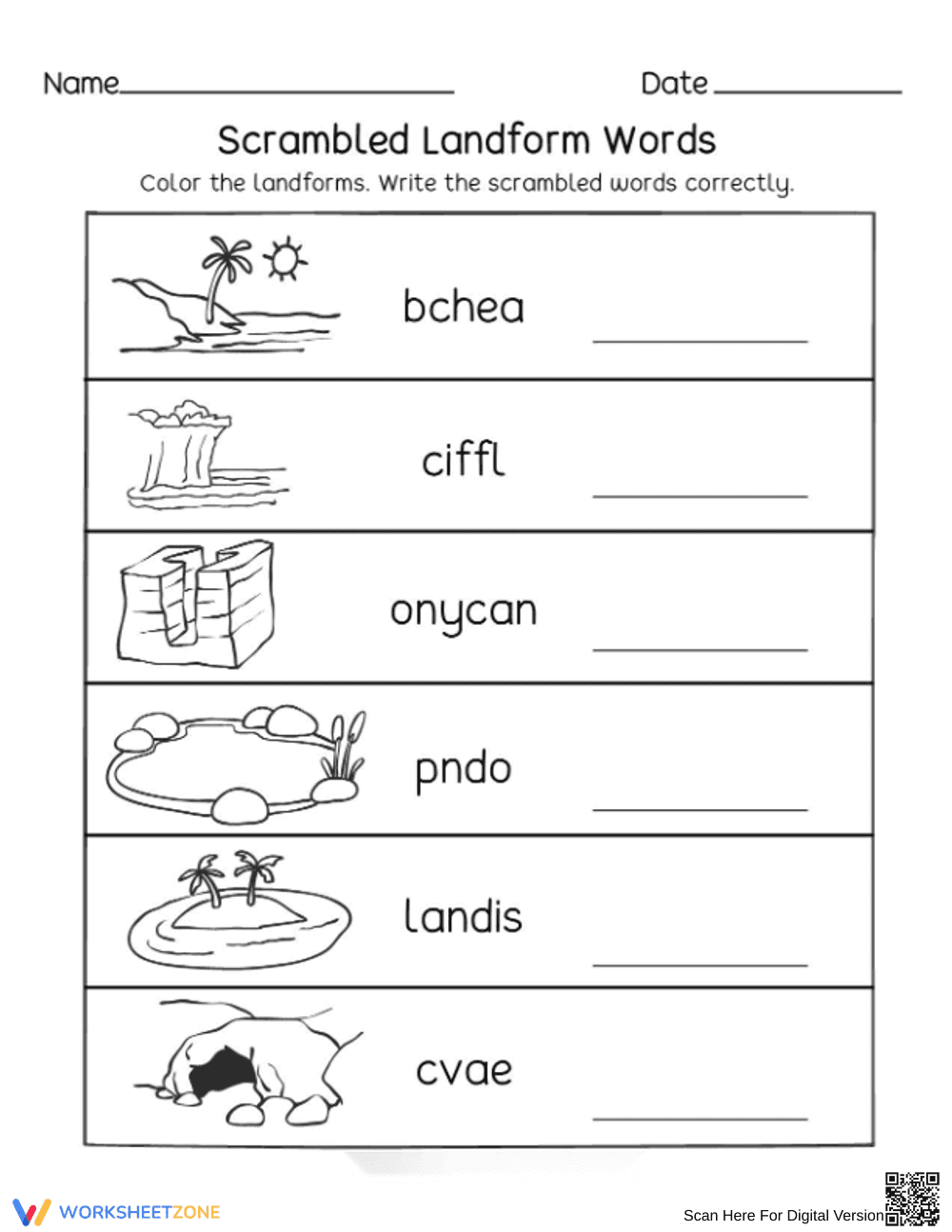

Essential Kindergarten Landform Words Science Worksheet
Paste this activity's link or code into your existing LMS (Google Classroom, Canvas, Teams, Schoology, Moodle, etc.).
Students can open and work on the activity right away, with no student login required.
You'll still be able to track student progress and results from your teacher account.
Master the basics of geography with this Kindergarten landform words worksheet. Students explore Earth's diverse features while strengthening their literacy through word unscrambling and coloring. This resource bridges science and language arts, helping young learners identify major landforms like islands, caves, and canyons while developing fine motor skills and phonetic awareness.
At a Glance
- Grade: Kindergarten · Subject: Science
- Standard:
K-ESS3-1— Use a model to represent relationships between needs and the places they live- Skill Focus: Landform identification and spelling
- Format: 1 page · 6 problems · Answer key included · PDF
- Best For: Vocabulary building and independent practice
- Time: 15–20 minutes
What's Inside
This clean, single-page PDF features six distinct landform sections. Each section includes a clear line-art illustration suitable for coloring, a scrambled version of the landform name (e.g., 'bchea' for beach), and a primary-ruled line for writing the correct word. The visual cues help students decode the scrambled letters, ensuring success for early readers. Featured landforms include beach, cliff, canyon, pond, island, and cave.
Zero-Prep Workflow
The zero-prep design of this worksheet facilitates an efficient classroom workflow. First, print the single-page document (30 seconds). Second, distribute to students during a science center or independent work block (1 minute). Third, review the correct spellings as a whole group or use the provided answer key for quick individual assessment (2 minutes). Total teacher prep time is under five minutes, making it ideal for morning work or sub plans.
Standards Alignment
This resource is aligned to `K-ESS3-1`, which asks students to represent the relationship between needs and the places (landforms/habitats) where organisms live. By identifying these physical features, students build the foundational knowledge necessary for later earth science mastery. Both standard codes can be copied directly into lesson plans, IEP goals, or district curriculum mapping tools.
How to Use It
Use this worksheet after an introductory lesson on Earth's features. It serves as an excellent formative assessment to check if students can match visual landform characteristics with their specific names. A great observation tip is to watch for students who use the first letter of the scrambled word to begin their writing, indicating emerging phonetic skills. Expect completion in approximately 15 minutes.
Who It's For
Designed primarily for Kindergarten students, this worksheet is also appropriate for First Grade learners needing additional spelling support or English Language Learners (ELLs) focusing on basic science vocabulary. Pair this resource with a landform anchor chart or a digital slide deck showing real-world photos of the featured features to deepen the conceptual connection.
The integration of literacy and science in early childhood education is a cornerstone of effective developmental pedagogy. According to the RAND AIRS 2024 report on curriculum effectiveness, cross-disciplinary worksheets that combine visual recognition with writing tasks significantly improve retention of academic vocabulary. This Scrambled Landform Words worksheet applies these principles by having students process the phonetic structure of words (K-ESS3-1) while engaging with scientific content. ScienceDirect TpT Analysis highlights that Kindergarten students benefit most from scaffolds that pair clear imagery with constrained choices, such as the six landforms presented here. By unscrambling 'bchea' or 'pndo', learners are not just spelling; they are reinforcing the mental models of Earth's systems. This structured approach ensures that students move beyond simple memorization toward a functional understanding of geography, providing a path toward early science mastery in elementary science environments.


