































Scaling a Thanksgiving Recipe: Proportions | Grade 7

Paste this activity's link or code into your existing LMS (Google Classroom, Canvas, Teams, Schoology, Moodle, etc.).
Students can open and work on the activity right away, with no student login required.
You'll still be able to track student progress and results from your teacher account.
This Grade 7 math worksheet develops student mastery of proportional relationships by scaling a holiday recipe across varied serving sizes. Students determine the constant of proportionality, formulate linear equations in the form y = kx, and solve multi-step real-world word problems. The activity bridges foundational ratio concepts to abstract algebraic reasoning.
At a Glance
- Grade: 7 · Subject: Math
- Standard:
7.RP.A.2— Recognize and represent proportional relationships between quantities in tables, equations, and contexts- Skill Focus: Proportional relationships and constant of proportionality
- Format: 2 pages · 30 problems · Answer key included · PDF
- Best For: Guided practice and independent skill reinforcement
- Time: 35–45 minutes
What's Inside
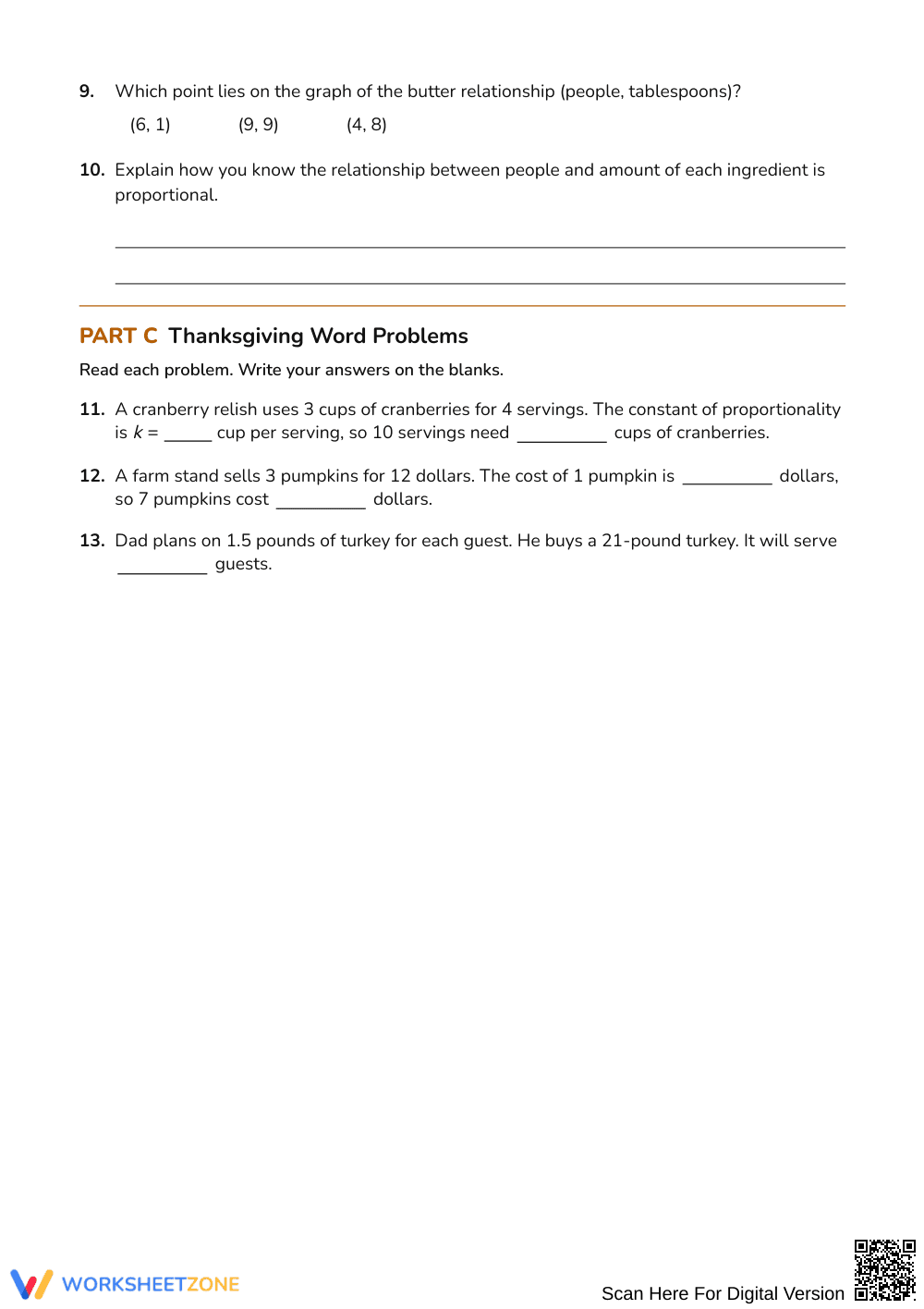
This 2-page printable worksheet contains 30 targeted tasks organized across three progressive sections. Students interact with structured recipe ratio tables, compute unit rates to isolate the constant of proportionality, construct direct variation equations, analyze coordinate points, and justify mathematical reasoning in complete sentences. A complete 2-page answer key provides step-by-step solutions for rapid grading.
Skill Progression
- Guided practice (Part A — 15 table entries): Students scale five recipe ingredients across three target quantities using established ratios and structured table scaffolds.
- Supported practice (Part B — 12 tasks): Learners identify unit rates, calculate constant of proportionality k, write linear equations, test coordinate points, and justify proportionality.
- Independent practice (Part C — 3 multi-step tasks): Students independently solve non-routine Thanksgiving word problems involving cranberries, pumpkin sales, and turkey roasting weights.
This sequence follows the gradual-release model, transitioning students smoothly from scaffolded arithmetic to independent algebraic reasoning.
Standards Alignment
This resource aligns directly with primary standard 7.RP.A.2: Recognize and represent proportional relationships between quantities. It also reinforces supporting standard 7.RP.A.2b by requiring students to determine the constant of proportionality from tables and verbal descriptions. Both standard codes can be copied directly into lesson plans, IEP goals, or district curriculum mapping tools.
How to Use It
Administer Part A and Part B during direct instruction to reinforce unit rate definitions and equation modeling immediately following an introductory mini-lesson. Assign Part C as an independent exit ticket after direct instruction to assess conceptual retention. During table completion, observe whether students identify multiplicative scaling factors across rows rather than applying additive differences. Completion time spans 35 to 45 minutes.
Who It's For
This worksheet serves general education Grade 7 math classes, targeted Tier 2 math intervention groups, and accelerated Grade 6 cohorts preparing for algebraic ratios. Differentiate by providing pre-printed ratio tables for struggling learners or requiring fractional unit rates for advanced students. Pair this activity with a visual proportion anchor chart.
According to instructional research by Fisher & Frey (2014), student mastery of abstract algebraic concepts improves significantly when lessons implement a structured gradual-release framework that shifts cognitive load from teacher modeling to independent execution. This Grade 7 mathematics resource operationalizes standard 7.RP.A.2 by establishing a concrete culinary scenario before transitioning students to abstract constant of proportionality calculations and formal algebraic equations. By connecting real-world ingredient scaling to unit rates, learners develop conceptual understanding of proportional relationships alongside computational fluency. Empirical findings indicate that structured tables and scaffolded prompts prevent common misconceptions, such as confusing additive with multiplicative relationships. The 30 targeted tasks guide middle school learners through authentic context analysis, symbolic representation with y = kx, and coordinate evaluation. Consequently, this worksheet provides verifiable evidence of standard 7.RP.A.2 mastery, making it an essential instructional asset for standards-aligned classroom assessment and intervention.


