


























Views
Downloads

Review of Resentments Worksheet | Printable Therapy Tool
Paste this activity's link or code into your existing LMS (Google Classroom, Canvas, Teams, Schoology, Moodle, etc.).
Students can open and work on the activity right away, with no student login required.
You'll still be able to track student progress and results from your teacher account.
This high school and adult therapy worksheet guides individuals through the critical process of identifying and analyzing personal resentments. By breaking down the causes and impacts of anger, students and clients develop essential self-awareness and emotional regulation skills necessary for long-term behavioral health and interpersonal success.
At a Glance
- Grade: 9–12 · Subject: Social Skills
- Standard:
CASEL.SA.1— Identify personal emotions and their impact on behavior- Skill Focus: Self-reflection and emotional processing
- Format: 2 pages · 12 problems · PDF
- Best For: Therapy sessions and independent reflection
- Time: 30–45 minutes
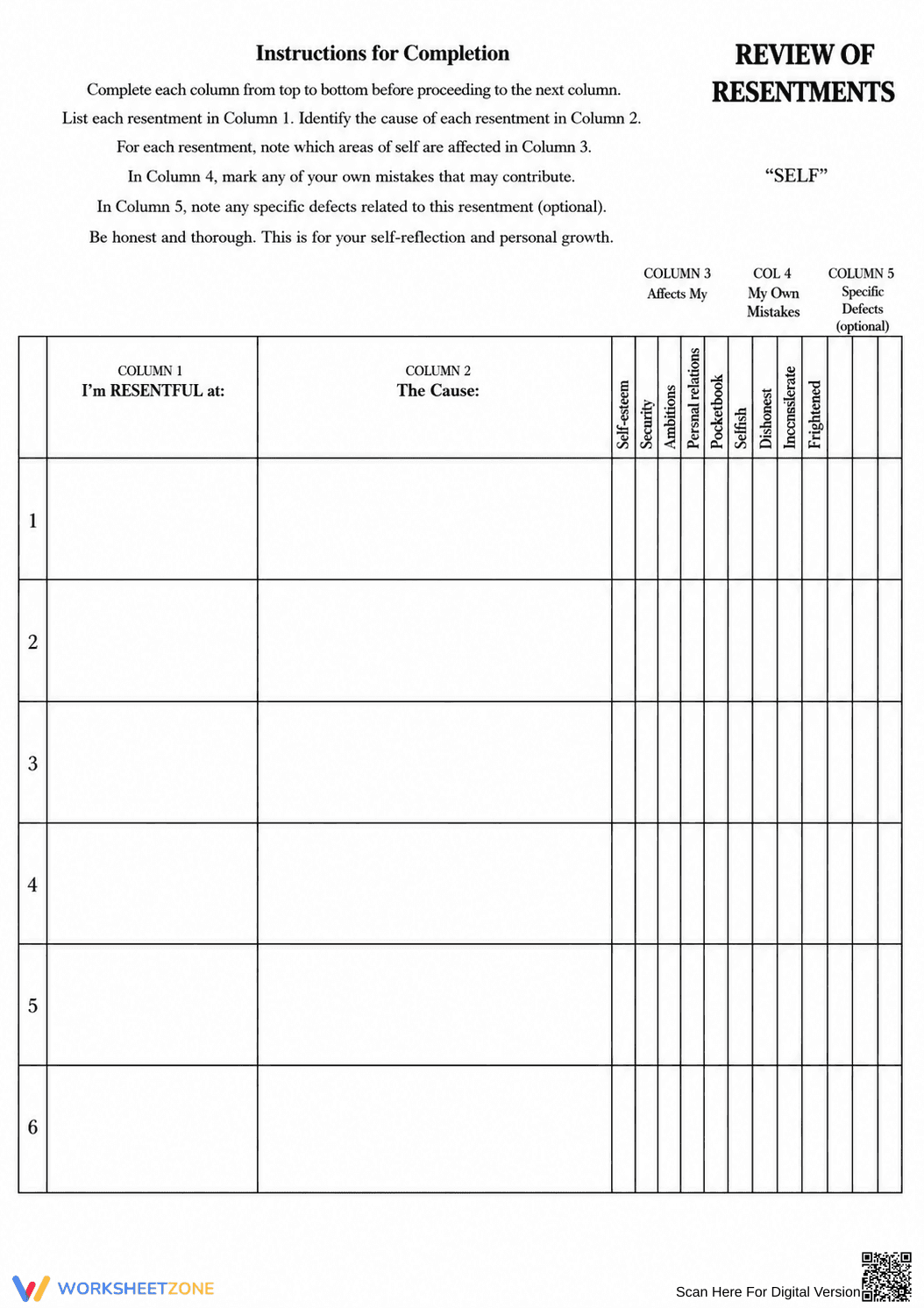
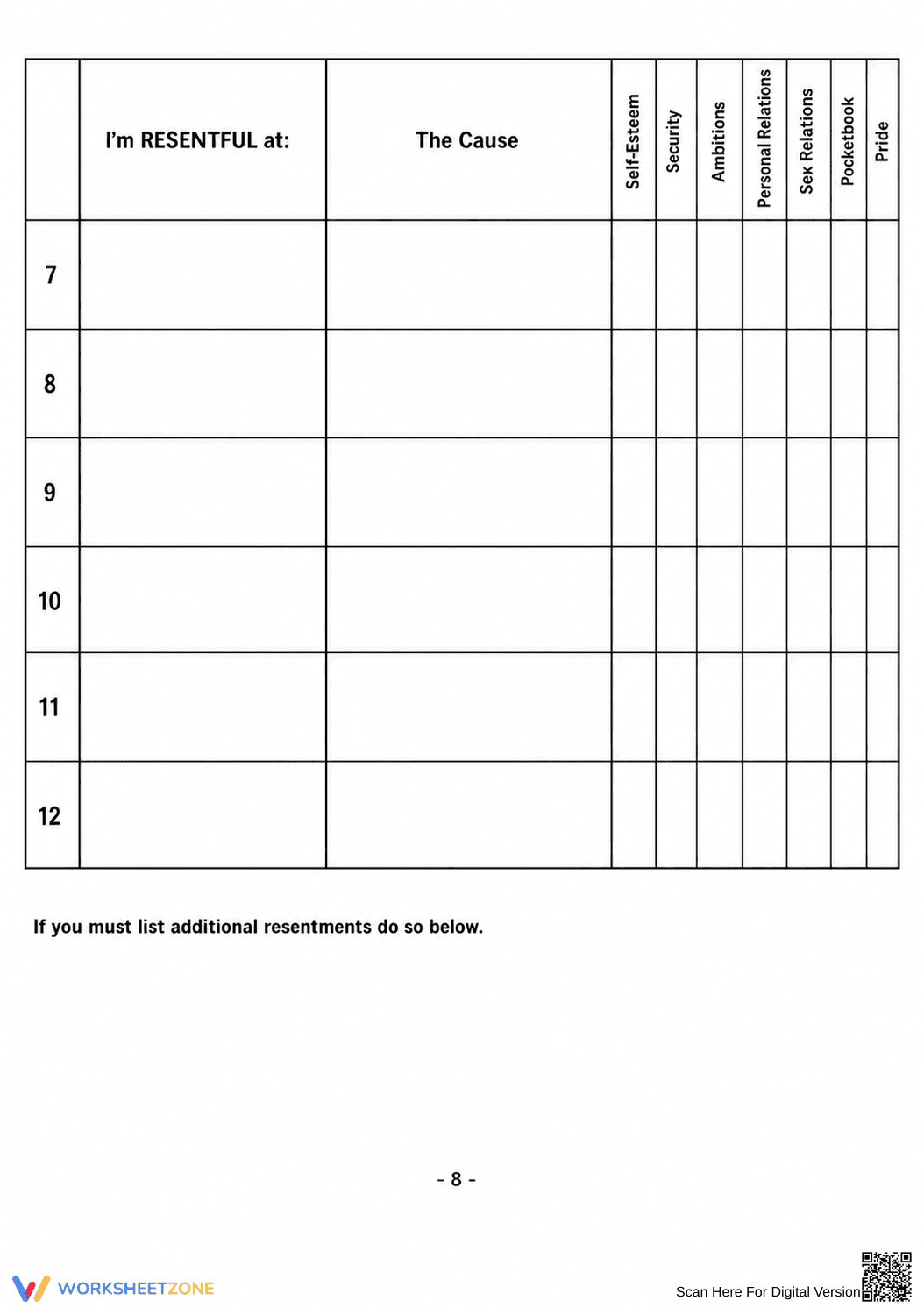
This two-page resource features a highly structured inventory table designed to help users systematically process their emotions. The worksheet includes space to analyze up to 12 specific resentments across five distinct columns. Users are prompted to identify the source of their resentment, the underlying cause, the specific areas of their life affected (such as self-esteem, security, or personal relations), and their own contributing mistakes. Clear instructions at the top ensure the tool is completely self-explanatory.
Because this resource requires no prior setup, it integrates smoothly into any counseling or advisory setting.
- Print (1 minute): Generate the two-page PDF for immediate use in individual or group settings.
- Distribute (1 minute): Hand out the inventory to clients or students with minimal required explanation.
- Review (15 minutes): Use the completed columns to facilitate guided discussions about emotional triggers and personal accountability.
Total facilitator prep time is under two minutes, making it an excellent ready-to-use tool for unexpected counseling needs or structured advisory periods.
This resource aligns with CASEL.SA.1, focusing on the ability to accurately recognize one's own emotions, thoughts, and values and how they influence behavior. It also supports broader social-emotional learning objectives related to self-management and responsible decision-making. Both standard codes can be copied directly into lesson plans, IEP goals, or district curriculum mapping tools.
Facilitators can utilize this inventory during one-on-one counseling sessions to help clients break down complex emotional barriers. It is highly effective when assigned as independent reflection homework prior to a group therapy discussion. As a formative assessment observation tip, monitor how easily individuals can identify their own contributing mistakes in the fourth column, which often indicates their current level of emotional maturity and readiness for behavioral change. Expect completion to take 30 to 45 minutes depending on the depth of reflection.
This tool is primarily designed for high school students, young adults, and individuals participating in therapy or 12-step recovery programs. The structured column format provides necessary scaffolding for individuals who struggle with abstract emotional processing, breaking complex feelings into manageable data points. It pairs exceptionally well with direct instruction on conflict resolution or cognitive behavioral therapy exercises.
Developing the capacity to identify personal emotions and their impact on behavior, as outlined in CASEL.SA.1, is a foundational component of effective social-emotional learning and behavioral therapy. According to a comprehensive RAND AIRS 2024 report, structured self-reflection tools significantly improve an individual's ability to process negative emotions and reduce reactive behaviors in interpersonal conflicts. By systematically breaking down resentments into specific causes and personal impacts, this worksheet operationalizes abstract emotional concepts into concrete, actionable insights. This methodical approach to emotional processing not only supports immediate psychological relief but also builds long-term cognitive resilience. Utilizing structured inventories in therapeutic and educational settings ensures that individuals develop the critical self-awareness required to navigate complex social dynamics and maintain healthy relationships throughout their adult lives.


