


























Views
Downloads

Printable Repeated Subtraction Division Activity | Grade 3-4
Paste this activity's link or code into your existing LMS (Google Classroom, Canvas, Teams, Schoology, Moodle, etc.).
Students can open and work on the activity right away, with no student login required.
You'll still be able to track student progress and results from your teacher account.
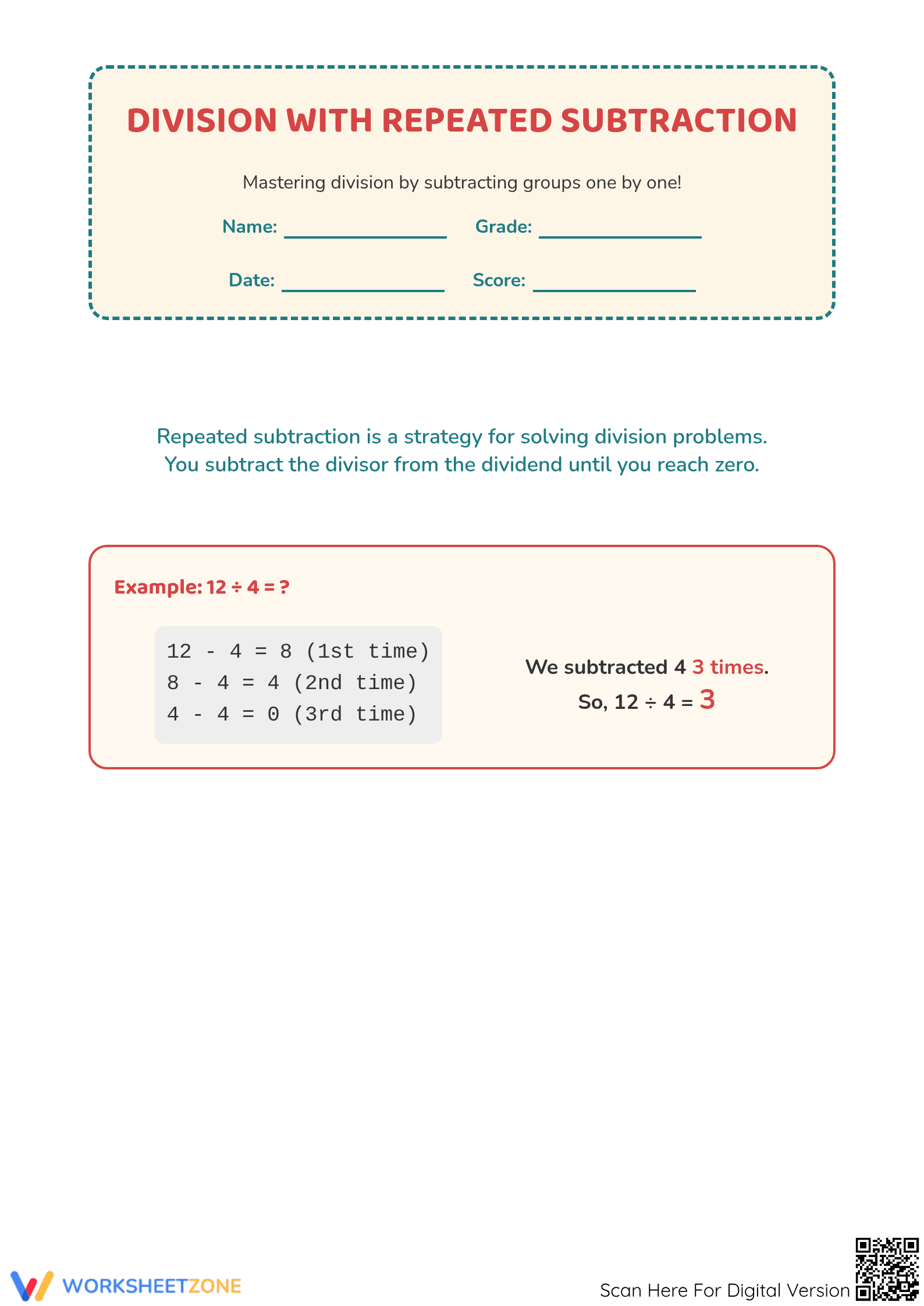
This comprehensive 5-page Math worksheet simplifies the transition from subtraction to division for Grade 3 and Grade 4 students. By using the repeated subtraction strategy, learners visualize division as taking away equal groups until reaching zero. This method builds a strong conceptual foundation, ensuring students understand division before moving to abstract algorithms.
At a Glance
- Grade: 3 · Subject: Math
- Standard:
CCSS.MATH.CONTENT.3.OA.A.2— Interpret whole-number quotients by representing division as equal groups subtracted from a total- Skill Focus: Division via Repeated Subtraction
- Format: 5 pages · 16 problems · Answer key included · PDF
- Best For: Conceptual introduction and independent practice
- Time: 30–45 minutes
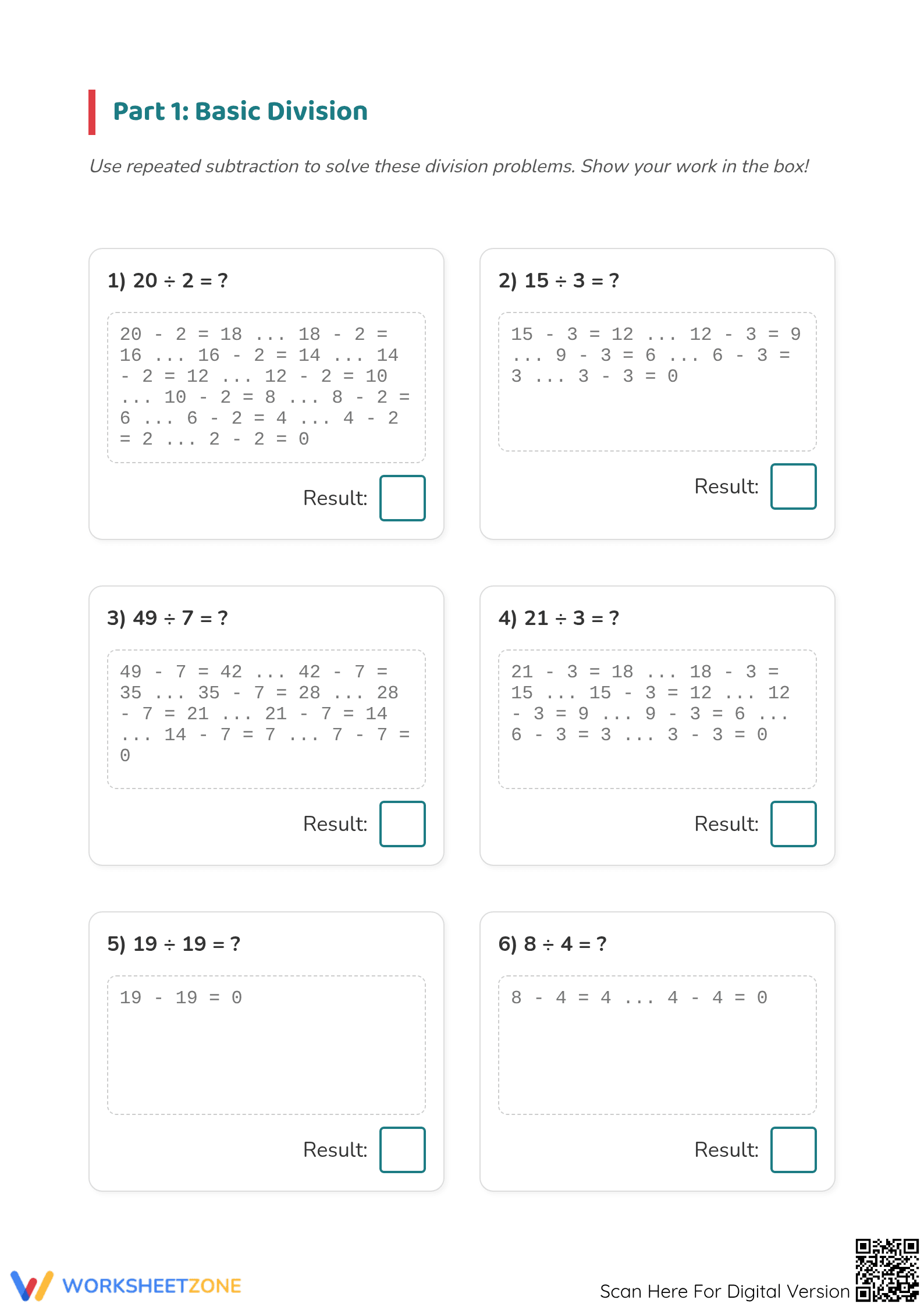
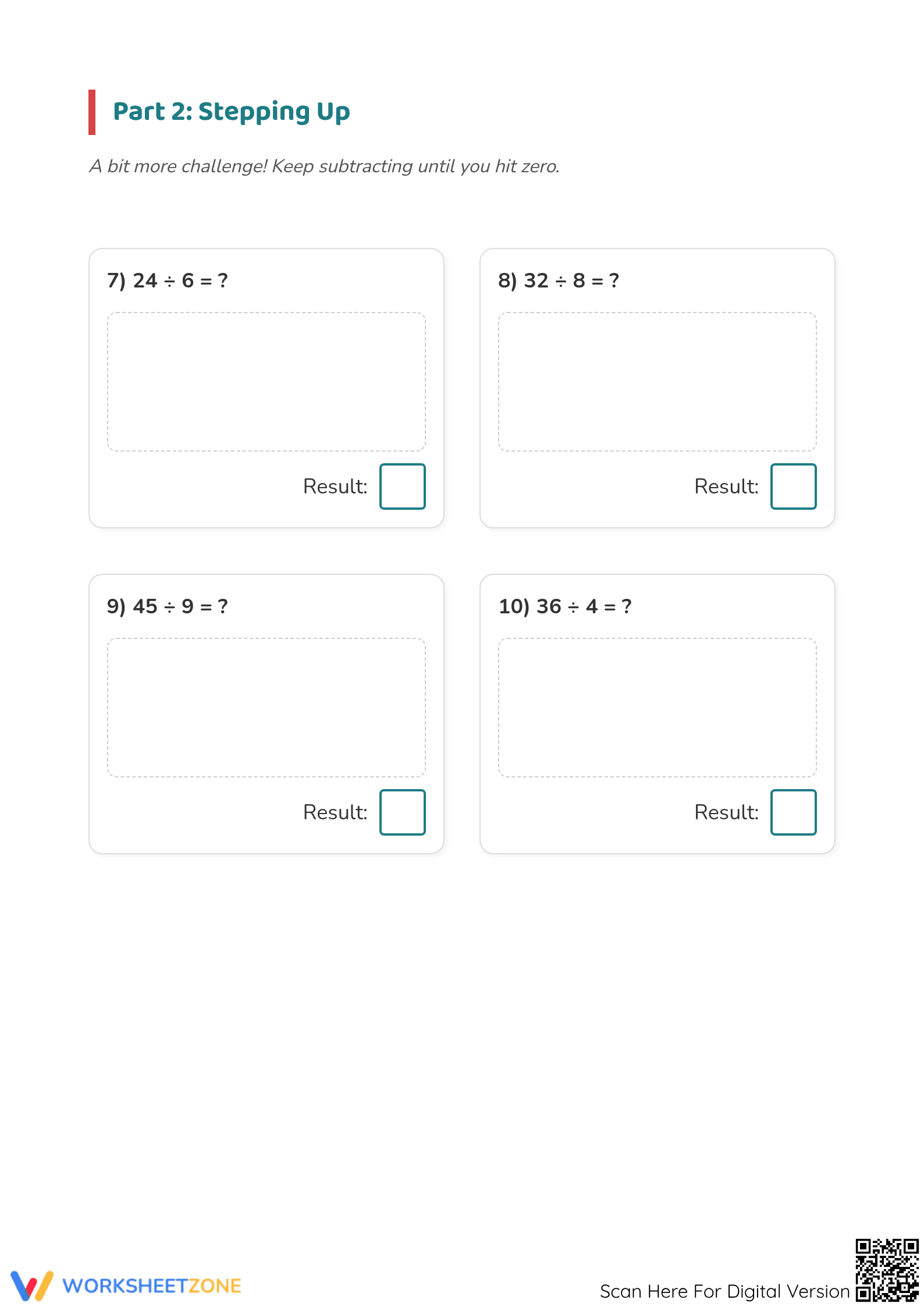
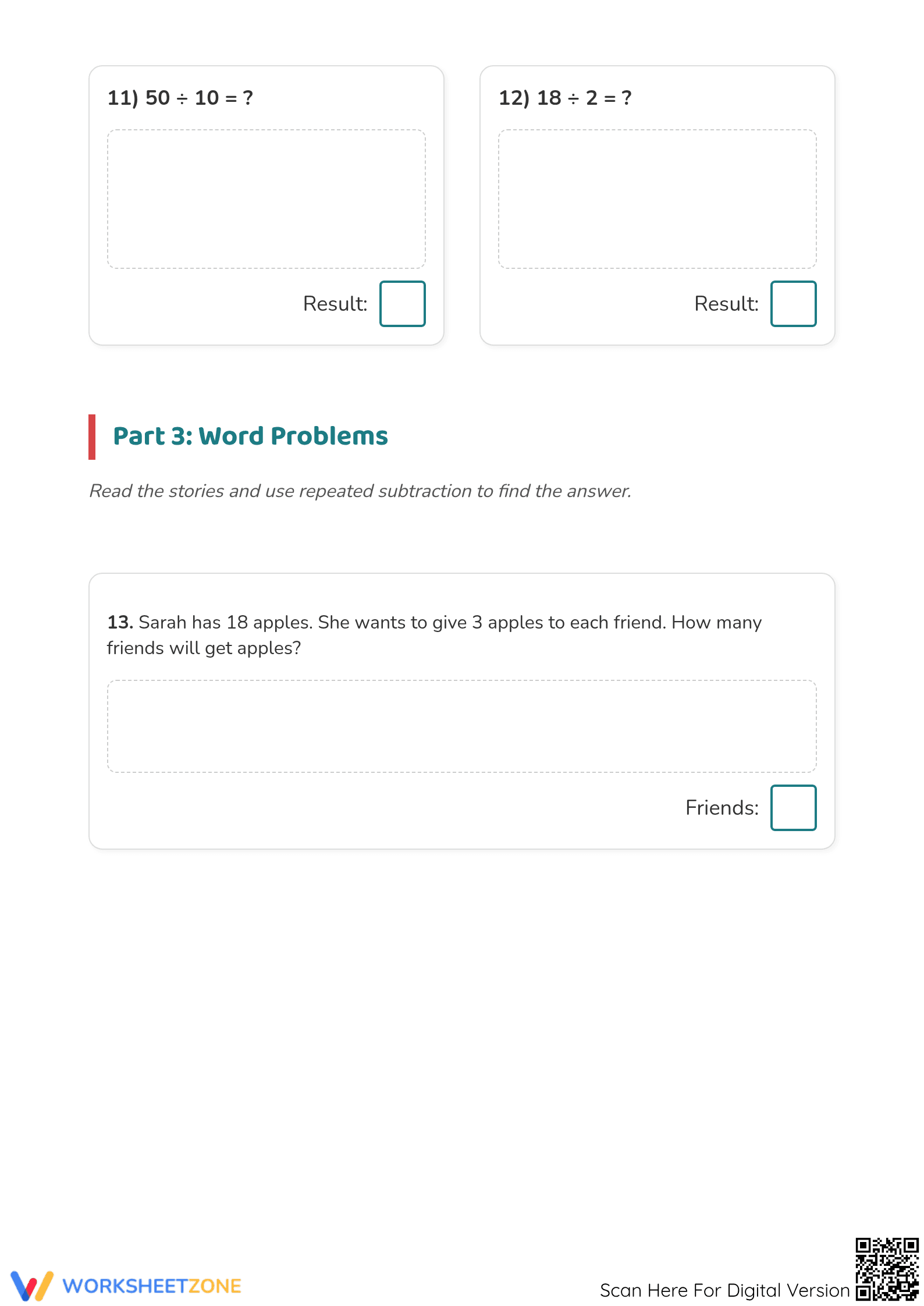
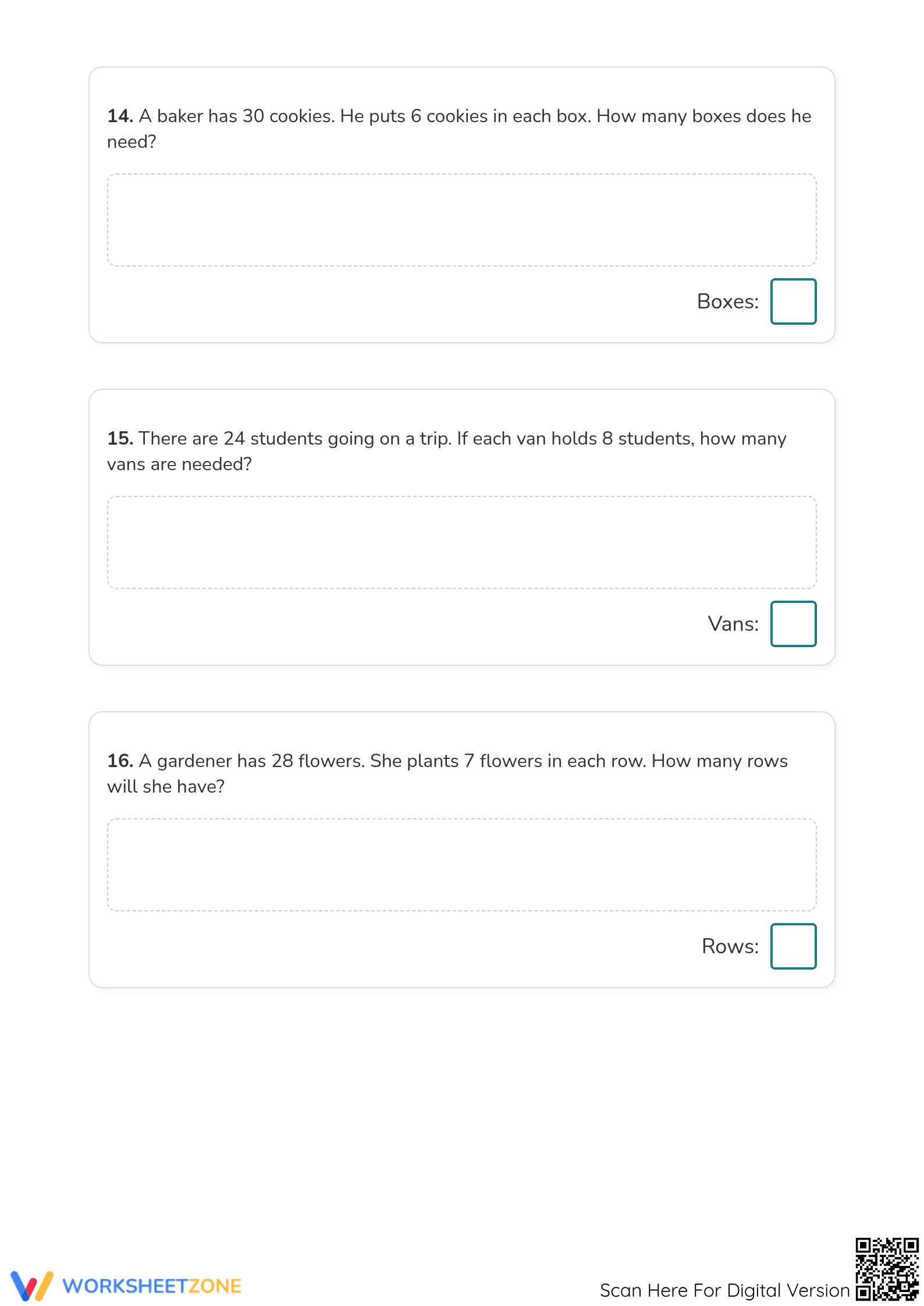
This resource contains five high-quality pages for immediate classroom use. It begins with an instructional example showing 12 divided by 4 solved through successive subtractions. The workload includes six basic division problems with guided workspace, six stepping up problems for independent work, and four word problems. A full answer key is included for rapid grading or student self-correction.
The design ensures teacher preparation takes under 2 minutes. First, print the 5-page PDF for each student or project the instructional first page for a whole-group introduction. Second, distribute the materials; the self-explanatory layout allows students to begin immediately. Third, review work using the provided answer key, which can be shared on a document camera for a collaborative 10-minute closing discussion.
This activity aligns to CCSS.MATH.CONTENT.3.OA.A.2, requiring students to interpret whole-number quotients. By repeatedly subtracting the divisor, students demonstrate deep understanding of partitioning totals into equal shares. It also supports CCSS.MATH.CONTENT.3.OA.A.3 for solving word problems. Both standard codes can be copied directly into lesson plans, IEP goals, or district curriculum mapping tools.
Use this worksheet during the "We Do" phase to bridge the gap between manipulatives and abstract division. Alternatively, assign Part 3 as a formative assessment to identify students struggling with subtraction facts. During the activity, observe if students correctly identify the divisor as the number to be subtracted; this is a key indicator of readiness for complex division.
This resource is ideal for Grade 3 students encountering division and Grade 4 students requiring intervention. The scaffolded workspace is effective for English Language Learners and students with IEPs who benefit from seeing the expanded mathematical process. It pairs naturally with base-ten blocks or a division anchor chart for a multi-modal learning experience.
According to research in Fisher & Frey (2014), the use of scaffolded strategy worksheets like this Repeated Subtraction Division Activity is essential for developing procedural fluency through conceptual understanding. The resource aligns with CCSS.MATH.CONTENT.3.OA.A.2 by providing 16 structured opportunities for students to interpret quotients as the result of equal grouping. By explicitly linking subtraction to division, the worksheet leverages prior knowledge to reduce cognitive load, a principle supported by modern instructional design. Educators can utilize the clear task progression to transition from guided to independent practice, ensuring that the skill of partitioning is mastered before students encounter remainder-based problems. This systematic approach ensures that the plain-English skill of finding how many times one number fits into another is firmly rooted in additive logic, providing a stable platform for the future study of fractions and ratios in later elementary grades.


