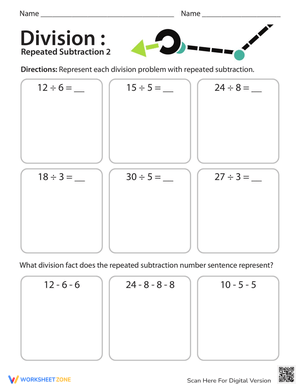
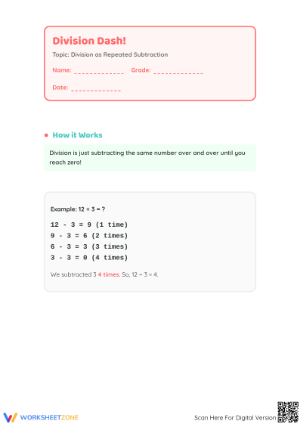
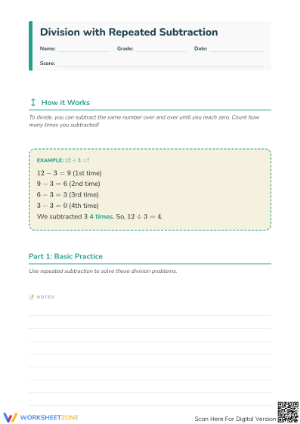
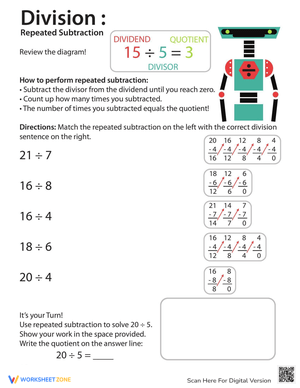
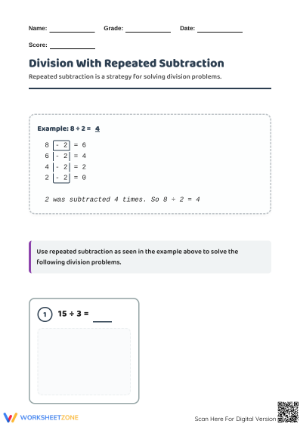
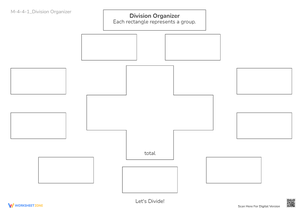
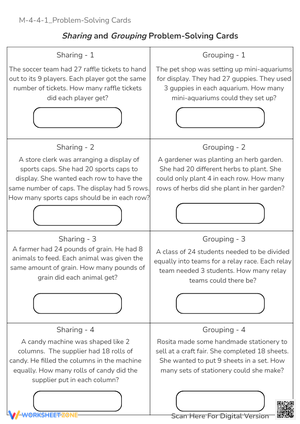
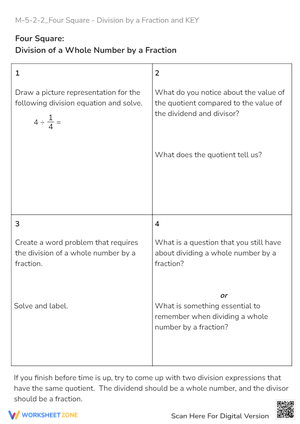
These division as repeated subtraction worksheets give 2nd and 3rd grade students a concrete entry point into division by grounding it in subtraction work they already know cold. Each page asks students to subtract the same value again and again, count those subtractions, and record the quotient — a process that turns an abstract operation into something a child can trace with a finger.
What Students Do on Each Page
The worksheet set covers three distinct problem formats, each targeting a different aspect of the repeated subtraction process.
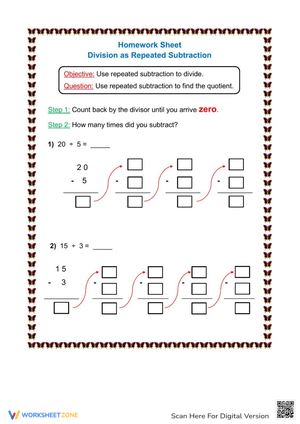
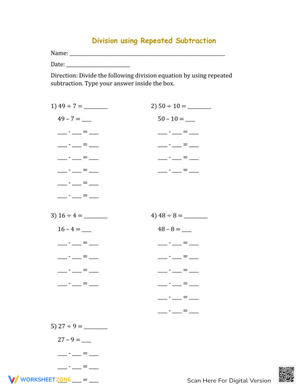
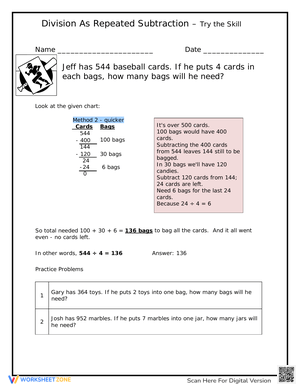
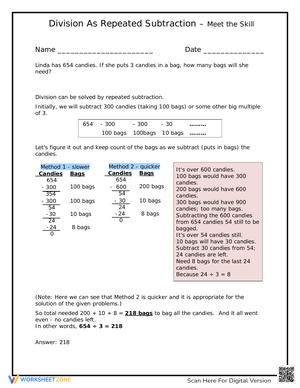
- Stepped equation chains: Students work through a table of descending equations — 18 − 6 = 12, then 12 − 6 = 6, then 6 − 6 = 0 — and write the quotient based on the row count. The scaffolding forces them to record every intermediate value rather than jumping to an answer.
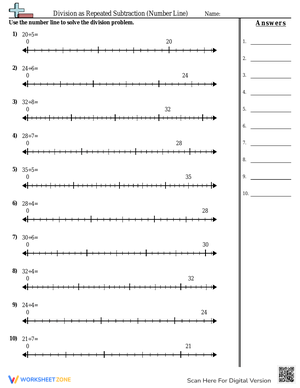
- Backward number line hops: Pre-drawn number lines run from 0 to 30 (or 0 to 40 on the challenge pages). Students mark their starting point and draw equal hops leftward, then count the hops. Students who write equations fluently but still miscount groups find this format revealing.
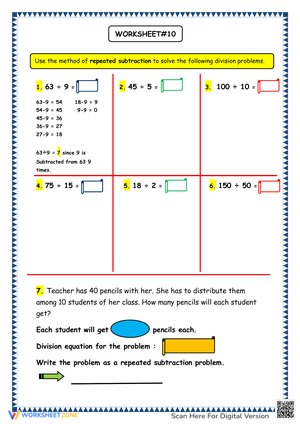
- Contextual word problems: Situations involving shared supplies, distributed snacks, or grouped objects require students to write out the full subtraction chain before stating the quotient. The written chain is part of the answer — students do not get credit for a bare number.
Where These Fit in a Lesson Sequence
Repeated subtraction sits between two distinct instructional moments: the point where students have solidified multi-digit subtraction and the point where they begin memorizing division facts. It is not a permanent strategy. Its purpose is to give students something to do with a division problem when no memorized fact is available — a fallback that is slow but always correct.
In practice, these pages work well during the first two weeks of a division unit, before fact fluency practice begins in earnest. Many teachers pull one page as a Monday warm-up during morning meeting, letting students talk through their chain with a partner before the class reconvenes. That five-minute conversation surfaces more misconceptions than a silent independent check ever will.
Patterns That Show Up in Student Work
The most common error is stopping one step early. A student solving 20 ÷ 4 will subtract four times, land on 4, and write 4 as the quotient instead of completing the final subtraction and counting five steps. They are counting the values, not the operations. Pointing to each subtraction sign — rather than each result — corrects this quickly.
A subtler issue appears on number line pages: students who draw hops correctly but count the tick marks between hops instead of the hops themselves. This mirrors the classic off-by-one error in ruler reading and usually appears in the same students. A brief conference with the phrase "count the jumps, not the landings" resolves most cases in one sitting.
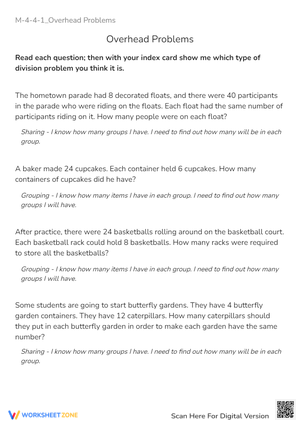
The word problem pages expose a third pattern worth watching. Students who have been told that division means "sharing equally" will sometimes assign the quotient to the wrong quantity — they find the right number but misidentify whether it represents the number of groups or the size of each group. These worksheets require students to label their answer in context, which is the most efficient way to catch that confusion before it hardens.
Scaling the Pages for the Whole Class
The stepped equation chain pages include two tiers: one where the first subtraction is completed for the student, and one where the chain is entirely blank. The scaffolded version is appropriate for students who understand the concept but lose their place mid-problem; removing it is the natural next step once they track the chain reliably.
For students who move through the standard pages quickly, the number line format can be made more demanding by whiting out the pre-labeled tick marks and asking students to build the line themselves before hopping. That small change shifts the task from procedural to genuinely constructive. At the other end, students who freeze when faced with an unmarked page do better starting with physical counters alongside the worksheet rather than the worksheet alone.
Standards Aligned
Common Core standard 3.OA.A.2 asks third graders to interpret whole-number quotients by reasoning about the number of shares or the number of objects in each share. Repeated subtraction addresses the second reading directly — students are finding how many groups fit into a total, which is the partitive interpretation of division. These worksheets do not address both interpretations equally; teachers working toward full 3.OA.A.2 coverage should pair them with equal-sharing tasks where the number of groups is given and the group size is unknown.
Frequently Asked Questions
1. When should students stop using repeated subtraction and switch to fact recall?
Repeated subtraction is a bridging strategy, not a permanent one. Once students can explain why division works — that they are counting equal groups — the goal shifts to automaticity. Most students are ready to begin fact fluency practice by the middle of third grade. Repeated subtraction remains useful as a fallback and as a checking strategy, but if a student is still relying on full chains in fourth grade, that signals a fluency gap worth addressing directly.
2. Do these pages work for students who already know their division facts?
They serve a different purpose for those students. Having a fluent student write out the full subtraction chain for 24 ÷ 6 is less about finding the answer than about articulating why the answer is correct. Some teachers use a page from this set as a short writing-about-math task, asking students to explain in a sentence what the chain shows. That exercise is more analytically demanding than it looks.
3. What if a student reaches a remainder instead of zero?
The pages in this set use divisors and dividends that produce whole-number quotients, so a remainder means an arithmetic error in the chain. That is actually useful — a non-zero stopping point tells the student immediately that something went wrong without needing a teacher to confirm it. If you want to introduce remainders, these pages are not the right format; a separate set with remainder recording is better suited to that concept.













 Interactive Worksheet Maker
 Quiz Maker
 Word Search Maker
 Crossword Puzzle Maker
 Word Scramble Generator
 Sentence Scramble Generator
 Handwriting Worksheet Generator
 Name Tracing Generator
 Fill In The Blank Generator