





























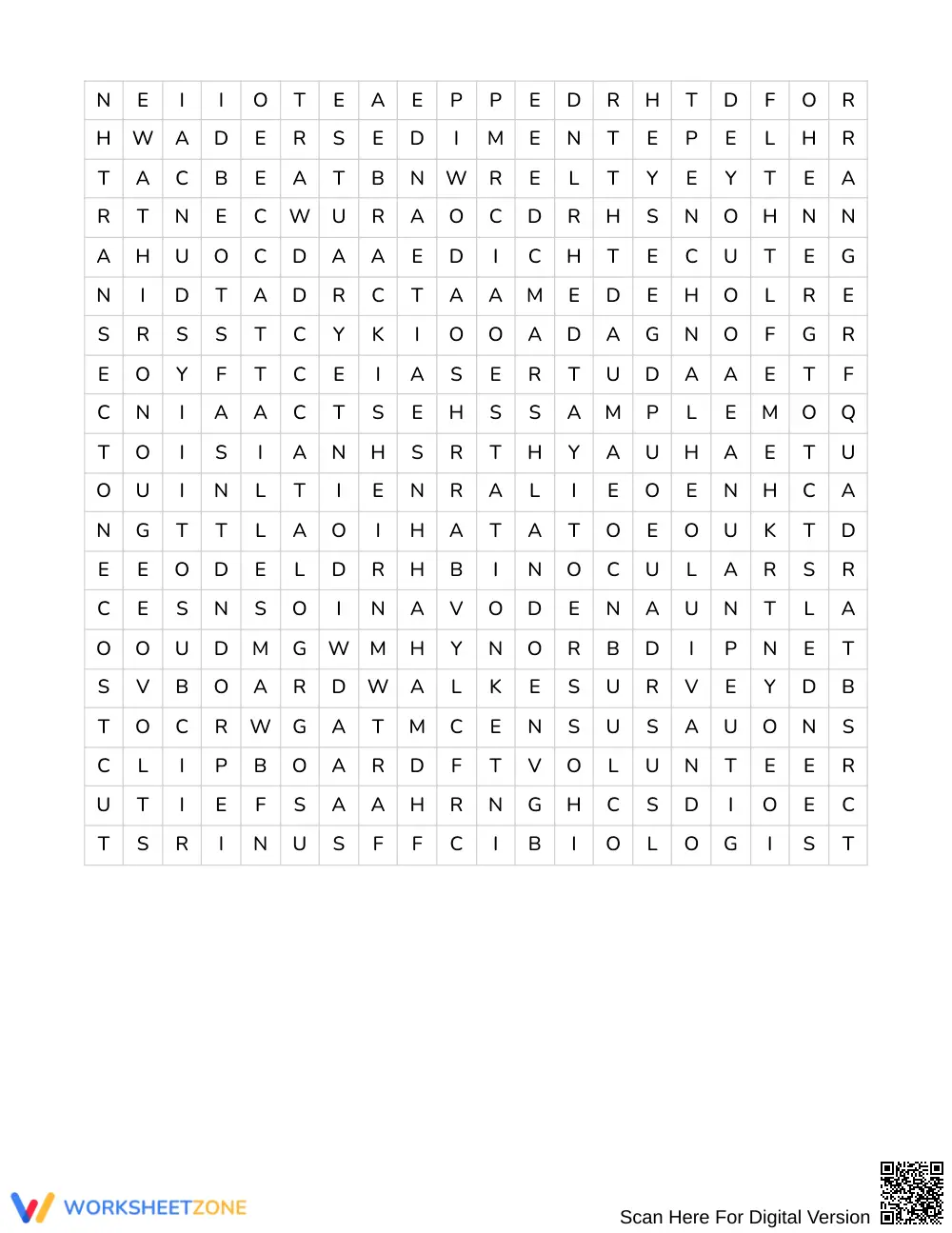


Ready Wetland Expedition Word Search | Grades 4–5 Science

Paste this activity's link or code into your existing LMS (Google Classroom, Canvas, Teams, Schoology, Moodle, etc.).
Students can open and work on the activity right away, with no student login required.
You'll still be able to track student progress and results from your teacher account.
This Grades 4–5 science word search reinforces essential ecosystem and field research vocabulary through an engaging wetland station investigation. Students locate 20 key environmental terms to strengthen scientific spelling, build habitat-related terminology, and connect authentic fieldwork tools with ecological concepts. It provides purposeful vocabulary acquisition for upper-elementary science classrooms.
At a Glance
- Grade: Grades 4–5 · Subject: Science
- Standard: Not standards-assessed — vocabulary enrichment
- Skill Focus: Wetland field-station expedition
- Format: 2 pages · 20 words · Answer key included · PDF
- Best For: Science centers and early finishers
- Time: 20–30 minutes
What's Inside
The 2-page student activity features a clear 20 by 20 letter grid containing 20 hidden vocabulary terms paired with an alphabetical word bank and descriptive field clues. Students connect terms such as transect, quadrat, and estuary with real scientific applications. A comprehensive 3-page answer key displays exact coordinate highlights for swift student verification.
Puzzle Structure
This puzzle is organized around an expansive 20 by 20 grid designed specifically for intermediate learners. Hidden words run in only two straightforward directions: East (horizontal from left to right) and South (vertical from top to bottom). Learners reference the alphabetical word bank alongside scientific descriptions, eliminating diagonal and backwards letter reversals to keep attention centered on term recognition.
Standards Alignment
This activity serves as supplemental vocabulary enrichment and is not aligned to a formal academic content standard. Teachers can integrate these 20 terms into broader Grade 4 and Grade 5 units on habitats, ecosystems, organisms, and scientific inquiry to bolster domain-specific academic language.
How to Use It
Deploy this word search during an introductory launch of an ecosystem unit or as an independent task during science lab rotations. For formative assessment, walk the room and observe whether learners read definitions to deduce targets before searching the letter grid. The entire vocabulary exercise typically requires 20 to 30 minutes of focused student work.
Who It's For
This resource supports Grade 4 and Grade 5 science students exploring wetlands, biodiversity, or environmental fieldwork methods. Restricted search directions provide accessible entry for developing readers and English learners without sacrificing academic rigor. Pair this puzzle directly with an informational reading passage on wetland conservation or an outdoor nature observation journal.
Scientific vocabulary acquisition in upper-elementary classrooms establishes the foundational knowledge necessary for comprehending complex ecosystem dynamics. This wetland field-station word search enriches domain-specific language by introducing 20 environmental fieldwork terms, ranging from sampling instruments to specialized coastal habitats. According to Fisher & Frey (2014), intentional exposure to academic vocabulary within domain-specific contexts significantly enhances reading comprehension and content retention across informational texts. By engaging intermediate learners with targeted terminology—such as transects, quadrats, and brackish waters—in structured search formats, educators bridge basic definitions with practical field science. This activity functions as targeted enrichment rather than formal standards assessment, providing low-anxiety exposure that prepares fourth and fifth grade students for subsequent scientific inquiry and ecological modeling tasks. Teachers can reliably utilize this resource to reinforce authentic scientific discourse while supporting student literacy growth across multi-week biology units.


