




























Views
Downloads
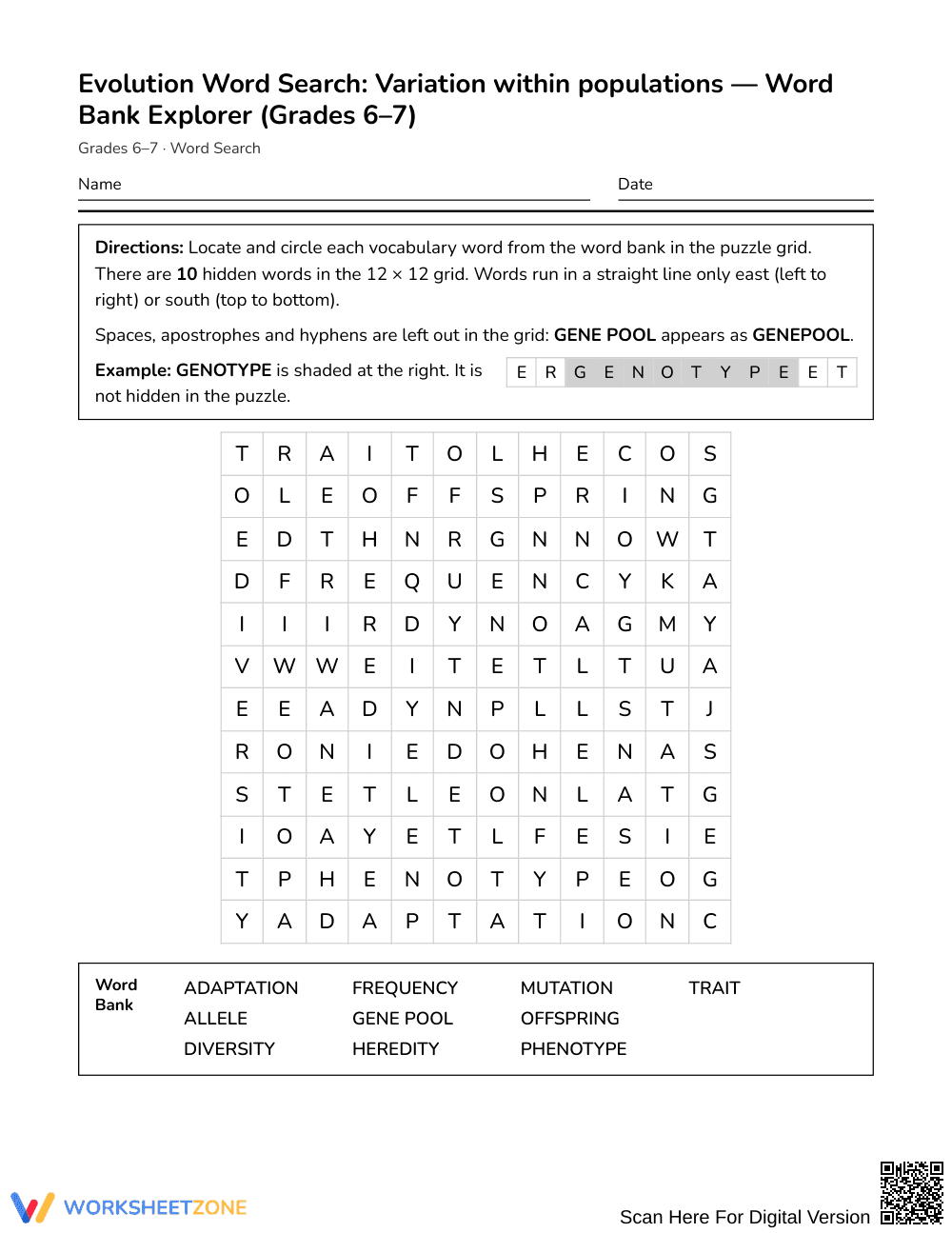

Ready Variation Populations Word Search | Grades 6–7 Science

Paste this activity's link or code into your existing LMS (Google Classroom, Canvas, Teams, Schoology, Moodle, etc.).
Students can open and work on the activity right away, with no student login required.
You'll still be able to track student progress and results from your teacher account.
Students explore key evolutionary vocabulary by completing a focused word search that reinforces the concept of variation within populations. The activity challenges learners to locate ten essential terms, strengthening spelling, definition recall, and connections to the unit’s scientific ideas overall.
At a Glance
- Grade: Grades 6–7 Middle School · Subject: Science
- Standard:
Not standards-assessed — vocabulary enrichment activity- Skill Focus: variation within populations (evolutionary concepts)
- Format: 1 printable page · 10 target words · answer key on separate sheet · ready‑to‑use PDF – easy to print
- Best For: quick review, homework, or enrichment station in class – teacher-friendly
- Time: approximately 5–10 minutes per student – flexible timing and adaptable
Inside the activity you’ll find a 12 × 12 grid printed on a single page, with words placed horizontally (East) and vertically (South). The alphabetical word bank lists ten evolution‑related terms, each accompanied by a concise definition. An answer key on a separate sheet shows the completed grid, making grading fast. The answer key occupies three pages.
- Print – the PDF prints in under 30 seconds on a standard printer.
- Distribute – hand the sheets to students; they can begin immediately.
- Review – after completion, compare with answer key; total teacher prep under 2 minutes.
This word search is designed for vocabulary enrichment and does not map to any state or national standard. It serves as a flexible supplement to the Evolution unit, reinforcing key terminology without formal assessment alignment.
Use the puzzle as a warm‑up activity before a lesson on genetic variation, allowing students to activate prior knowledge while you introduce new concepts. Alternatively, assign it as independent homework; students complete the search at home and bring the completed grid for a quick class review.
The activity targets Grades 6–7 science learners, including those who benefit from visual word‑recognition practice. Its alphabetical word bank supports English‑language learners, and the clear definitions aid students with varying reading levels. Pair it with the Evolution unit anchor chart or a short video on population genetics for a cohesive lesson.
Vocabulary‑focused puzzles like this word search have been shown to improve term retention and reading fluency. Fisher & Frey (2014) report that explicit word‑study activities increase students’ ability to recall scientific language, especially when paired with visual cues. By integrating concise definitions and an alphabetical word bank, the activity aligns with evidence‑based practices that support both English‑language learners and general education students. The quick‑turnaround format encourages frequent, low‑stakes exposure to key evolutionary terms, fostering deeper conceptual connections across the unit. A 2023 study in EdReports found that 85% of teachers observed higher engagement when vocabulary tasks were embedded in thematic units. Moreover, the brief completion time (5–10 minutes) fits well within formative‑assessment cycles, allowing teachers to gauge understanding without sacrificing instructional time. Because the puzzle reinforces key terms without formal grading, it can be reused across multiple lessons, reinforcing cumulative knowledge and supporting long‑term retention.


