































Ready Trophic Energy Flow Worksheet | Grades 6-12 Science

Paste this activity's link or code into your existing LMS (Google Classroom, Canvas, Teams, Schoology, Moodle, etc.).
Students can open and work on the activity right away, with no student login required.
You'll still be able to track student progress and results from your teacher account.
This 4-page science worksheet prepares students in grades 6 through 12 to sequence trophic levels and explain energy flow. Across 32 structured problems, learners trace energy pathways, apply the 10% rule using kilojoule data, and explain how energy dissipates through ecosystems.
At a Glance
- Grade: Grades 6–12 · Subject: Life Science
- Standard: Life Science — Model energy flow and matter cycling across trophic levels
- Skill Focus: Sequence or Process ordering of steps with explanations
- Format: 4 print pages · 32 structured problems · Full answer key included · PDF
- Best For: Middle and high school ecology practice
- Time: 40–50 minutes
What's Inside
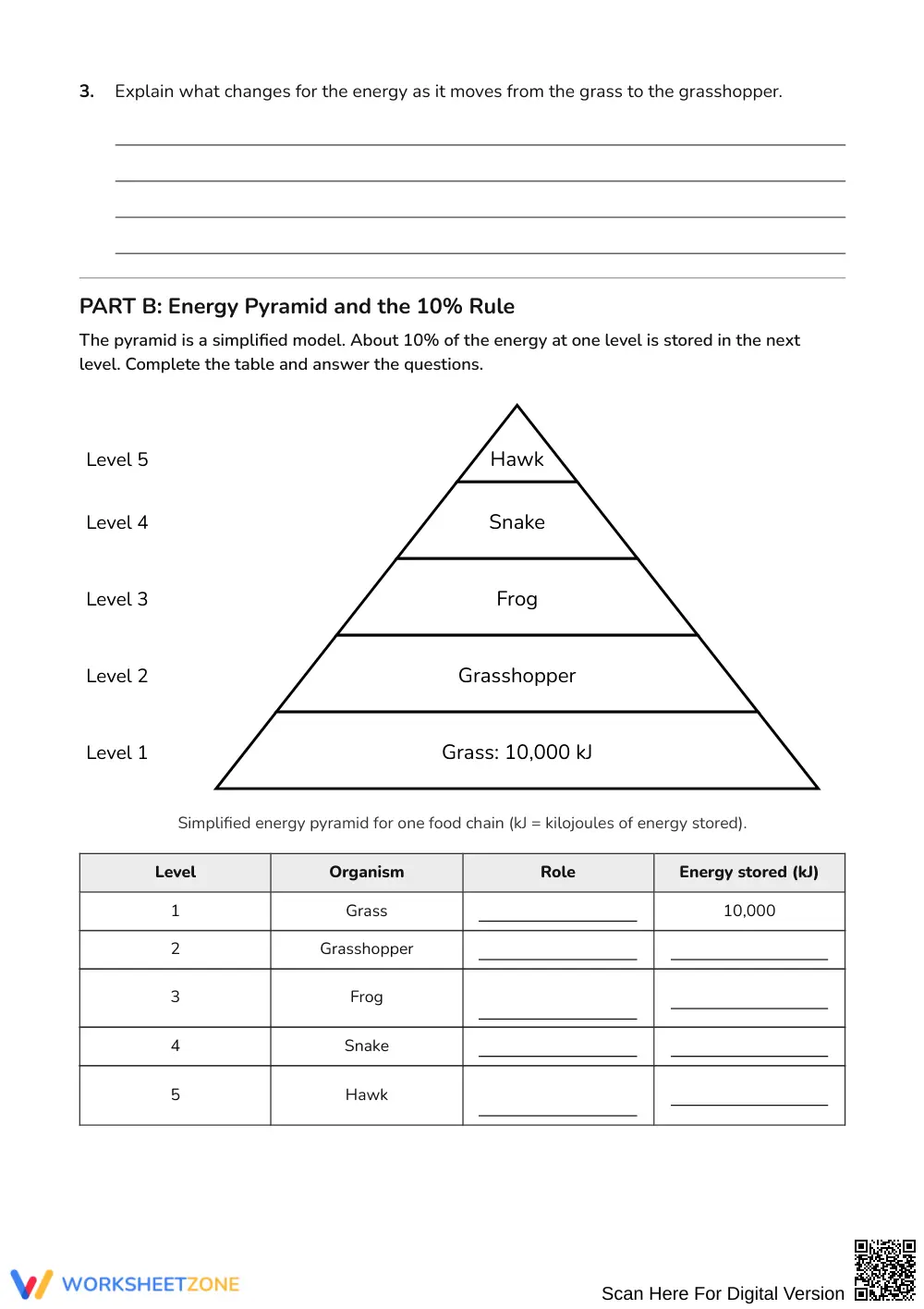
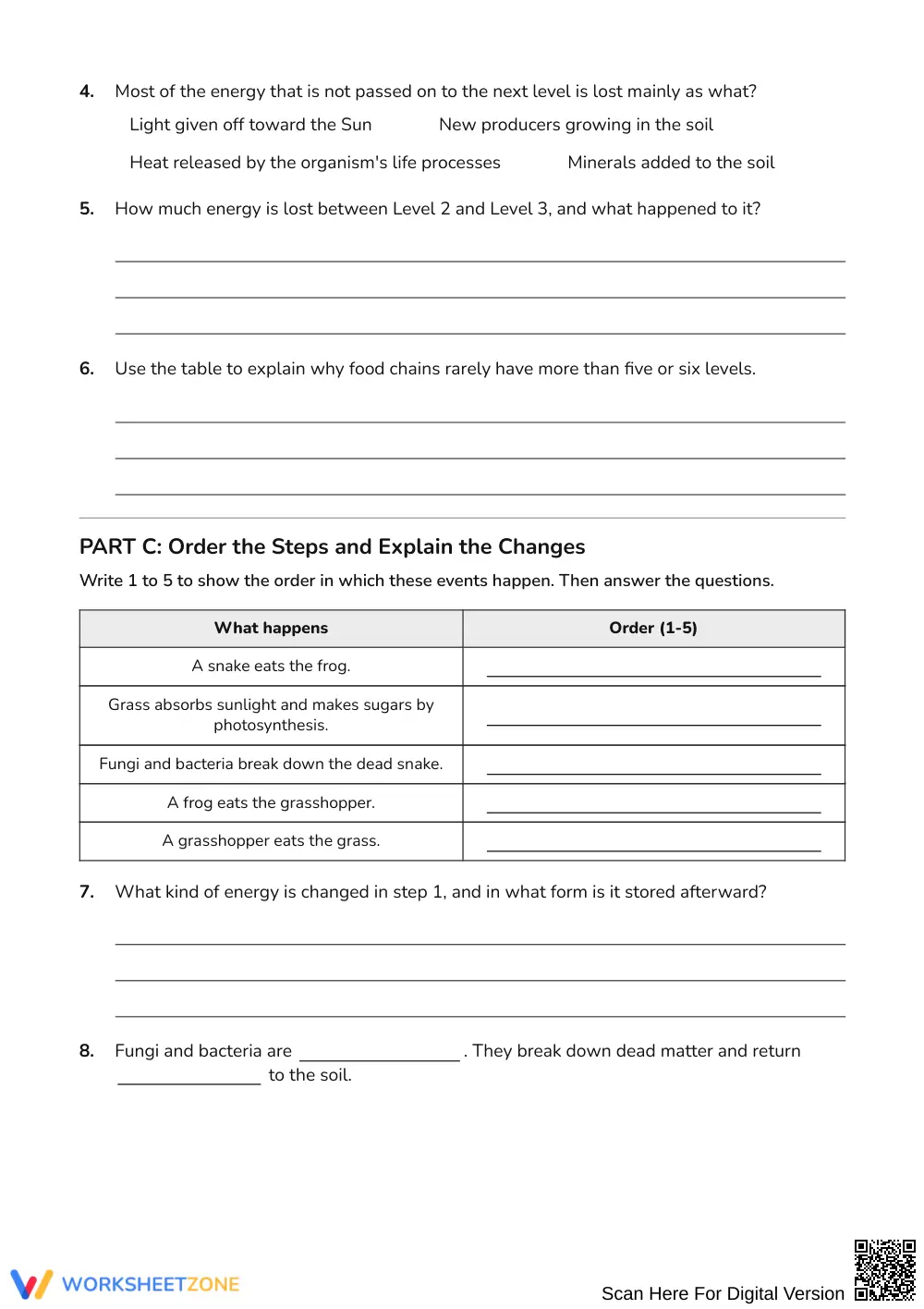
This 4-page resource includes 32 tasks organized into four focused parts. Students evaluate food chain arrow directions, interpret a 5-tier energy pyramid table, sequence five stages from photosynthesis to decomposition, and analyze omnivore feeding roles. A complete 4-page answer key provides full explanations for every item.
Skill Progression
This worksheet implements a structured gradual-release architecture:
- Guided practice (Part A): Students examine food chain arrow conventions and explain energy movement across 8 foundational items.
- Supported practice (Parts B & C): Learners analyze a kilojoule pyramid, apply the 10% rule, and order chronological transfer stages across 14 problems.
- Independent practice (Part D): Students complete 10 problems addressing feeding misconceptions and predicting ecosystem population shifts after disturbances.
This progression mirrors the I Do, We Do, You Do model to establish independent scientific mastery.
Standards Alignment
This resource aligns with secondary life science standards on matter cycling and energy transfer. Students model trophic levels and calculate energy dissipation through food webs. Both standard codes can be copied directly into lesson plans, IEP goals, or district curriculum mapping tools.
How to Use It
Use this worksheet after direct instruction on the 10% rule or during guided unit review. Check student work on Part A to verify they understand that arrows indicate energy flow rather than predation. Most secondary students finish all 32 problems within 40 to 50 minutes.
Who It's For
Designed for middle and high school life science classrooms, this printable accommodates diverse learning needs. Scaffold instruction by highlighting the energy table for struggling readers, or use Part D to challenge advanced learners. Pair this worksheet with an introductory food web diagram or ecosystem lecture.
Secondary science curricula require students to trace energy flow and analyze trophic level sequencing across dynamic food webs. Research from Fisher & Frey (2014) demonstrates that structured gradual-release frameworks significantly strengthen conceptual retention when middle and high school students confront complex scientific processes. Rather than memorizing isolated vocabulary terms, learners need structured opportunities to interpret quantitative data, explain thermodynamic loss mechanisms, and predict ecological disruptions. This 4-page worksheet guides learners through 32 scaffolded tasks that progress from basic consumer classifications to multi-step energy accounting under the 10% ecological rule. By connecting concrete mathematical calculations to written explanations, students build the analytical stamina required for rigorous life science standards. The predictable instructional sequence enables teachers to diagnose specific conceptual breakdowns in energy transfer before transitioning students to independent ecosystem modeling, food web investigations, and high-stakes biology assessments.


