




























Views
Downloads




Ready Seismic-Velocity Records Worksheet | Grade 8 Science

Paste this activity's link or code into your existing LMS (Google Classroom, Canvas, Teams, Schoology, Moodle, etc.).
Students can open and work on the activity right away, with no student login required.
You'll still be able to track student progress and results from your teacher account.
This Grade 8 science worksheet teaches students to read simplified seismic-velocity records and use P-wave speed, S-wave speed, and density as evidence for Earth's layers. Students learn to connect data patterns to boundaries, then judge what the data can and cannot show.
At a Glance
- Grade: 8 · Subject: Science
- Standard: Earth's layers from seismic evidence — Read data tables and infer Earth's layers from wave speed and density
- Skill Focus: Interpret simplified seismic-velocity records
- Format: 5 pages · 10 problems · Answer key included · PDF
- Best For: Data-driven Earth's Layers unit practice
- Time: 40–50 minutes
What's Inside
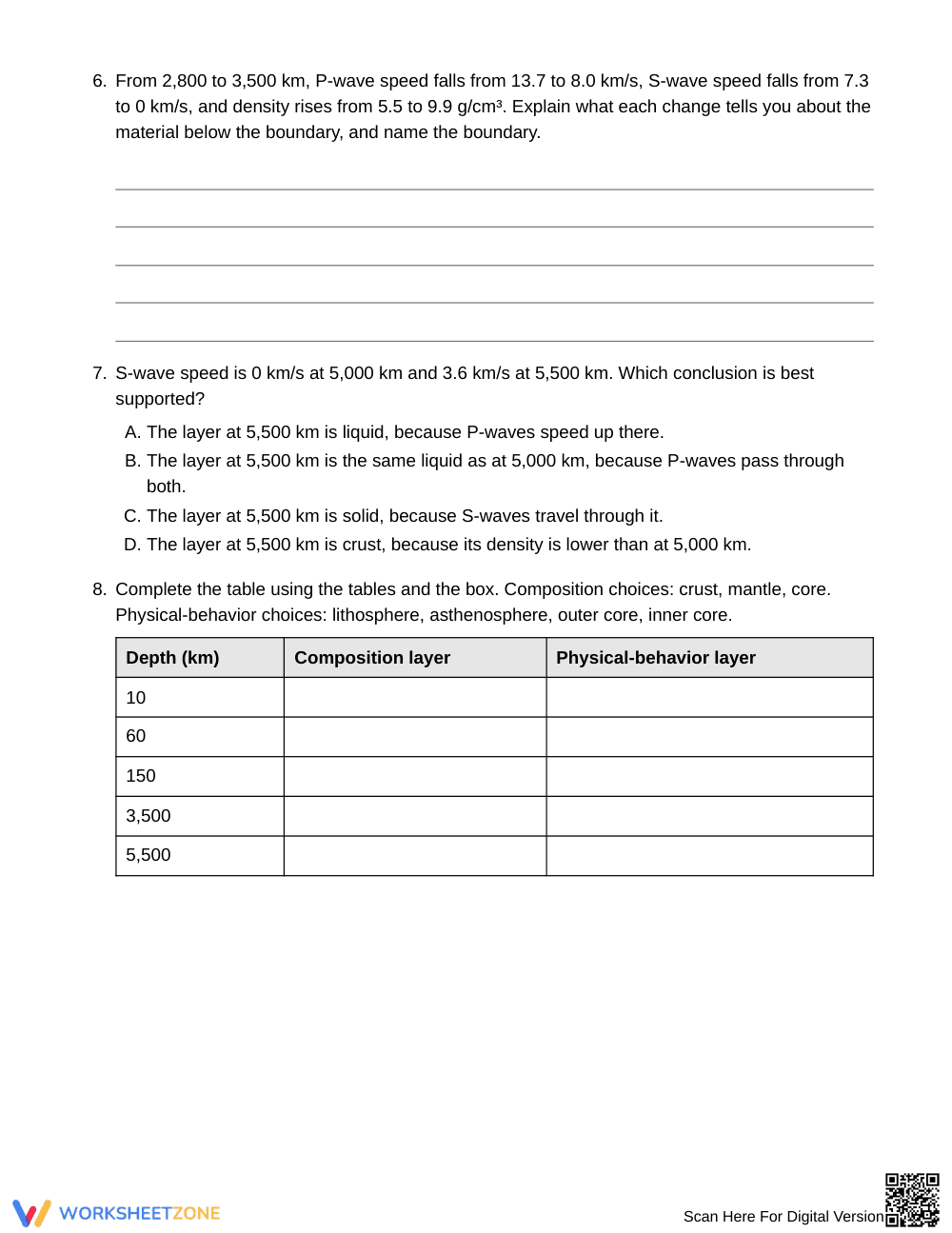
The worksheet has 5 pages with a short background section, two synthetic data tables (wave speeds and density), and 10 tasks across three parts. Task types include value lookup, calculation with shown work, multiple choice, a layer-classification table, and written evaluation. A 3-page answer key is included.
Skill Progression
- Guided practice: Part A, 2 tasks. Students read P-wave, S-wave, and density values with units.
- Supported practice: Part B, 6 tasks. Students calculate average change, choose the best-supported interpretation, explain boundaries, and classify layers.
- Independent practice: Part C, 2 tasks. Students evaluate claims and name the evidence still missing.
This sequence follows the gradual-release model: I Do, We Do, You Do.
Standards Alignment
The worksheet targets middle school Earth science: using seismic-wave and density data as evidence for the layered structure of Earth, by composition and by physical behavior. No standard code was supplied, so add your state or district code when copying this into lesson plans, IEP goals, or curriculum mapping tools.
How to Use It
- After direct instruction: Assign Parts A and B as independent practice once students know P-waves and S-waves.
- Before a unit assessment: Use Part C as a discussion review on the limits of data.
Formative tip: watch whether students cite numbers from both tables rather than only naming a layer. Expect 40–50 minutes.
Who It's For
Grade 8 Science students in an Earth's Layers unit. Students who need support can complete Part A and the multiple-choice tasks first, and a Part B calculation can be modeled aloud. Pair it with a labeled diagram of Earth's layers or a lesson on seismic waves.
The Reading Earth's Interior worksheet for Grade 8 Science asks students to interpret simplified seismic-velocity records and use them as evidence for Earth's layers. Across 10 tasks in 5 pages, students read values from two synthetic tables, calculate average changes in P-wave speed, match depths to composition and physical-behavior layers, and evaluate two claims about boundaries and mantle flow. The sequence follows the gradual release of responsibility model described by Fisher & Frey (2014), moving from guided reading of data to independent evaluation of limitations. Because every number is invented and simplified for one imagined path through Earth, the worksheet practices the reasoning of seismology without implying real measurements. A 3-page answer key supports quick checking and feedback. It suits classroom, homework, or review use when students need to justify conclusions with numbers.


