

































Ready Newton's First Law Worksheet | Grades 8-12 Science

Paste this activity's link or code into your existing LMS (Google Classroom, Canvas, Teams, Schoology, Moodle, etc.).
Students can open and work on the activity right away, with no student login required.
You'll still be able to track student progress and results from your teacher account.
This physical science worksheet equips students in grades 8 through 12 to master Newton's First Law of Motion through data analysis. Learners examine mass and inertia relationships, calculate velocities from position sensors, and analyze balanced forces across four structured pages. Students connect numerical observations directly to inertia without relying on rote memorization.
At a Glance
- Grade: Grades 8–12 · Subject: Science
- Standard: Core Physics — Analyze quantitative data to explain inertia and balanced forces on moving objects
- Skill Focus: Data Table Analysis for Newton's First Law
- Format: 4 pages · 20 problems · Answer key included · PDF
- Best For: High school physics or physical science practice
- Time: 40–50 minutes
What's Inside
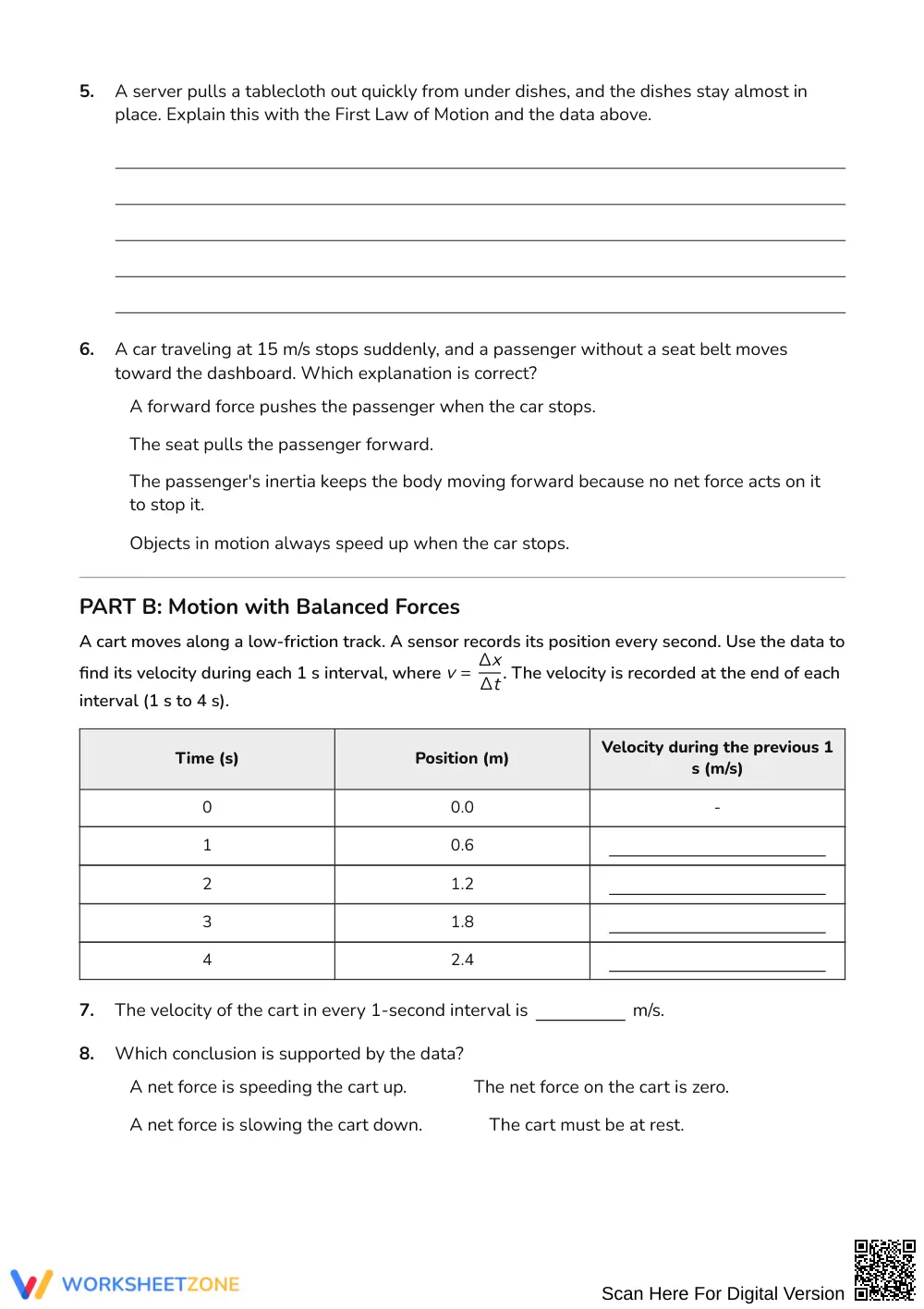
The 4-page student activity includes 20 sequential questions organized around laboratory data sets. Part A features mass and displacement data, guiding students to identify inverse patterns, explain inertia conceptually, and predict new values. Part B provides position and velocity tables alongside velocity-time graphing and vector analysis. A complete 4-page answer key provides worked solutions.
Skill Progression
- Guided practice (Problems 1–6): Students complete data tables with given product constants and answer scaffolded questions exploring inverse relationships between mass and displacement.
- Supported practice (Problems 7–13): Learners write open-ended explanations connecting inertia to everyday vehicular stops and compute interval velocities using provided formulas.
- Independent practice (Problems 14–20): Students construct velocity-time graphs, evaluate balanced forces, and determine net forces on moving carts.
This sequence implements a gradual-release model, progressing from guided data interpretation to independent force synthesis.
Standards Alignment
This resource aligns with physical science expectations for forces and motion. Students analyze data to verify that objects maintain constant velocity when the net force equals zero. Standard descriptions can be copied directly into lesson plans, IEP goals, or district curriculum mapping tools.
How to Use It
Use this worksheet after introducing Newton's First Law of Motion or following a dynamics cart lab. During independent practice, check whether students recognize that constant velocity indicates zero net force. Expect student completion within 40 to 50 minutes.
Who It's For
This practice set serves grade 8 physical science classes and high school physics students studying mechanics. Teachers can provide sentence frames for written explanations to assist developing writers. Pair this worksheet with an interactive motion simulation or dynamic cart demonstration.
Analyzing quantitative motion data grounds abstract mechanics principles in concrete empirical evidence. This worksheet develops data table analysis skills for Newton's First Law of Motion by requiring learners to calculate velocity from position intervals, evaluate inertia through inverse mass-distance patterns, and demonstrate that zero net force produces constant speed. According to research cited by EdReports 2024, standards-aligned science tasks that integrate graphical representations with quantitative tables foster deeper conceptual retention than isolated vocabulary drills. Students must actively synthesize multiple representations, transitioning from numerical tables to kinematic plots and free-body force reasoning. By connecting observable numerical values directly to fundamental physical laws, the 20 structured prompts guide students to articulate cause-and-effect relationships across varying mass values. This systematic approach establishes the foundational scientific literacy and rigorous reasoning habits necessary for advanced projectile and multi-dimensional Newtonian mechanics coursework.


