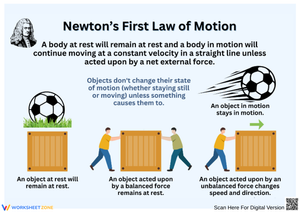
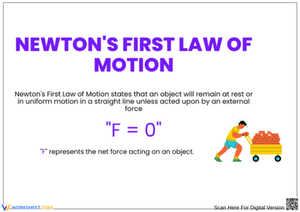
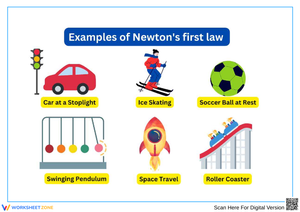
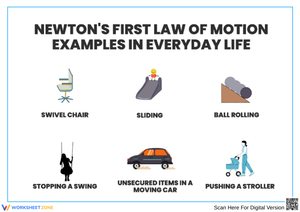
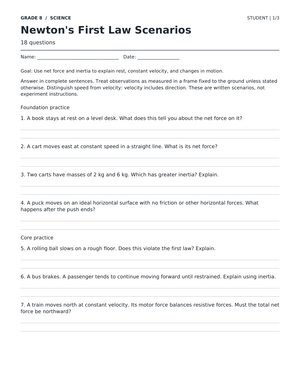
These first law of motion pdf worksheets give physical science teachers a direct route past the most persistent misconception in introductory mechanics: the belief that a moving object requires a continuous force to keep going. The set spans grades 6–10 and targets both qualitative reasoning about motion states and quantitative analysis of net force.
The Specific Skills These Worksheets Build
Each worksheet isolates a distinct component of Newton's First Law rather than folding the entire concept into a single exercise. Students work through six targeted skill areas:
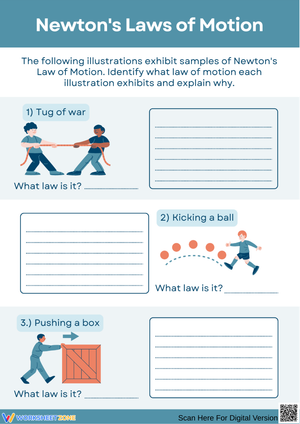
- Identifying balanced and unbalanced forces — labeling force arrows on diagrams and deciding whether net force is zero or nonzero
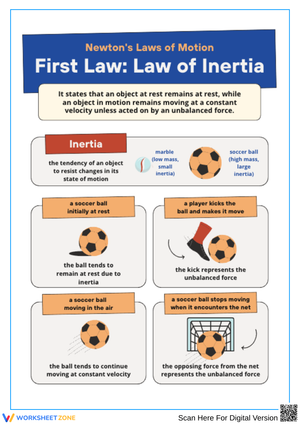
- Relating mass to inertia — comparing pairs of objects (a loaded truck vs. a bicycle, a bowling ball vs. a tennis ball) and ranking their resistance to changes in motion
- Predicting motion outcomes — given a net force value and an initial state, students state what happens next in plain language
- Reading pre-drawn free-body diagrams — interpreting arrow diagrams and writing a sentence explaining the resulting motion
- Constructing original force diagrams — translating a written scenario into arrows, then calculating net force
- Separating inertia from force — a distinction that trips up students from 6th grade through AP Physics
One worksheet focuses entirely on vocabulary—inertia, net force, unbalanced force, state of motion—using context-based fill-ins rather than rote definitions, so students encounter each term in a sentence that shows its actual function rather than just its dictionary meaning.
Mistakes Students Make That These Worksheets Help You Catch
The Aristotelian intuition runs deep. Students who have never studied physics already carry a physics theory: things move because something is pushing them, and things stop when the push runs out. That folk model is coherent and, in a world full of friction, mostly predictive—which is exactly what makes it so hard to dislodge. The most recognizable version in student work is a sentence like "the soccer ball keeps rolling because of its forward force." The word force appears where the student means tendency to keep moving. These first law of motion pdf worksheets are built to surface that error in writing early, before it calcifies into a semester-long misunderstanding.
A second error is subtler: students accept that a stationary book sitting on a table isn't going anywhere because the forces are balanced, but they resist applying the same logic to a moving object. They don't extend "balanced forces = no change" to cover a hockey puck gliding at constant velocity across frictionless ice—even though the physics is identical. Placing both scenarios side by side on the same worksheet makes the parallel visible in a way that class discussion alone rarely achieves. Students who see the two scenarios together stop treating them as different rules and start recognizing them as one.
Building These Worksheets Into Your Lesson Plans
The most effective sequence begins with a physical demonstration before any written work. Place an index card on top of a cup, set a coin on the card, and flick the card away sharply. The coin drops straight into the cup. Students watch inertia play out in real time, and that concrete image carries weight when they're staring at a force diagram ten minutes later. A second option is the skateboard-and-backpack demo: load a backpack onto a skateboard, roll it into a wall stop, and watch the backpack continue forward. Students who see the backpack fly off the stopped skateboard have a physical referent for every diagram they draw in the subsequent activity.
Within the weekly schedule, the shorter identification tasks—reading pre-drawn force diagrams and labeling forces—work well in the first eight minutes of class. They're self-contained enough that early arrivals can begin without instruction and generate a visible artifact to discuss as students finish. The multi-step net force calculation exercises fit better in a structured work block the day after the core lesson, when students have heard the concept once but haven't yet put it on paper. Using first law of motion pdf worksheets this way—distributed across the instructional week rather than assigned all at once—builds retention through spaced retrieval rather than a single sitting.
Standard Alignment
These worksheets align directly with NGSS MS-PS2-2, which requires students to plan and carry out investigations showing that a change in an object's motion depends on the sum of the forces acting on it and its mass. In practical classroom terms, MS-PS2-2 sits at the front of a forces unit, before students move into Second Law calculations. The force diagram and net force exercises here build the exact conceptual groundwork that standard demands: students identify all forces acting on an object, determine whether those forces are balanced, and predict the resulting motion state. Teachers working under state frameworks that adapt NGSS—including versions in California, Texas, and New York—will find the same alignment holds. The vocabulary and diagram formats used on these worksheets also prepare students for the quantitative language they'll encounter on state science assessments in grades 8 and 10.
Differentiating the Worksheets Across Ability Levels
For students who struggle with the spatial demands of force diagrams, the most productive modification is providing arrows pre-drawn and asking students to label only the direction and name of each force. This keeps cognitive demand on the physics reasoning rather than on the construction task. Pairing that with a reference card showing standard conventions—gravity pointing down, normal force pointing up, friction opposing motion—gives students a reliable anchor and removes the working memory load of recalling symbols so they can focus entirely on force balance.
Advanced students benefit less from harder numbers than from a different kind of task entirely. Ask them to write a paragraph explaining why a spacecraft in deep space doesn't need its engines running to maintain speed, or give them a fictional student's written explanation that contains the classic "forward force" error and ask them to identify and correct it. Both tasks require students to articulate the law rather than apply it mechanically, which surfaces gaps in understanding that a calculation exercise won't expose. For students working well above grade level, introducing two-dimensional force analysis—where horizontal and vertical components must be resolved separately before net force can be determined—extends the same conceptual framework directly into high school physics.
Frequently Asked Questions
Do these worksheets work for both middle school and high school students?
Yes. The set spans a range of complexity. The qualitative worksheets—identifying balanced forces, predicting motion from diagrams, vocabulary in context—are appropriate for grades 6–8. The net force calculation exercises and two-dimensional force tasks match grades 9–10. Teachers typically select individual worksheets based on where their class is in the unit rather than moving through all of them in order.
How does mass connect to inertia, and do the worksheets cover it directly?
Mass is the quantitative measure of inertia—the greater an object's mass, the greater the force required to change its motion. Several worksheets address this by asking students to compare pairs of objects and predict which resists a change in motion more strongly. A loaded freight truck and a bicycle moving at the same speed require vastly different forces to stop, and students work through that comparison explicitly rather than simply reading a definition in a textbook.
What is the most effective way to pair these worksheets with a classroom demonstration?
Run the demonstration first, then distribute the worksheet while the physical image is still vivid. The coin-and-cup activity is low-prep and reliable. The skateboard-and-backpack version works especially well with older students because the scale makes the effect harder to dismiss as a trick. Each of these first law of motion pdf worksheets can serve as the direct written follow-up to whichever demonstration you use, asking students to label the forces they just observed and explain the outcome in terms of the law—bridging the physical experience to the formal vocabulary.
How do balanced forces fit into Newton's First Law?
The First Law is a statement about what happens when net force equals zero: nothing changes. An object at rest stays at rest; an object moving at constant velocity continues at that velocity. Students often absorb the "objects at rest" case easily but treat constant-velocity motion as a separate and more confusing rule. Worksheets that place a stationary scenario and a constant-velocity scenario on the same worksheet make the symmetry explicit and help students see the law as a single principle rather than two disconnected facts.












 Interactive Worksheet Maker
 Quiz Maker
 Word Search Maker
 Crossword Puzzle Maker
 Word Scramble Generator
 Sentence Scramble Generator
 Handwriting Worksheet Generator
 Name Tracing Generator
 Fill In The Blank Generator