































Ready Natural Selection Worksheet | Grades 8-12 Science

Paste this activity's link or code into your existing LMS (Google Classroom, Canvas, Teams, Schoology, Moodle, etc.).
Students can open and work on the activity right away, with no student login required.
You'll still be able to track student progress and results from your teacher account.
This cumulative science assessment measures student mastery of natural selection mechanisms, population trait shifts, and evolutionary patterns. Students analyze empirical population datasets, evaluate phenotypic frequency shifts under environmental pressures, and articulate scientific arguments across 17 structured questions. The activity equips learners to explain directional, stabilizing, and disruptive selection using biological evidence.
At a Glance
- Grade: Grades 8–12 · Subject: Science
- Standard: Analyze empirical data to explain how natural selection leads to adaptation in populations
- Skill Focus: Patterns of natural selection, data interpretation, and evolutionary mechanisms
- Format: 4 pages · 17 problems · Answer key included · PDF
- Best For: End of unit summative assessment
- Time: 45–60 minutes
What's Inside
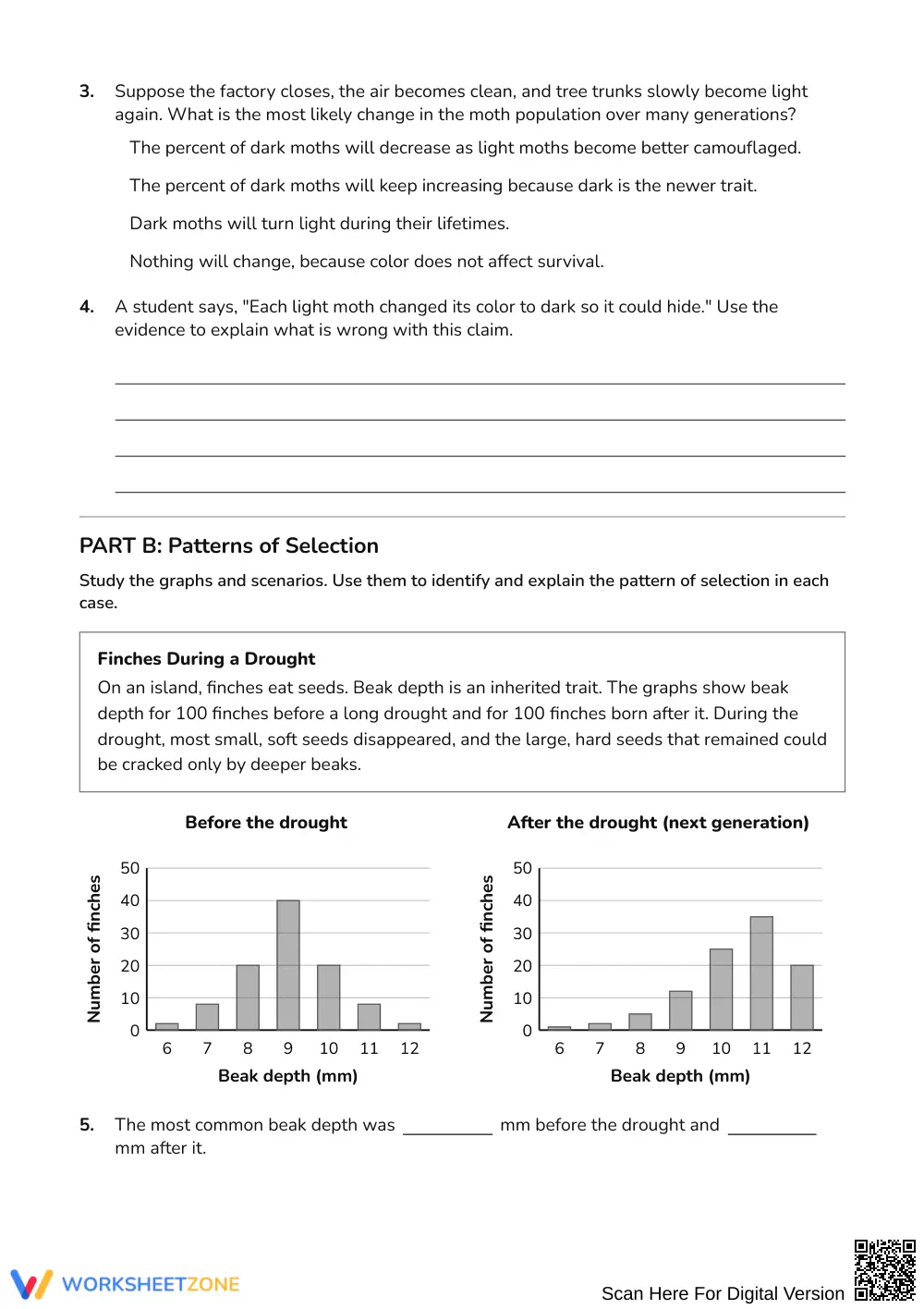
This 4-page assessment contains two sections testing core evolutionary concepts. Part A focuses on population shifts over time, featuring a data table tracking moth coloration frequencies over 15 years, followed by constructed responses and a misconception-check task. Part B provides graphical frequency distributions and scenarios—such as drought-impacted finch beaks and coastal snail camouflage—requiring students to identify directional, stabilizing, and disruptive selection. A 4-page answer key provides complete model explanations.
Skill Progression
- Guided practice (Tasks 1–4): Students examine tabulated moth frequencies across four intervals, calculating percentage changes and using prompt cues to connect survival to bird predation.
- Supported practice (Tasks 5–10): Learners interpret distribution graphs of finch beak depths before and after drought, using specified vocabulary—variation, survive, and inherited—to justify shifts.
- Independent practice (Tasks 11–17): Students classify real-world biological scenarios into stabilizing, directional, or disruptive selection, explain bimodal snail distributions, and predict pesticide resistance over generations.
This structure follows the gradual release of responsibility model, guiding students from data extraction to independent causal modeling.
Standards Alignment
This resource aligns with secondary life science standards requiring students to analyze and interpret data to construct explanations for how environmental factors drive natural selection. Supporting standards emphasize using mathematical models and population graphs to illustrate differential survival. Both standard codes can be copied directly into lesson plans, IEP goals, or district curriculum mapping tools.
How to Use It
Administer this 4-page packet after direct instruction as a summative unit exam, or divide Parts A and B across two class periods for mid-unit review. During work time, check Tasks 4 and 10 to ensure students understand that populations evolve across generations rather than individual organisms adapting by choice. Completion takes 45 to 60 minutes.
Who It's For
This assessment serves general biology, life science, and honors students in Grades 8 through 12. For English learners, structured vocabulary prompts in Tasks 5 and 17 offer supportive sentence scaffolding without lowering rigor. Pair this worksheet naturally with a direct-instruction lesson or interactive peppered moth simulation before testing.
This 4-page natural selection assessment evaluates student proficiency in analyzing evolutionary mechanisms, interpreting trait frequency graphs, and explaining patterns of directional, stabilizing, and disruptive selection. Grounded in the gradual release framework described by Fisher & Frey (2014), the 17 tasks scaffold student analysis from empirical population counts through multi-generational phenotypic predictions. By pairing quantitative data tables of industrial moth populations with graphical models of finch beak depth distributions, the resource requires learners to articulate how selective pressures alter population genetics over time rather than relying on rote recall. Incorporating explicit non-examples, such as correcting the misconception that individual organisms adapt deliberately, directly addresses persistent conceptual hurdles identified in evolutionary biology education. The assessment provides educators with an objective diagnostic tool that captures measurable evidence of student mastery across complex biological systems and scientific reasoning competencies.


