


























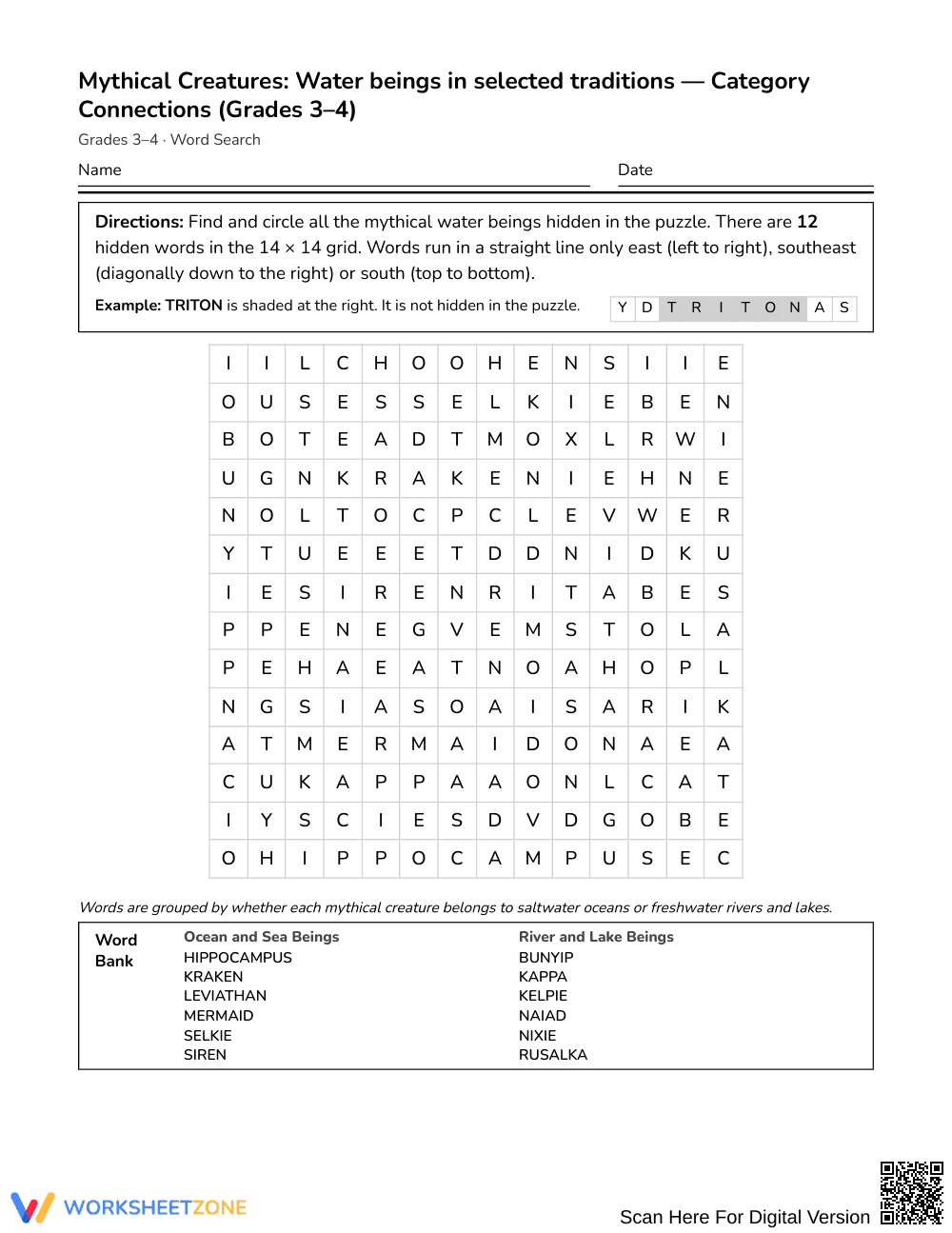

Ready Mythical Water Beings Word Search | Grades 3–4 ELA
Paste this activity's link or code into your existing LMS (Google Classroom, Canvas, Teams, Schoology, Moodle, etc.).
Students can open and work on the activity right away, with no student login required.
You'll still be able to track student progress and results from your teacher account.
This mythical water beings word search introduces Grades 3–4 students to twelve legendary creatures from global folklore traditions. Learners expand cultural literacy and ELA vocabulary by identifying mythological beings across saltwater and freshwater habitats. The activity reinforces word recognition, spelling precision, and reading stamina through thematic, high-interest folklore discovery.
At a Glance
- Grade: Grades 3–4 · Subject: English Language Arts
- Standard: Not standards-assessed — vocabulary enrichment
- Skill Focus: Water beings in selected traditions
- Format: 1 page · 12 words · Answer key included · PDF
- Best For: Myth unit vocabulary and morning work
- Time: 15–25 minutes
What's Inside
This single-page puzzle delivers a targeted vocabulary exercise featuring 12 folklore terms organized into two thematic categories: Ocean and Sea Beings alongside River and Lake Beings. Each entry includes an informative clue explaining the creature's cultural origin and legendary traits. A comprehensive three-page answer key provides clear solution pathways for swift verification.
Puzzle Structure and Mechanics
The activity features a 14 by 14 letter grid designed specifically for intermediate elementary readers. Hidden vocabulary words run in three forward-facing directions: East (horizontal left-to-right), South (vertical top-to-bottom), and Southeast (diagonal downward-right). Students locate terms using a categorized word bank that connects each mythical entity to its aquatic environment, supported by descriptive folklore clues.
Standards Alignment
This resource serves as targeted vocabulary enrichment and cultural background building rather than a standard-assessed diagnostic worksheet. It reinforces cross-curricular literacy during myths, legends, and world folklore units without attaching formal assessment benchmarks to the recreational puzzle format.
How to Use It
Deploy this word search during an introductory folklore unit to spark interest before reading mythical narratives, or assign it after direct instruction as an engaging fast-finisher activity. During independent completion, circulate to observe whether students use the semantic category headers to predict creature habitats, noting which cultural origins prompt questions. Expect typical student completion within 15 to 25 minutes.
Who It's For
This puzzle supports Grades 3–4 general education classes, English language learners building descriptive vocabulary, and gifted learners exploring cross-cultural mythology. Pair this activity naturally with an informational anchor text about world legends, sea monster tales, or an indigenous storytelling read-aloud.
Vocabulary acquisition within thematic literacy units builds foundational background knowledge necessary for reading comprehension across complex narrative genres. According to Fisher & Frey (2014), intentional exposure to domain-specific terminology through varied print formats cements word consciousness and strengthens orthographic memory during middle childhood. By examining twelve mythical water beings organized by ecological habitats, third and fourth graders engage in contextual categorization that directly links written word forms to rich cultural definitions. Integrating focused puzzle mechanics—including directional word scanning and clue-assisted retrieval—encourages active cognitive processing without inducing cognitive overload. The structured search across East, Southeast, and South orientations provides deliberate visual-spatial practice that supports elementary orthographic scanning routines. Consequently, thematic vocabulary enrichment grounded in world folklore expands learner lexicons, improves spelling retention, and cultivates sustained student engagement during elementary English language arts instruction.


