




























Ready Mountain Building Word Search | Grades 6–7 Science
Paste this activity's link or code into your existing LMS (Google Classroom, Canvas, Teams, Schoology, Moodle, etc.).
Students can open and work on the activity right away, with no student login required.
You'll still be able to track student progress and results from your teacher account.
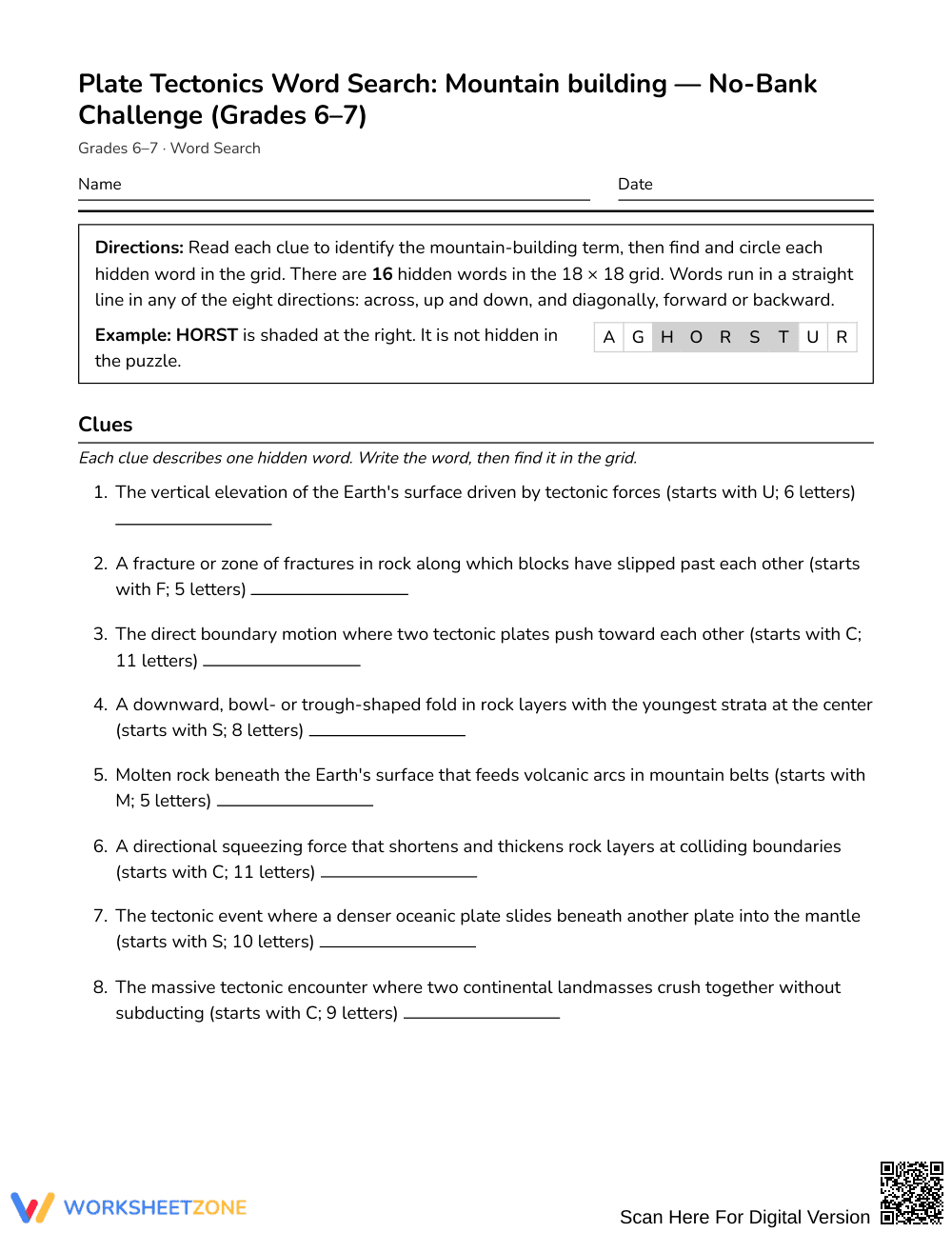
This mountain building word search reinforces Earth science vocabulary for Grades 6–7 students exploring plate tectonics and landforms. Learners read descriptive geological clues to determine target terms before finding them in the grid. This resource strengthens scientific literacy and conceptual recall during independent practice, review sessions, or enrichment.
At a Glance
- Grade: Grades 6–7 Earth Science · Subject: Science
- Standard: Not standards-assessed — vocabulary enrichment for landforms and tectonic plate boundaries
- Skill Focus: Mountain building processes and structures
- Format: 3 pages · 16 words · Full answer key included · Printable PDF
- Best For: Independent vocabulary review, early finishers, and unit enrichment
- Time: 20–30 minutes of focused work
What's Inside
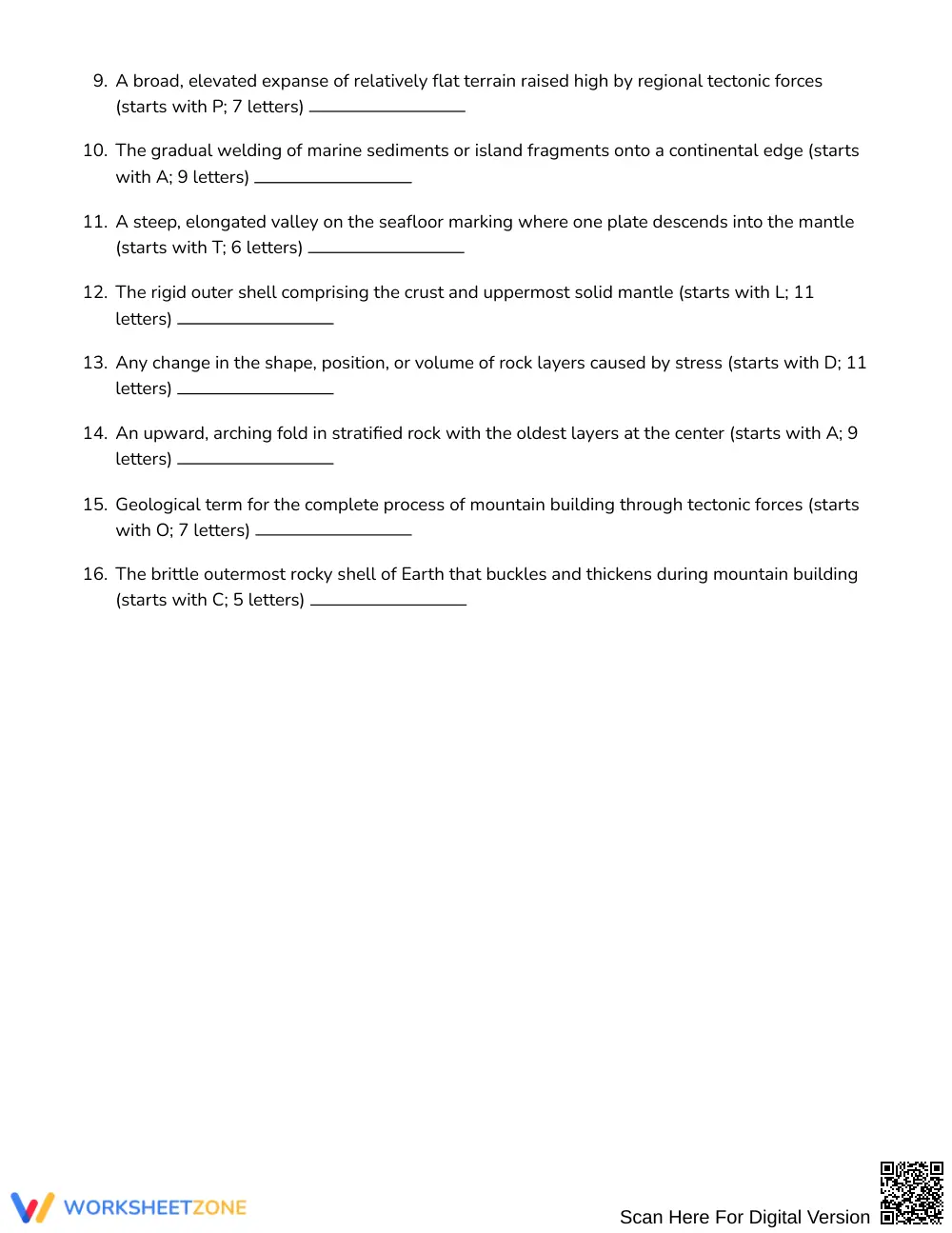
The activity package features a 3-page printable PDF containing a student puzzle sheet and a complete answer key. Instead of a standard word bank, students receive 16 descriptive clues defining essential geological concepts. Learners use these definitions to identify terms before locating them within the grid.
Puzzle Mechanics
This puzzle features an 18 x 18 grid with 16 hidden terms related to mountain building and tectonic forces. With no visible word bank, students must first solve the clue to determine the target word. Words are hidden across eight directions: north, northeast, east, southeast, south, southwest, west, and northwest, offering a rewarding vocabulary challenge.
Standards Alignment
This activity provides targeted vocabulary enrichment and conceptual reinforcement; it is not formally aligned to an assessed content standard. By focusing on domain-specific vocabulary such as crustal deformation, uplift, and convergence, the puzzle supports science reading comprehension and strengthens technical retention across middle school Earth science units.
How to Use It
Use this puzzle after direct instruction on plate boundaries to evaluate term retention, or assign it during review periods prior to a unit test. While circulating, check whether students identify terms like anticline from the clue alone, noting who needs support with folding versus faulting concepts. Most students complete the activity within 20 to 30 minutes.
Who It's For
This resource is tailored for Grades 6–7 science students studying plate tectonics and landform evolution. Support struggling readers by pairing the puzzle with an illustrated tectonic boundary anchor chart. Advanced learners can write original sentences connecting three or more discovered terms. Pair this activity with an introductory reading passage on continental collision.
This Grades 6–7 science word search targets domain-specific vocabulary for mountain building, reinforcing 16 key terms including orogeny, subduction, anticline, and compression. Designed as an enrichment resource without a formal standard code, the activity emphasizes technical vocabulary acquisition and retrieval through clue-based problem solving. According to Fisher & Frey (2014), intentional exposure to academic vocabulary within domain-specific contexts dramatically improves disciplinary reading comprehension and conceptual retention. By requiring students to read complex geological definitions rather than merely copying terms from a visible bank, this puzzle engages active cognitive processing across an 18 x 18 grid. Educators can utilize the 3-page resource for formative vocabulary checks, station rotations, or independent study, providing structured practice that effectively solidifies core concepts of crustal deformation, uplift, and tectonic movement before high-stakes assessments or advanced earth science investigations in secondary classrooms.


