




























Views
Downloads
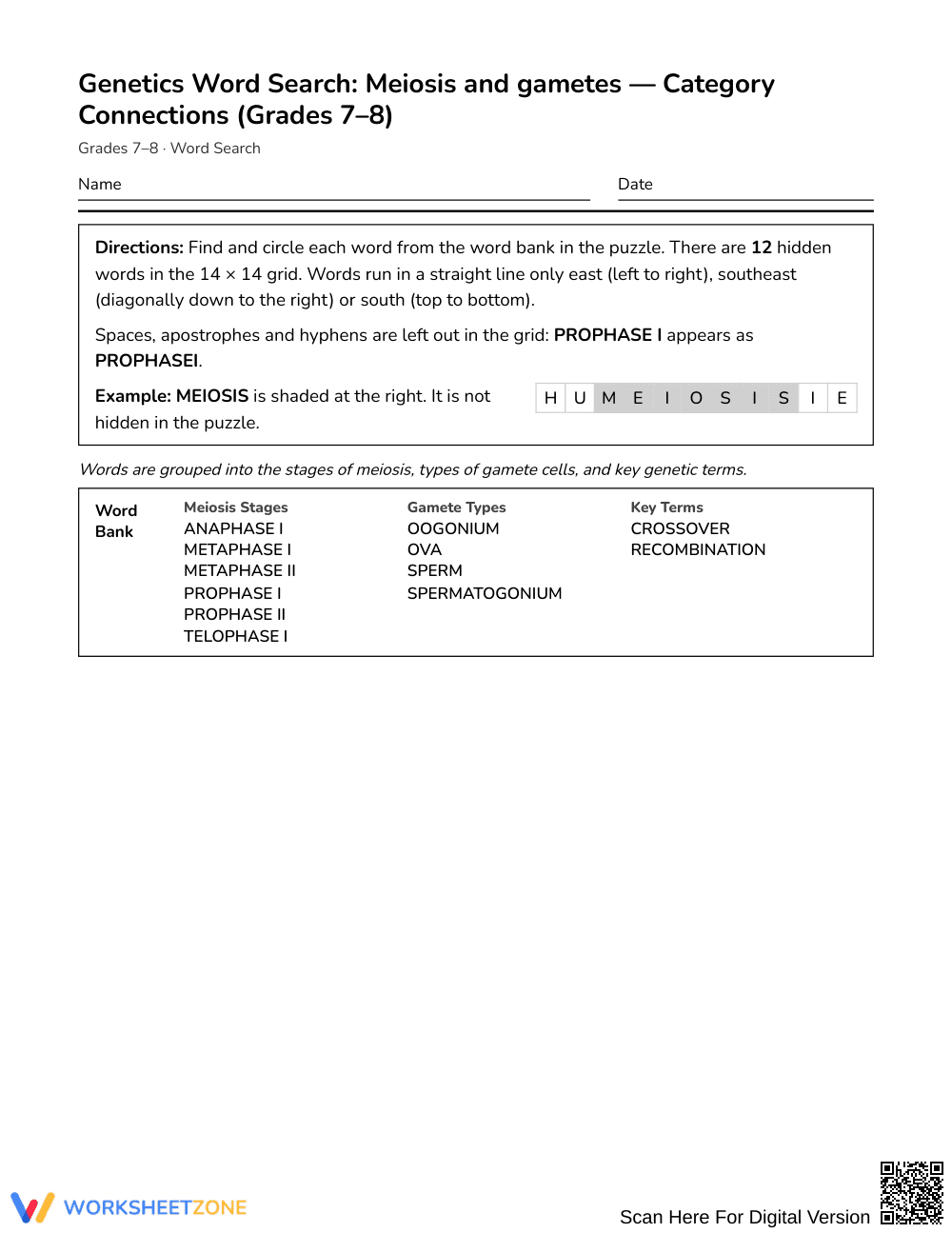


Ready Meiosis and Gametes Word Search | Grades 7–8 Science

Paste this activity's link or code into your existing LMS (Google Classroom, Canvas, Teams, Schoology, Moodle, etc.).
Students can open and work on the activity right away, with no student login required.
You'll still be able to track student progress and results from your teacher account.
This Grades 7–8 science word search strengthens student familiarity with meiosis and gametes through targeted vocabulary practice. Middle school life science learners identify key biological terms to reinforce conceptual understanding of cell division, reproductive cells, and genetic variation. The activity provides an engaging method to consolidate science terminology during genetics units.
At a Glance
- Grade: Grades 7–8 · Subject: Science
- Standard: Not standards-assessed — vocabulary enrichment
- Skill Focus: Meiosis and gametes
- Format: 2 pages · 12 words · Answer key included · PDF
- Best For: Vocabulary review and unit warm-up
- Time: 15–25 minutes
What's Inside
The printable download contains a 2-page student activity featuring 12 words to find. The terms are organized into a categorized word bank dividing concepts across meiosis stages, gamete types, and genetic terms. A complete 3-page answer key provides teacher solutions showing exact word placements across the puzzle grid for quick reference.
Puzzle Structure and Mechanics
The puzzle is built upon a 14 x 14 letter grid designed for focused vocabulary location. Words run in three specific directions: East (horizontal left-to-right), South (vertical top-to-bottom), and Southeast (diagonal down-and-right). The word bank organizes the 12 words into three conceptual categories: Meiosis Stages, Gamete Types, and Key Terms.
Standards Alignment
This resource serves as targeted vocabulary enrichment and is not aligned to a specific academic standard. It supports foundational scientific literacy by reinforcing essential life science terminology within middle school genetics and cellular division units.
How to Use It
Use this puzzle as an introductory warm-up before direct instruction to activate prior knowledge of cell structures, or assign it after teaching meiosis as an independent consolidation task. During completion, circulate to observe whether students recognize the distinction between gamete precursor cells like oogonium and mature gametes like ova. Students typically complete the 12 hidden terms within 15 to 25 minutes.
Who It's For
This activity is designed for Grades 7–8 life science students learning cellular division and reproduction. It offers accessible terminology reinforcement for diverse learners requiring visual word recognition support. Pair this word search with a mitosis versus meiosis comparative diagram to deepen conceptual mastery of chromosome behavior.
Middle school science achievement relies heavily on disciplinary literacy and fluency with specialized biological vocabulary. This Grades 7–8 science word search targets 12 words spanning meiosis and gametes, providing intentional exposure to phase terminology, reproductive cell types, and genetic recombination concepts. As highlighted by Fisher & Frey (2014), explicit vocabulary acquisition in content-area instruction accelerates student comprehension when technical terms are encountered within authentic context and categorization schemes. While this resource is designated as vocabulary enrichment rather than assessed against a single standard code, systematic engagement with domain-specific terms builds the lexical schema necessary for advanced genetics coursework. The structured 14 x 14 grid format encourages active letter-pattern recognition while reinforcing correct spelling and scientific categorization across Meiosis Stages, Gamete Types, and Key Terms. Consequently, this print-and-go activity serves as an effective low-stakes instructional bridge during cellular reproduction units.


