

































Ready In-Text Citation Worksheet | Grade 11 English III

Paste this activity's link or code into your existing LMS (Google Classroom, Canvas, Teams, Schoology, Moodle, etc.).
Students can open and work on the activity right away, with no student login required.
You'll still be able to track student progress and results from your teacher account.
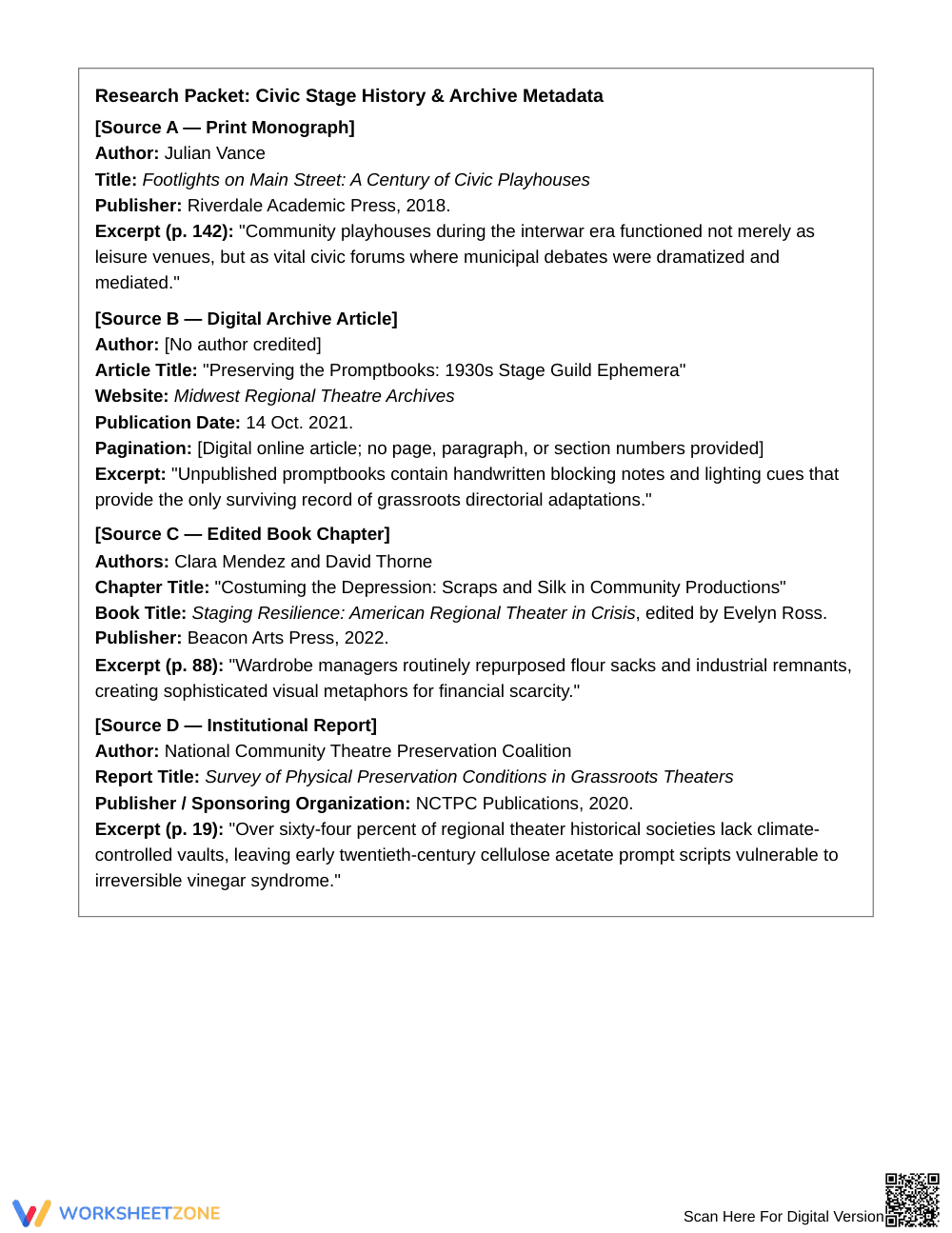
This Grade 11 MLA citation worksheet equips high school researchers to translate raw source metadata into flawless in-text narrative and parenthetical citations. Students examine four authentic archive source profiles, evaluate common citation errors, and construct academic citations following MLA 9th Edition rules.
At a Glance
- Grade: 11 · Subject: English III
- Standard:
W.11-12.8— Cite authoritative sources accurately using standard citation formats without plagiarism- Skill Focus: In-Text Citations from Source Metadata
- Format: 6 pages · 12 problems · Answer key included · PDF
- Best For: Research paper citation practice
- Time: 45–60 minutes
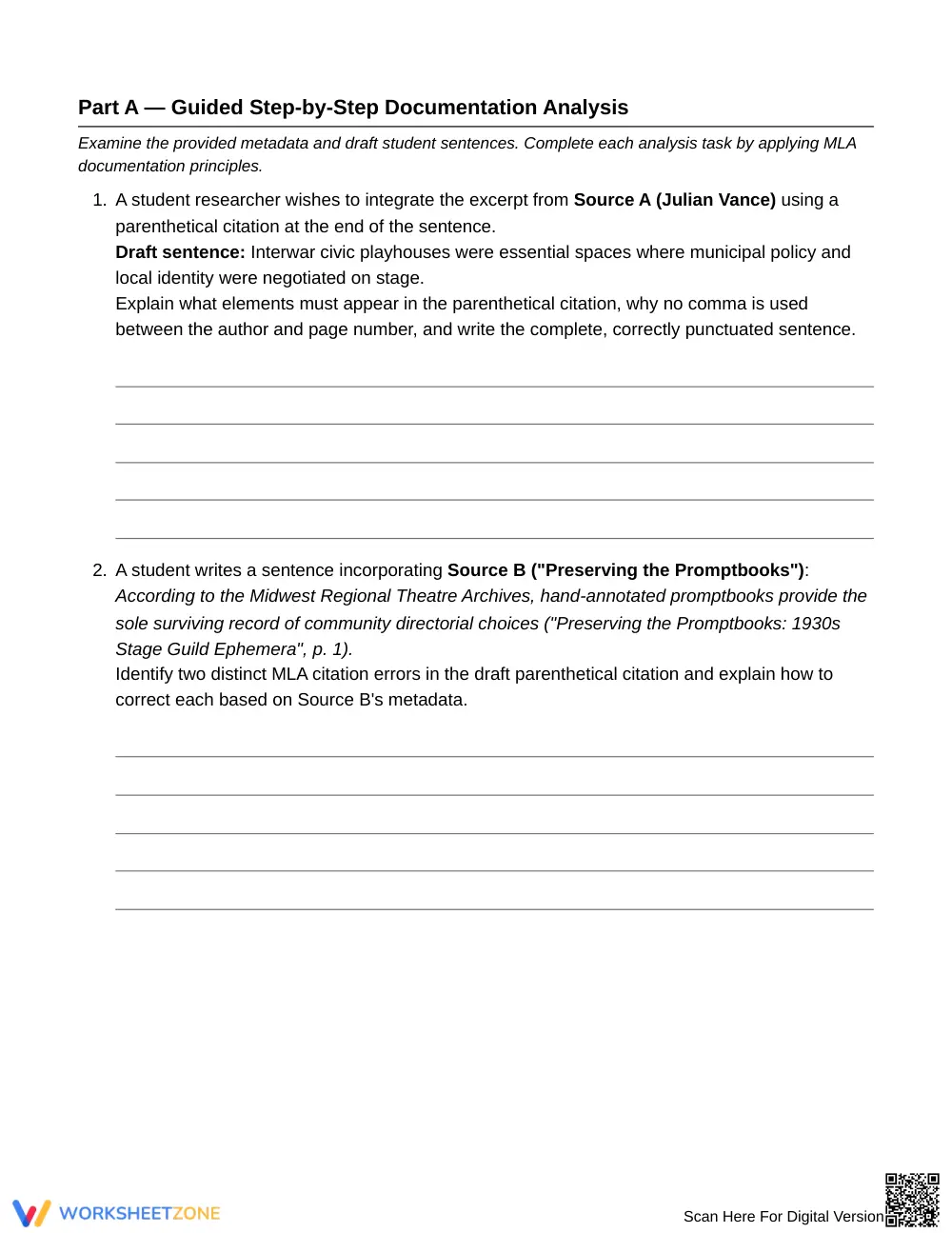
This 6-page instructional resource contains a curated archive metadata packet (monograph, unpaginated digital article, edited collection chapter, and institutional report) paired with 12 rigorous analysis and generation tasks. A complete 3-page answer key provides fully modeled sentences, error diagnoses, and explanations of citation rules.
Skill Progression
- Guided practice (Tasks 1–3): Students analyze pre-drafted sentences against source metadata, identifying missing parenthetical components, comma misuse, and container title rules with explicit rule box reference support.
- Supported practice (Tasks 4–9): Students draft original narrative and parenthetical citations directly from raw source metadata, varying sentence structures between direct quotes and paraphrased claims across single-author, multi-author, corporate, and unpaginated works.
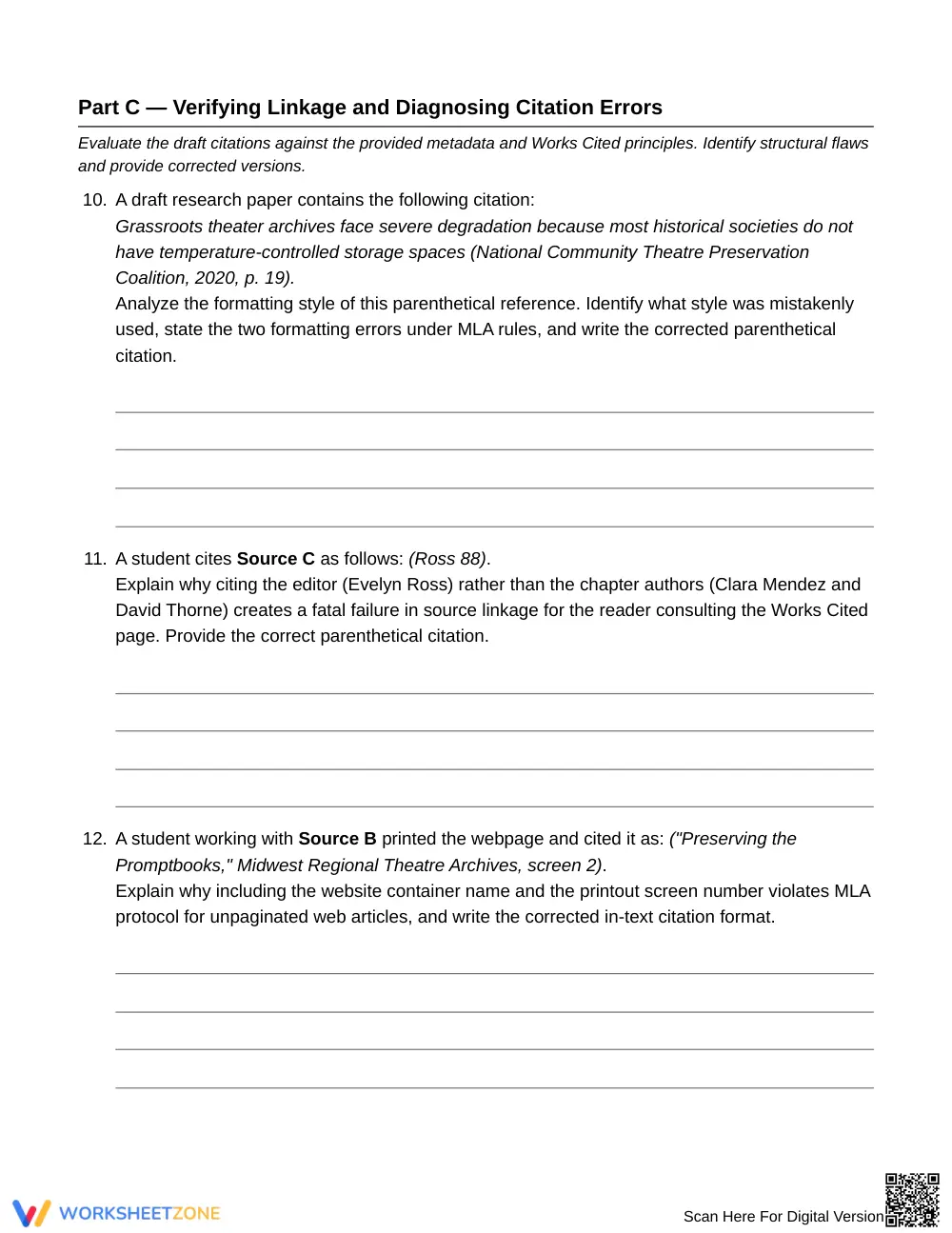
- Independent practice (Tasks 10–12): Students diagnose and correct complex documentation failures, explaining why incorrect style borrowings (such as APA dates) or editor misattributions break source linkage.
This structured progression follows a gradual-release model, shifting students from guided metadata evaluation to independent citation construction and error diagnosis.
Standards Alignment
This resource directly addresses primary standard `W.11-12.8`: Gather relevant information from multiple authoritative print and digital sources, using advanced searches effectively; assess the strengths and limitations of each source in terms of the task, purpose, and audience; integrate information into the text selectively to maintain the flow of ideas, avoiding plagiarism and overreliance on any one source and following a standard format for citation.
Both standard codes can be copied directly into lesson plans, IEP goals, or district curriculum mapping tools.
How to Use It
Deploy this worksheet during the drafting phase of an argumentative or informative research unit, directly after mini-lessons on MLA 9th Edition mechanics. During guided work, circulate to observe whether students mistakenly add commas between authors and page numbers or insert unverified digital page numbers—two high-frequency diagnostic flags. The complete activity takes approximately 45 to 60 minutes of focused classroom work.
Who It's For
Designed for Grade 11 English III and Advanced Placement English Language students writing source-based essays. Scaffolding supports emerging researchers via explicit rule reminders, while advanced learners refine nuances like corporate author signal phrases. Pair this worksheet directly with a research paper drafting guide or an MLA Works Cited anchor chart.
Academic documentation requires students to connect text citations to Works Cited entries systematically. Under standard `W.11-12.8`, eleventh-grade students must synthesize source metadata into standardized parenthetical and narrative in-text citations while avoiding common citation errors. Research by Fisher & Frey (2014) highlights that intentional, scaffolded documentation practice with authentic archival excerpts bridges the gap between mechanical rule memorization and authentic academic writing. When students actively transform primary source cards—including print monographs, unpaginated digital repositories, edited volumes, and corporate white papers—into syntactically mature sentences, they build crucial disciplinary literacy. This 12-task worksheet reinforces exact MLA 9th Edition conventions by requiring learners to diagnose formatting mismatches, eliminate extraneous punctuation, and cite editors versus chapter authors accurately. Systematic practice with source metadata ensures secondary students achieve sustained independence during high-stakes research drafting.


