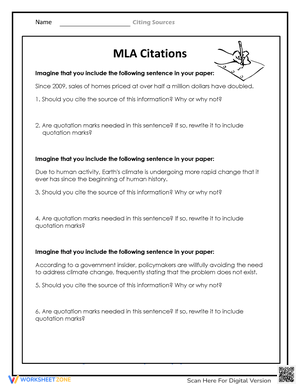
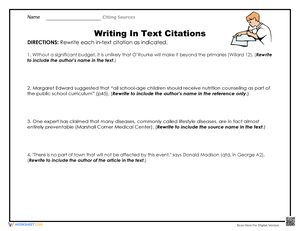
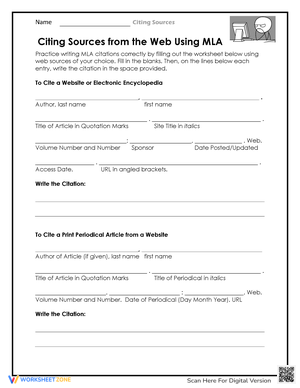
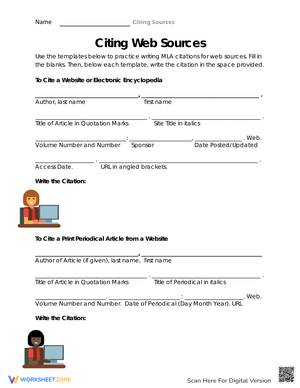
These citing sources worksheets give grades 3–8 teachers a set of focused, print-ready resources that move students from locating source information to formatting complete MLA and APA entries. The set covers the full arc of citation instruction: identifying where information comes from, evaluating whether a source is worth citing at all, and applying the punctuation and ordering rules of a specific style guide. Each worksheet targets one narrow skill rather than piling every formatting rule onto a single task.
What These Worksheets Cover
The skills in this set break down into three distinct phases, which mirrors the order most research units actually follow.
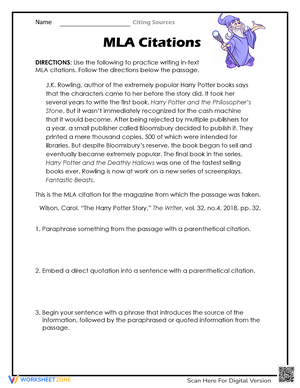
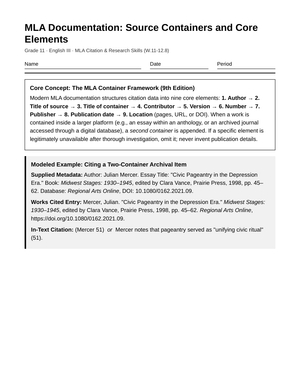
The first phase asks students to dissect citations rather than produce them. Each worksheet in this group presents a complete, correctly formatted citation and asks students to label each component—author, title, publication date, URL, publisher. This analysis work matters because students who can read a citation fluently make far fewer errors when constructing one from scratch. A student who has circled the publication date in ten different MLA entries will not confuse it with the access date when she finally formats her own.
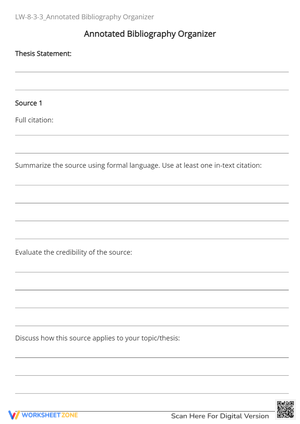
The second phase covers source credibility. Students work through a structured evaluation checklist—examining authorship, publication context, date, and any visible bias—before deciding whether a source earns a place in a bibliography. This prevents the bibliography that consists entirely of Wikipedia pages and a YouTube video with no clear author.
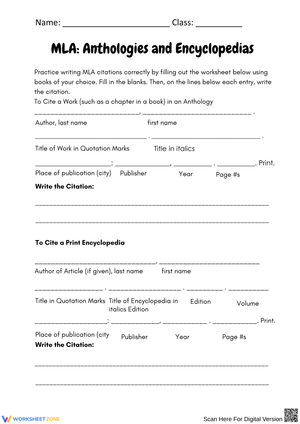
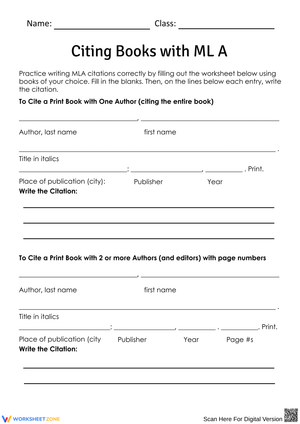
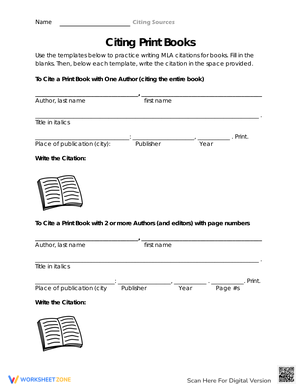
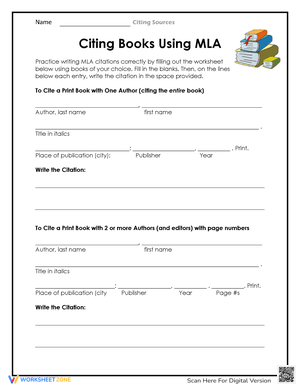
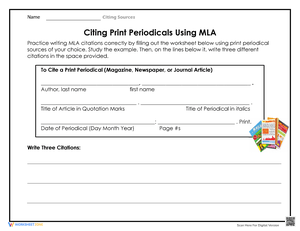
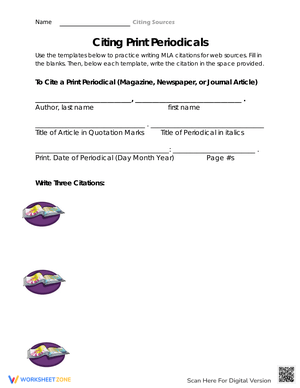
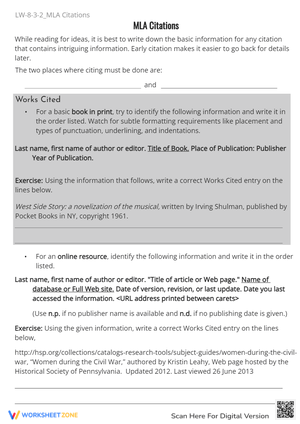
The third phase is the formatting work itself: constructing citations for books, websites, journal articles, and encyclopedias in both MLA and APA formats. Students use a provided reference guide alongside each worksheet, which mirrors how adults actually handle citation work in professional and academic settings.
Errors Worth Anticipating Before You Hand These Out
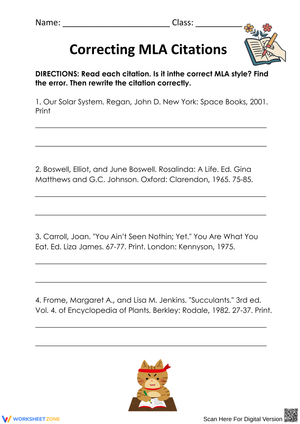
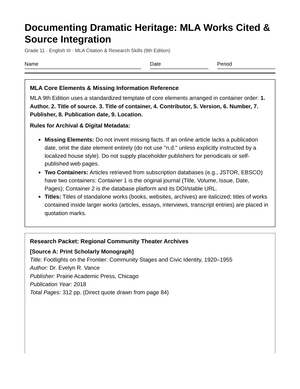
The most persistent error pattern across grades 5–8 is what you might call the "container collapse"—students understand that a book title is italicized, and they apply that rule to article titles too, writing The Benefits of Solar Energy when the article title should appear in quotation marks. The distinction between a container (the journal, the website, the anthology) and an item within it (the article, the chapter, the poem) does not become automatic quickly. Expect to address it more than once across the unit.
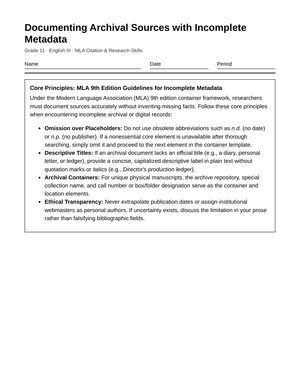
A second reliable stumbling block is the access date in online citations. When students see multiple dates on a webpage—the publication date, the "last updated" note, and the date they retrieved it—they routinely grab the wrong one or omit one entirely. The citing sources worksheets that address online articles build in a step asking students to identify and distinguish each date type before they write anything, which catches this confusion before it migrates into final projects.
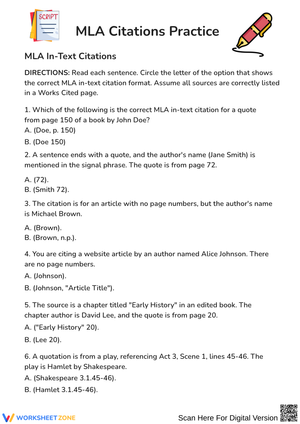
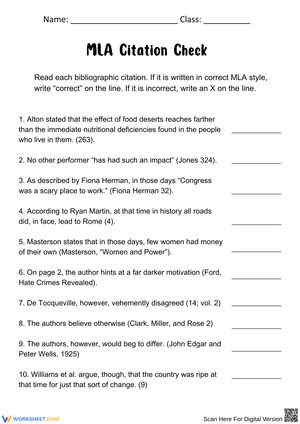
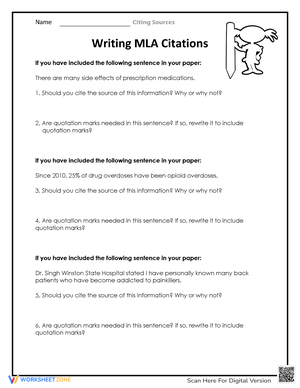
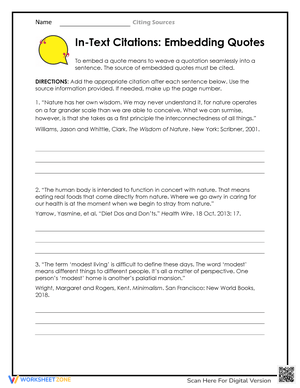
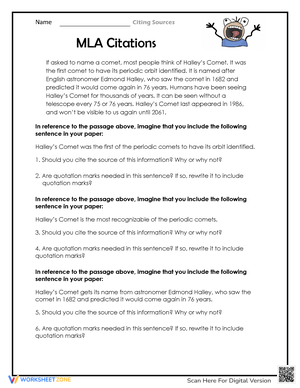
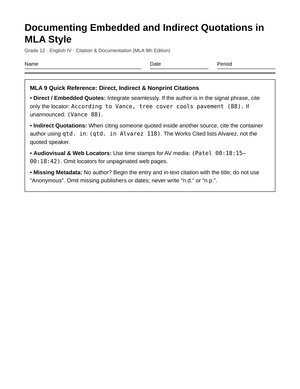
Punctuation within citations trips up students who are otherwise careful writers. A period after a parenthetical citation closing a quoted sentence produces genuine confusion for seventh graders who have spent two years learning that the period goes before the closing quotation mark. These two rules exist in direct tension, and students need explicit instruction on why in-text citations shift the period's position—not just a correction mark on their returned paper.
Fitting These Worksheets Into Your Week
The most effective placement for citation practice is not a standalone unit. Citation skills retain far better when students practice them alongside an actual research assignment, because the formatting rules feel purposeful rather than arbitrary when they connect to something a student is actively writing.
Use the source-identification worksheets during the early research phase of any unit—the days when students are gathering information and taking notes. Run the MLA or APA formatting worksheets once students have a working source list and are beginning to organize their writing. This distributes the cognitive load across the project timeline rather than front-loading every citation rule before students have anything to apply it to.
Pull one citing sources worksheets activity as a 10-minute warm-up at the start of a writing workshop day rather than assigning it as standalone homework. When the worksheet connects directly to what students are drafting that period, the application is immediate and the rules stick more reliably than they do after an evening of decontextualized practice.
For classes that do not have a current research project running, the credibility-evaluation worksheets work well as independent reading tasks. Students read a short passage or examine a provided URL, complete the evaluation checklist, and defend their credibility rating in two or three sentences. That functions as both citation instruction and argument-writing practice at the same time.
Standard Alignment
These worksheets align primarily to CCSS.ELA-LITERACY.W.6.8 through W.8.8, the research standards that require students to gather information from multiple sources, assess source credibility, and quote or paraphrase while avoiding plagiarism and providing basic bibliographic information. The citation-formatting content also supports CCSS.ELA-LITERACY.W.6.2d, which expects students to use precise language and maintain formal style in informational writing—a standard many teachers address through grammar instruction but that citation mechanics reinforces directly through repetition with real source material.
Grades 4–5 teachers will find the source-identification and credibility worksheets align with W.5.7 and W.5.8, which introduce students to gathering information from multiple print and digital sources. Full MLA or APA formatting is generally a grades 6–8 target, but high-achieving fifth graders working on extended research projects can use the MLA basics worksheet with a reference guide in hand.
Adjusting the Set for a Range of Learners
The component-labeling worksheets serve as entry-level practice for students who have never seen a formal citation before. Students who have already encountered citation formats benefit more from the error-correction activities—those tasks require them to apply rules they partially know rather than meeting those rules for the first time.
Students who struggle with formatting respond better to the citing sources worksheets activities that keep the reference guide visible at all times and reduce the number of citation fields to complete in one sitting. Having students format one MLA book citation correctly and thoroughly beats having them produce four incomplete ones. The number of fields per task matters more than the number of tasks assigned.
For students who consistently finish early, the credibility-evaluation worksheets scale up naturally. Rather than completing the provided checklist, stronger students write a paragraph synthesizing their findings about a source's reliability and compare two sources covering the same topic. That extension moves them into comparative analysis without changing the core citation content.
The MLA-to-APA conversion worksheet—which asks students to reformat the same source in both styles—works best as a culminating task for students who have moved past basic formatting and are ready to think about why two different conventions exist. That conceptual comparison tends to land in grades 7 and 8, once students have had sustained exposure to at least one style.
Frequently Asked Questions
Do these worksheets teach MLA or APA, or both?
The set includes worksheets for both MLA and APA formatting, as well as source-identification and credibility-evaluation worksheets that are style-neutral. Most middle school classrooms use MLA, so the MLA worksheets form the larger group. The APA materials are appropriate for classes that require science or social studies research reports formatted in that style.
At what grade should students start learning to format citations formally?
Grades 3–5 students handle source identification well—tracking where a piece of information came from and writing a simplified reference entry. Formal MLA or APA formatting, with its specific punctuation and ordering rules, is generally a grades 6–8 skill. Introducing the full formatting rules before sixth grade tends to generate more confusion than fluency, particularly around punctuation placement and title formatting.
Should students have a reference guide available while completing these worksheets?
Yes—each worksheet is written with the assumption that students have a style guide or simplified reference sheet visible while working. Citation formatting is not a memory test; it is a procedural skill, and practicing it with a reference guide in hand is exactly how professional writers handle citations. The goal is to build the habit of checking the guide accurately, not to memorize punctuation rules cold.












 Interactive Worksheet Maker
 Quiz Maker
 Word Search Maker
 Crossword Puzzle Maker
 Word Scramble Generator
 Sentence Scramble Generator
 Handwriting Worksheet Generator
 Name Tracing Generator
 Fill In The Blank Generator