
































Ready Feeling Word Search | Grades 6–7 Behavior Worksheets

Paste this activity's link or code into your existing LMS (Google Classroom, Canvas, Teams, Schoology, Moodle, etc.).
Students can open and work on the activity right away, with no student login required.
You'll still be able to track student progress and results from your teacher account.
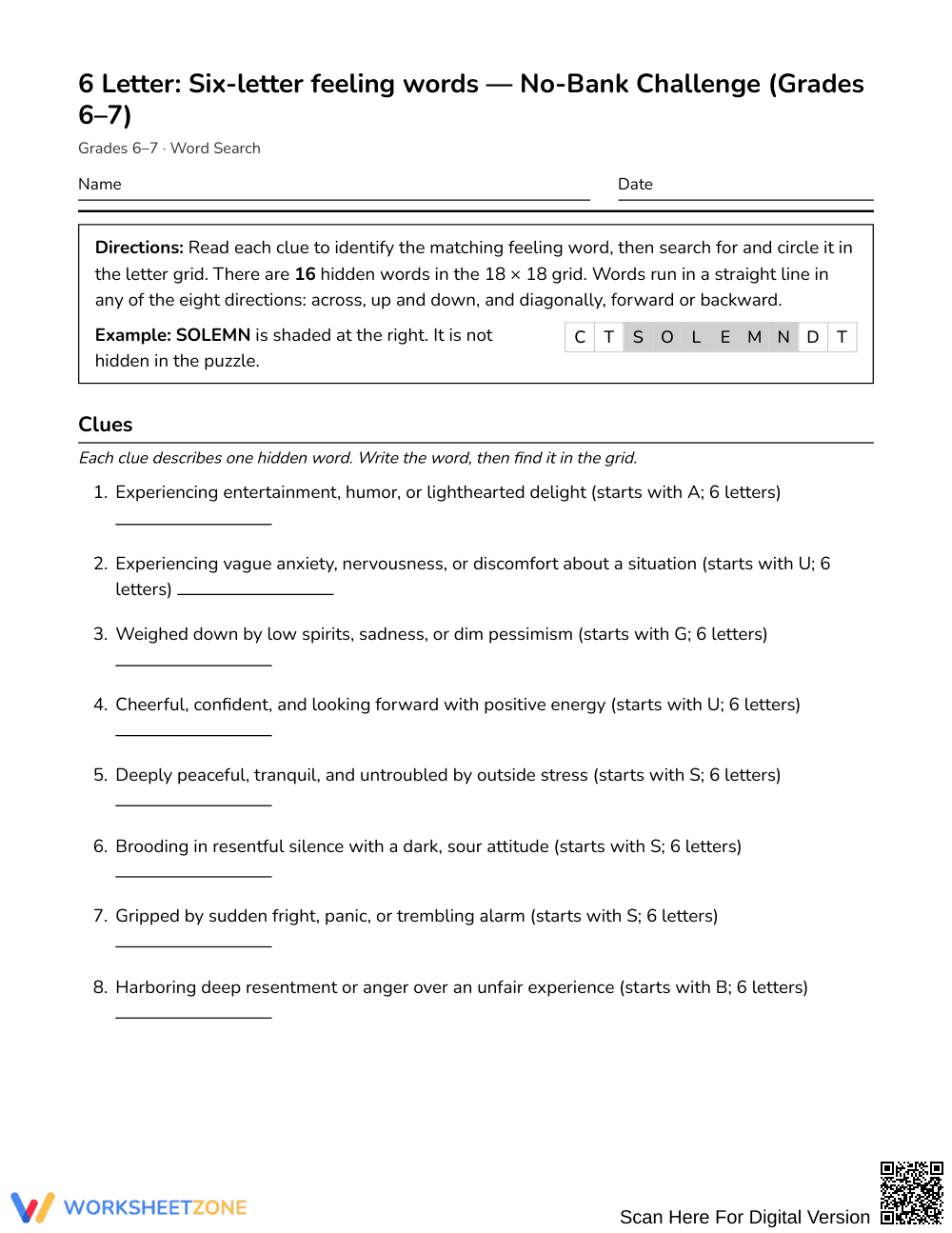
This six-letter feeling words word search expands emotional vocabulary for middle school learners. Students read descriptive affective definitions to identify 16 targeted emotion terms, locating each word within an unscaffolded letter grid. The activity strengthens self-awareness and emotional literacy, enabling adolescents to articulate nuanced internal states during social-emotional learning sessions.
At a Glance
- Grade: Grades 6–7 · Subject: Behavior Worksheets
- Standard: Not standards-assessed — vocabulary enrichment
- Skill Focus: Six-letter feeling words and emotional descriptor identification
- Format: 3 pages · 16 hidden words · Full teacher answer key included · Printable PDF
- Best For: Middle school emotional vocabulary building, advisory lessons, and calm reflection
- Time: 20–30 minutes of focused independent student seatwork
What's Inside
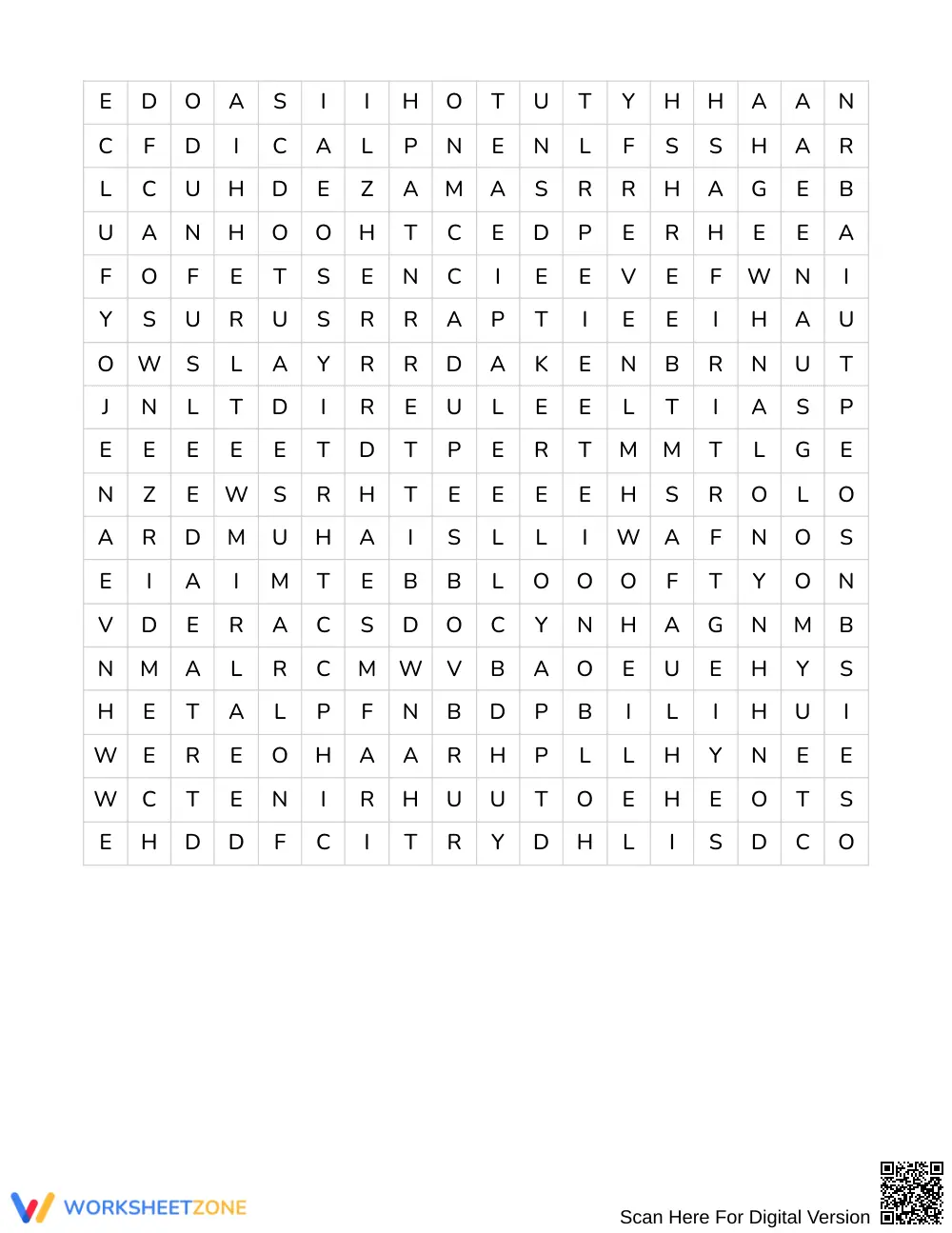
This 3-page printable resource features a no-bank word search challenge containing 16 words focused on emotional literacy. Instead of relying on a pre-printed word bank, students interpret 16 comprehensive behavioral clues defining specific emotional states to deduce each target term. The puzzle is complemented by an explicit 3-page answer key showing full letter-grid word placements for straightforward grading and self-checking.
Puzzle Structure and Mechanics
This word search operates as an engaging cognitive exercise with specific mechanics:
- Grid Size: The puzzle utilizes an 18 x 18 letter grid, providing a substantial layout for word discovery.
- Search Directions: Words run in all 8 directions across the matrix: north, northeast, east, southeast, south, southwest, west, and northwest.
- Clue-Based Retrieval: Rather than using a visible word bank, the activity supplies descriptive clues that prompt learners to deduce the feelings before circling them.
Standards Alignment
This resource is designed strictly for vocabulary enrichment and affective development; it is not aligned to a formal academic standard. Middle school educators can integrate these 16 feeling words into counseling lessons, restorative justice circles, advisory periods, or English language arts enrichment to support emotional expression without standard constraints.
How to Use It
This word search serves versatile instructional moments in middle school settings:
- Advisory Check-In (Before Direct Instruction): Assign the puzzle during morning homeroom to activate emotional self-awareness before academic lessons begin.
- Post-Lesson Reflection (After Direct Instruction): Use the puzzle following a behavioral health unit to reinforce precise vocabulary for nuanced feelings like serene or sullen.
For formative assessment, observe whether students identify words directly from the definitions or struggle to link clues to terms, noting who requires verbal scaffolding. Expected completion time is 20 to 30 minutes.
Who It's For
This activity is tailored for Grades 6–7 students expanding their emotional literacy and behavioral self-regulation. To support emergent readers or English language learners, teachers can provide a preliminary word list or highlight first letters in the grid. Pair this puzzle naturally with an emotion anchor chart or a feelings wheel poster during social-emotional learning blocks.
As an unaligned vocabulary enrichment resource, this Grades 6–7 feeling words word search targets the acquisition of sixteen precise affective terms without standards-based constraints. According to Fisher & Frey (2014), intentional vocabulary acquisition that pairs contextual semantic definitions with active cognitive retrieval significantly enhances long-term word retention and conceptual understanding. By navigating an 18 x 18 letter matrix across all eight directional pathways, students engage in sustained visual processing while reinforcing the exact definitions of complex emotional states such as placid, bitter, and serene. This clue-driven approach eliminates passive word scanning, prompting learners to process internal psychological states before seeking spatial patterns. Integrating affective vocabulary into middle school behavioral routines supports self-regulation and positive classroom communication, offering an accessible, low-stress bridge between social-emotional awareness and language development across advisory, counseling, and English language arts environments.


