































Ready Evolution Comparison Worksheet | Grade 8-12 Science

Paste this activity's link or code into your existing LMS (Google Classroom, Canvas, Teams, Schoology, Moodle, etc.).
Students can open and work on the activity right away, with no student login required.
You'll still be able to track student progress and results from your teacher account.
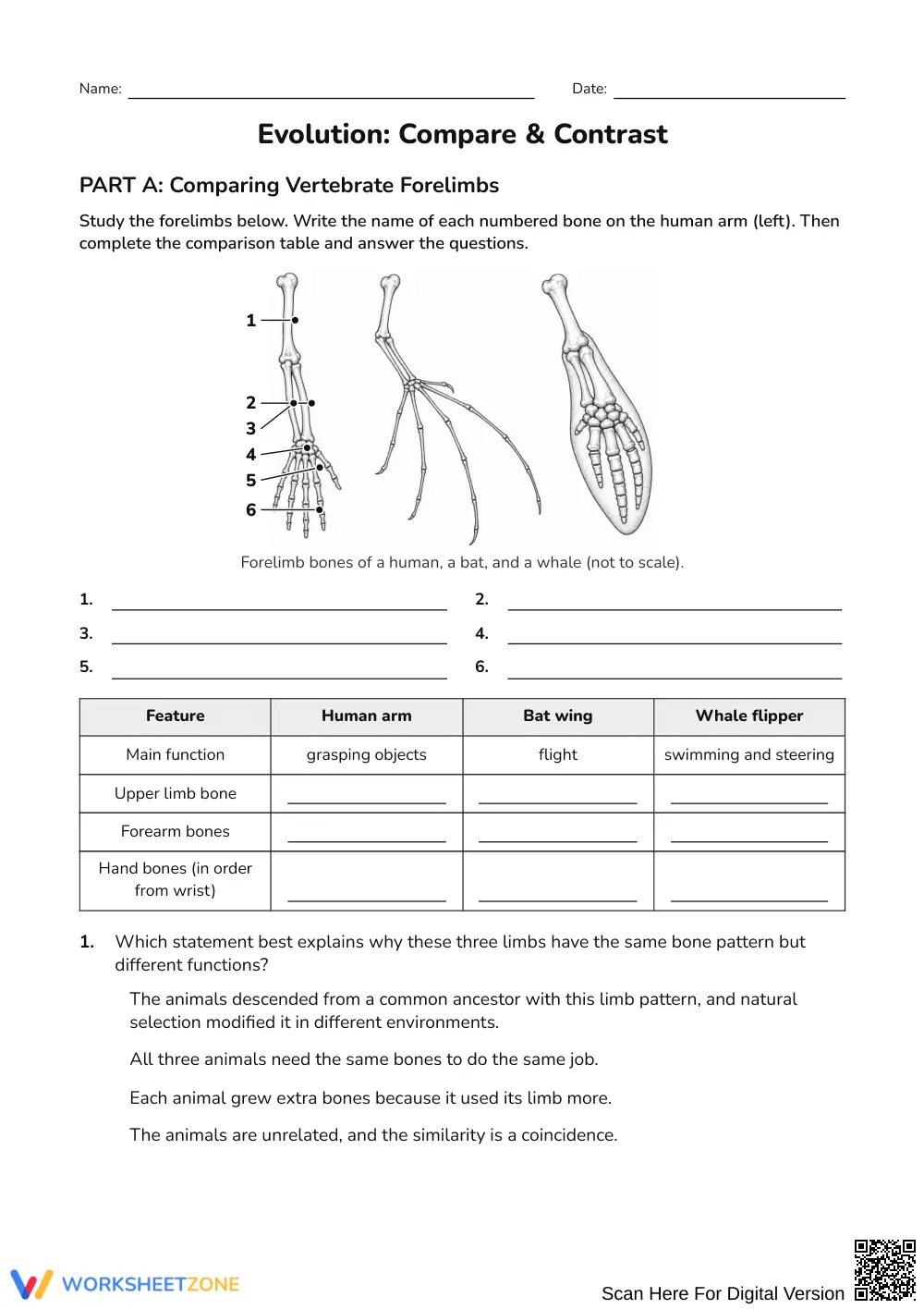
This 4-page evolution worksheet strengthens biological reasoning by guiding secondary science students through comparative analysis of mechanisms and evidence. Learners analyze homologous vertebrate forelimbs, evaluate environmental selection pressures on moth populations, read phylogenetic trees, and contrast natural versus artificial selection. Completing these 37 structured tasks equips students to construct evidence-based claims.
At a Glance
- Grade: Grades 8–12 · Subject: Science
- Standard: Life Science Core Standards — Compare anatomical structures and selection mechanisms using evidence and data tables
- Skill Focus: Comparative analysis of evolutionary evidence, trees, and selection
- Format: 4 pages · 37 problems · Answer key included · PDF
- Best For: Mid-unit practice or assessment review
- Time: 45–60 minutes
What's Inside
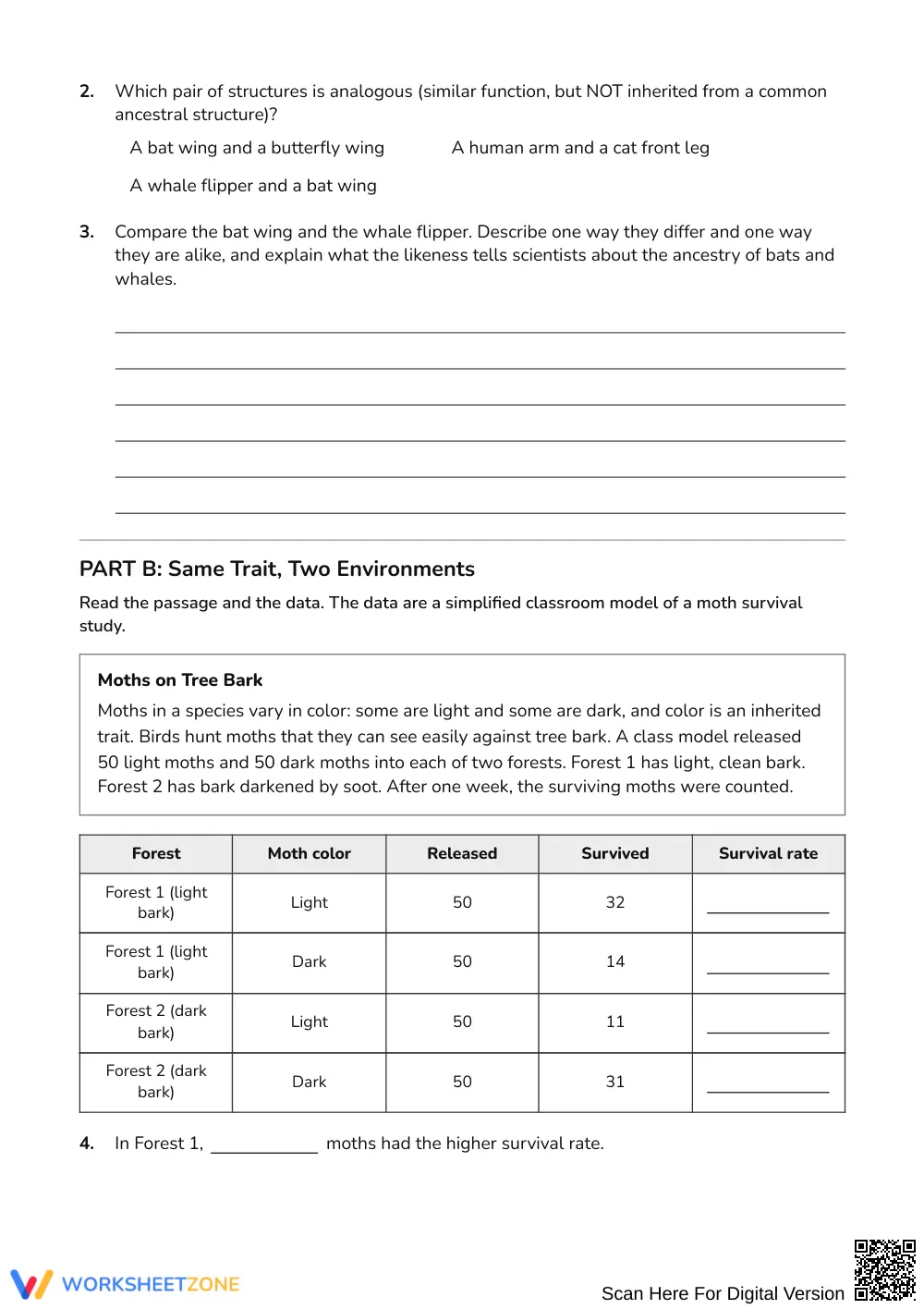
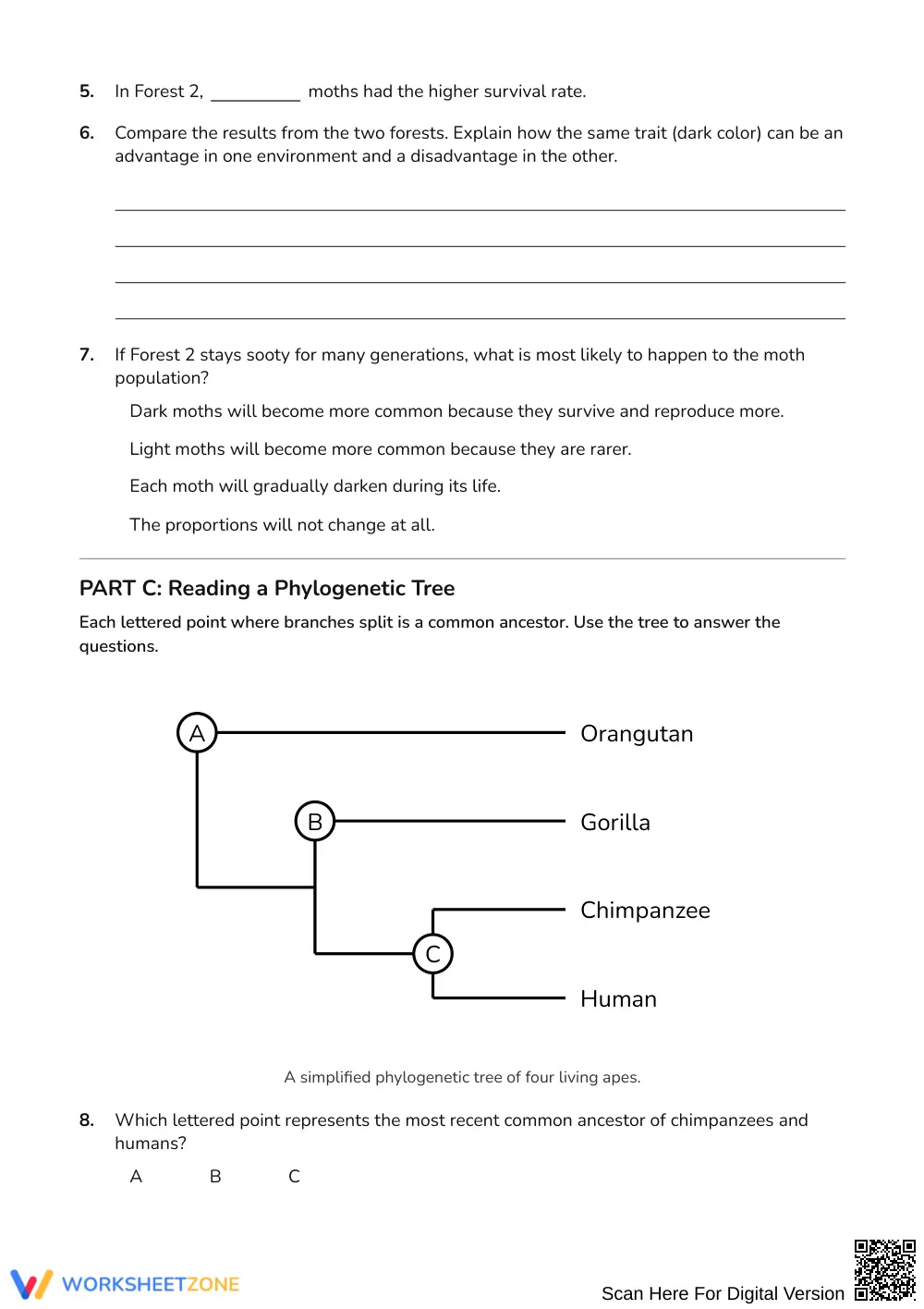
This 4-page activity contains 37 targeted problems organized across four sections. Students label anatomical forelimbs, calculate survival rates from a moth data table, trace primate ancestry on a cladogram, and complete a comparative selection organizer. A complete 4-page answer key provides teacher solutions.
Skill Progression
- Guided practice (Part A, 10 tasks): Structural limb labeling and a comparison table establishing homologous versus analogous structures.
- Supported practice (Part B, 9 tasks): Environmental data table interpretation linking differential moth survival directly to selective pressures.
- Independent practice (Parts C & D, 18 tasks): Cladogram analysis and an open comparison table contrasting natural and artificial selection.
This structure follows gradual release, moving students from guided observation to independent scientific reasoning.
Standards Alignment
This worksheet aligns with middle and high school Life Science standards for Biological Evolution. Students communicate scientific information about how common ancestry is supported by anatomical homologies and data. Supporting standards address constructing explanations for how natural selection leads to adaptation. Both standard codes can be copied directly into lesson plans, IEP goals, or district curriculum mapping tools.
How to Use It
Implement this worksheet after direct instruction on evidence for evolution. Use Parts A and B as partner practice to reinforce comparative anatomy and environmental selection. Assign Parts C and D as independent exit assessments. Formatively check Part C to verify students read common ancestors rather than assuming linear descent. Completion takes 45 to 60 minutes.
Who It's For
This resource serves general biology, life science, and introductory AP biology courses in grades 8 through 12. Visual limb diagrams and structured comparison tables support developing readers, while tree analysis offers rigorous critical thinking. Pair this resource with an introductory lecture on adaptation mechanisms.
According to Fisher & Frey (2014), structured visual organizers and progressive scaffolding significantly enhance secondary students' capacity to articulate scientific reasoning. This evolutionary biology worksheet provides 37 targeted tasks that guide learners to compare and contrast evolutionary mechanisms, homologous anatomical structures, and selection models using structured data tables and phylogenetic diagrams. By progressing methodically from guided bone identification to independent cladogram interpretation, students build the analytical stamina required to construct evidence-based scientific claims. The curriculum design directly reinforces national standards for biological evolution and natural selection by requiring students to distinguish homology from analogy and evaluate selective advantages in changing environments. Empirical research demonstrates that providing clear visual organizers alongside rigorous analytical prompts accelerates academic language acquisition and deepens conceptual understanding for diverse learners across grades 8 through 12, making this instructional resource an effective tool for achieving measurable biology mastery.


