































Ready Energy Flow Variables Worksheet | Grade 6-12 Science

Paste this activity's link or code into your existing LMS (Google Classroom, Canvas, Teams, Schoology, Moodle, etc.).
Students can open and work on the activity right away, with no student login required.
You'll still be able to track student progress and results from your teacher account.
Mastering ecological energy transfer requires students to connect experimental inquiry directly with biological models. This four-page science worksheet guides learners through 15 structured tasks that examine independent and dependent variables, analyze experimental evidence from a simulated pond ecosystem, and track directional energy loss through trophic levels.
At a Glance
- Grade: 6–12 · Subject: Science
- Standard:
Inquiry & Ecosystems— Analyze experimental variables and trace directional energy transfer through food webs- Skill Focus: Investigation and variables in energy flow
- Format: 4 pages · 15 problems · Answer key included · PDF
- Best For: Guided practice after ecosystem energy instruction
- Time: 45–60 minutes
What's Inside
The resource is divided into three focused sections: experimental design analysis, quantitative evidence interpretation, and trophic modeling. Students identify control conditions, testable questions, and fair test parameters within a 10-day pond-jar investigation. The activity includes quantitative data interpretation, calculation practice using the 10% ecological rule of thumb, and food chain arrow diagramming. A complete four-page answer key provides teacher solutions and instructional explanations.
Skill Progression
- Guided Practice (Part A, Tasks 1–5): Students examine a controlled pond-jar scenario to pinpoint manipulated variables, responding variables, constant conditions, and formal hypothesis construction.
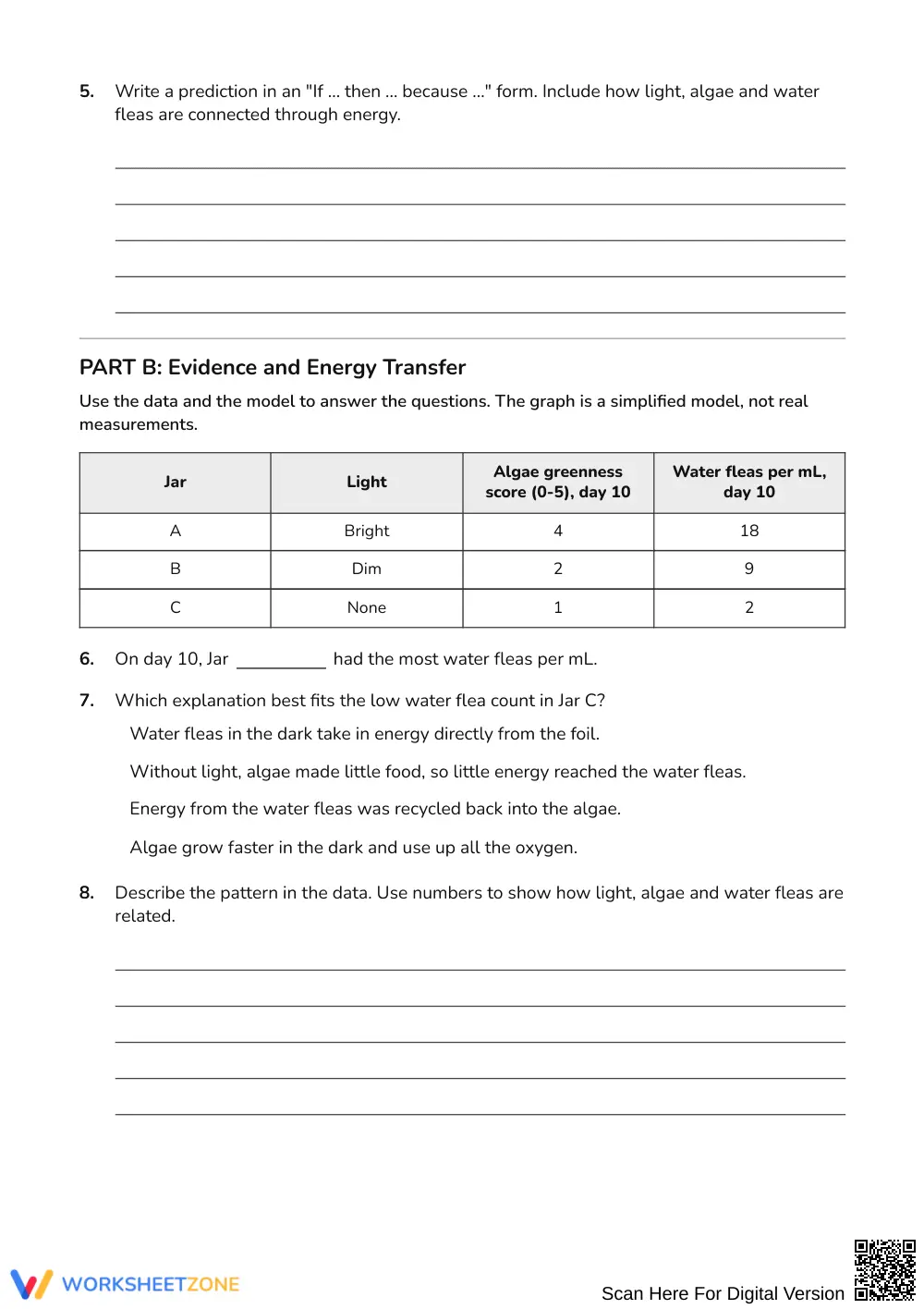
- Supported Practice (Part B, Tasks 6–10): Learners interpret a structured 10-day data table, correlate light availability with consumer counts, and apply the 10% rule to calculate stored energy across trophic levels.
- Independent Practice (Part C, Tasks 11–15): Students model food chain directionality, explain thermal dissipation, and evaluate why ecosystems rarely sustain more than four or five trophic levels.
This explicit structure reflects the gradual release of responsibility model, shifting students smoothly from scaffolded experimental planning to autonomous ecological analysis.
Standards Alignment
This activity aligns with middle and high school life science standards requiring students to develop models showing how matter and energy cycle through ecosystems. Students analyze empirical data to construct explanations regarding how light constraints limit biomass and consumer viability across successive trophic tiers. Both standard concepts can be copied directly into lesson plans, IEP goals, or district curriculum mapping tools.
How to Use It
Deploy this worksheet during the practice phase immediately after introducing food chains, trophic pyramids, and experimental design principles. For an effective formative check, examine student responses to Task 4 (control condition justification) and Task 10 (heat dissipation) to diagnose whether students understand why energy flows unidirectionally rather than recycling. The four-page sequence functions effectively as a 45-to-60-minute paired collaborative lab follow-up or an independent post-lecture assignment.
Who It's For
This worksheet serves general science, life science, and introductory biology students in grades 6 through 12. Built-in contextual prompts support emergent bilingual learners and developing readers by defining key ecological roles directly within the experimental prompt. Pair this activity with an anchor chart detailing food pyramid energy dissipation or a hands-on light-sensor demonstration.
According to Fisher & Frey (2014), scaffolding scientific inquiry through sequenced variable identification and quantitative analysis significantly deepens conceptual retention of abstract mechanisms. This four-page energy flow worksheet engages secondary science students in evaluating 15 evidence-based tasks that illustrate how photosynthetic energy diminishes across trophic levels. Learners examine an experimental three-jar system to isolate light exposure, monitor Daphnia population dynamics, calculate secondary consumer kilojoules via the 10% rule, and model thermal loss. By integrating rigorous variable analysis with ecological reasoning, this resource ensures students actively synthesize empirical observations rather than memorizing definitions. The accompanying four-page teacher answer key provides explicit model responses that streamline formative feedback, making the resource a reliable, high-utility asset for standards-aligned life science and biology classrooms.


