




























Ready Competition & Predation Worksheet | Grade 9 Biology
Paste this activity's link or code into your existing LMS (Google Classroom, Canvas, Teams, Schoology, Moodle, etc.).
Students can open and work on the activity right away, with no student login required.
You'll still be able to track student progress and results from your teacher account.
Mastering community ecology requires students to evaluate how species interactions shape population densities. This high school biology worksheet provides structured data analysis to help ninth-grade learners explain competition and predation patterns. Students interpret synthetic population tables, contrast competitive mechanisms, and predict the downstream ecological impacts of community disturbances across trophic levels.
At a Glance
- Grade: 9 · Subject: Biology
- Standard: High School Life Science — Explain how competition and predation regulate population sizes in ecosystems
- Skill Focus: Competition and Predation Dynamics
- Format: 5 pages · 12 problems · Answer key included · PDF
- Best For: High school ecology data analysis
- Time: 40–50 minutes
What's Inside
This 5-page printable resource includes 12 multi-part analytical questions divided into three progressive sections. Students examine an introductory reference box with core ecological principles, evaluate a multi-year population data table featuring primary and secondary consumers, and apply ecological models. A comprehensive 3-page answer key provides complete biological explanations.
Skill Progression
- Guided Practice (Part A): Students define foundational concepts, distinguishing between intraspecific and interspecific competition, identifying mechanisms that establish carrying capacity, and explaining cyclical predator-prey lag times across 3 targeted conceptual prompts.
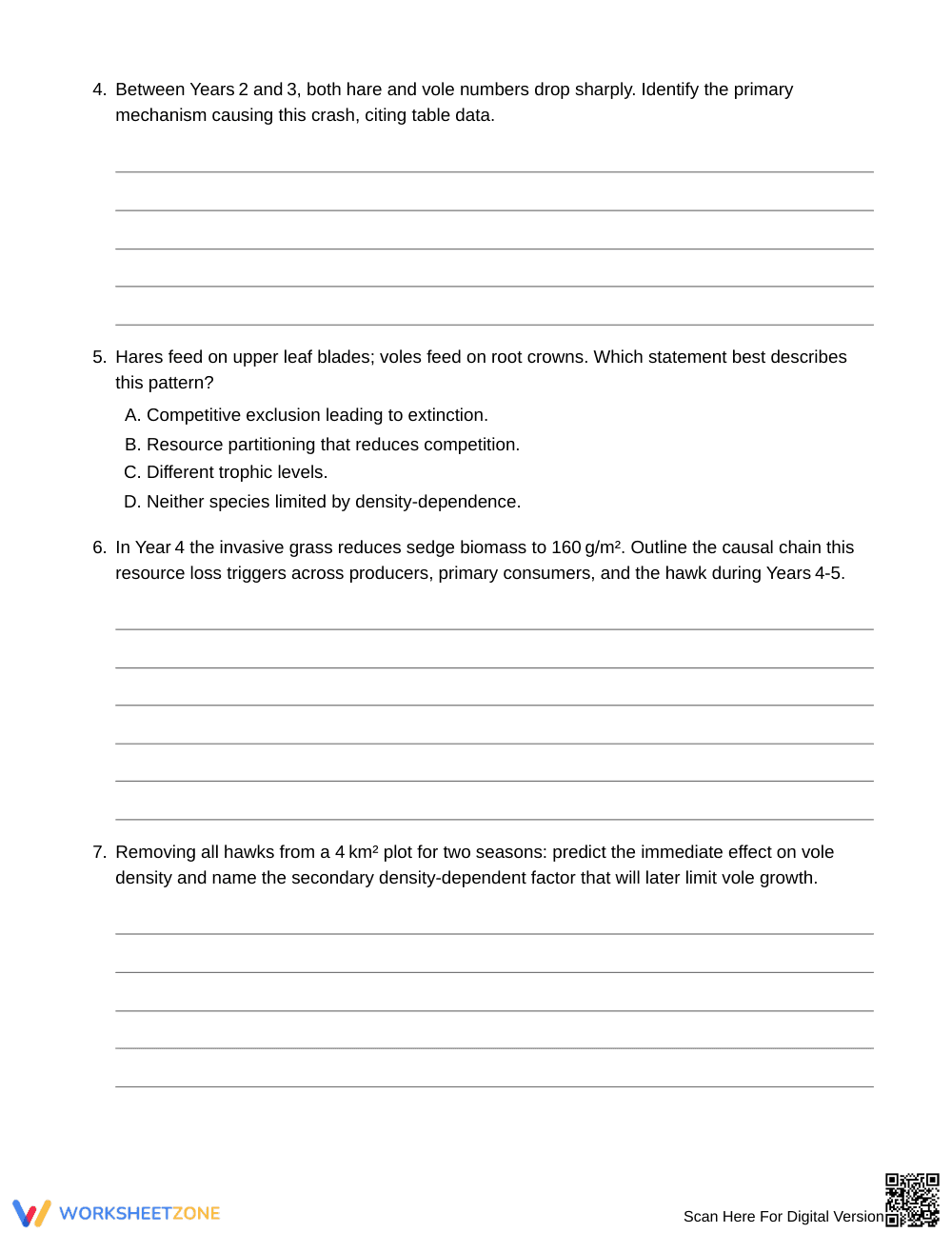
- Supported Practice (Part B): Students interpret a 6-year multi-species population survey table across 6 data-driven tasks, analyzing resource partitioning, competitive exclusion, prey-switching behavior, and trophic cascades.
- Independent Practice (Part C): Students apply learned principles to 3 complex novel disturbance scenarios, predicting population shifts caused by severe drought, targeted rodenticides, and microhabitat structural refugia.
This sequence implements a structured gradual-release framework, moving students from foundational terminology to independent ecological systems modeling.
Standards Alignment
This activity aligns with standard high school life science benchmarks requiring students to use mathematical and conceptual representations to support explanations of factors affecting population dynamics and biodiversity. Both core ecological concepts and quantitative modeling skills can be copied directly into lesson plans, IEP goals, or district curriculum mapping tools.
How to Use It
Deploy this worksheet after direct instruction on community ecology and density-dependent limiting factors. For mid-unit formative assessment, have student pairs complete the Table 1 analysis in Part B to observe whether learners connect declining sedge biomass to delayed hawk declines. Alternatively, assign Part C as an independent post-lab evaluation. Plan for 40 to 50 minutes of instructional time.
Who It's For
This resource is designed for Grade 9 Biology students in general and honors life science courses. Built-in data tables and structural framing support varied learning tiers. Pair this assignment directly with an introductory food web lesson or an interactive predator-prey graphing simulation.
Explaining how competition and predation regulate ecosystem dynamics is a core competency in secondary life science education. According to research on structured science pedagogy by Fisher & Frey (2014), explicit gradual-release instructional frameworks significantly enhance students' capacity to transfer conceptual scientific knowledge to novel analytical data sets. By progressing from foundational principle recall to multi-variable data table interpretation and multi-step disturbance modeling, this 12-task biology activity builds durable analytical reasoning skills. High school biology students systematically deconstruct complex ecological trophic relationships, connecting carrying capacity limits and resource partitioning directly to long-term community population stability. The synthetic population survey reinforces essential quantitative scientific literacy while ensuring learners comprehend how density-dependent limiting mechanisms operate across ecosystems. High school educators can efficiently evaluate student mastery using the included three-page explanatory answer key and scoring guide provided.


