


























Views
Downloads

Amphibians Reading Worksheet | Grade 3 Essential
Paste this activity's link or code into your existing LMS (Google Classroom, Canvas, Teams, Schoology, Moodle, etc.).
Students can open and work on the activity right away, with no student login required.
You'll still be able to track student progress and results from your teacher account.
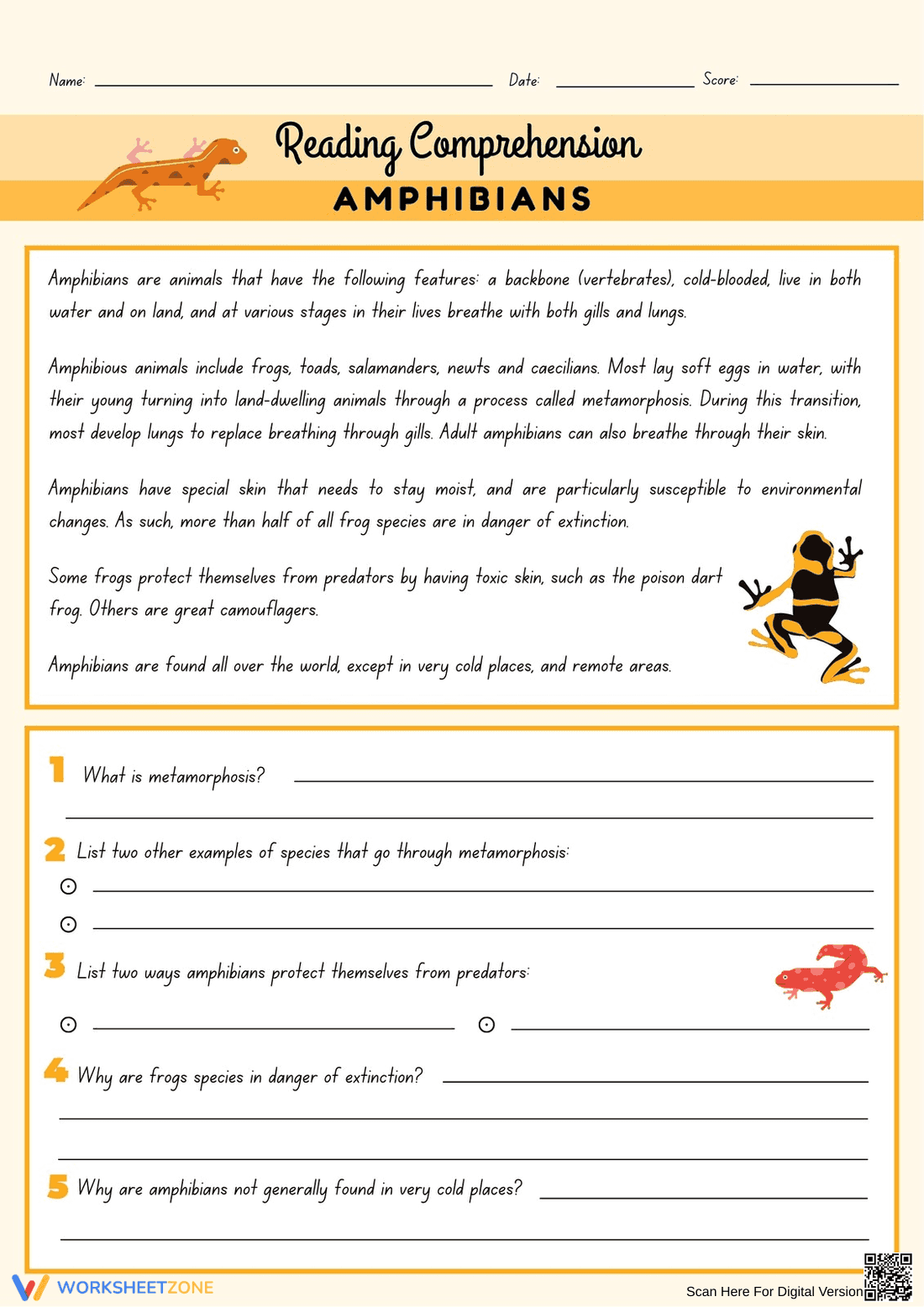
This Grade 3 amphibians reading comprehension worksheet provides students with a focused informational text and five targeted questions to improve literal and inferential understanding. By engaging with scientific content, learners practice extracting specific evidence to define biological processes like metamorphosis and identify environmental threats. It is an effective tool for building content-area literacy.
At a Glance
- Grade: 3 · Subject: ELA / Science
- Standard:
CCSS.ELA-LITERACY.RI.3.1— Ask and answer questions to demonstrate understanding by referring explicitly to the text.- Skill Focus: Informational Text Comprehension
- Format: 1 page · 5 problems · Answer key included · PDF
- Best For: Independent practice or science literacy integration
- Time: 15–20 minutes
The worksheet features a concise five-paragraph passage covering amphibian characteristics, life cycles, and habitats. Following the text, students encounter five open-ended response questions. These tasks require students to list examples, define key terms, and explain cause-and-effect relationships found within the reading. The layout is clean and includes helpful illustrations to maintain student engagement.
Zero-Prep Workflow
- Print: Generate the single-page PDF in approximately 30 seconds.
- Distribute: Hand out copies for independent or small-group work in under 1 minute.
- Review: Use the included answer key to provide immediate feedback in 30 seconds.
Total teacher preparation time is under two minutes, making this an ideal resource for morning work, literacy centers, or emergency sub plans.
Standards Alignment
This resource aligns with `CCSS.ELA-LITERACY.RI.3.1`, focusing on the student's ability to locate specific information within a text to support their answers. It also supports `3-LS1-1` by introducing life cycle concepts. Both standard codes can be copied directly into lesson plans, IEP goals, or district curriculum mapping tools.
How to Use It
Use this worksheet during the independent practice phase of a literacy block or as a cross-curricular science activity. It works well as a formative assessment to check if students can identify key details without teacher prompting. Teachers should observe if students are looking back at the text to find the definition of metamorphosis. Completion typically takes 15 to 20 minutes.
Who It's For
This is designed for third-grade students but serves as an excellent scaffolded resource for fourth-grade English Language Learners or students needing reading intervention. It pairs naturally with a classroom anchor chart on animal classifications or a direct instruction lesson on the differences between reptiles and amphibians.
According to the RAND AIRS 2024 report, integrating informational text across subjects like science significantly improves long-term retention of both literacy skills and core content knowledge. This worksheet utilizes the CCSS.ELA-LITERACY.RI.3.1 standard to ensure students are not just reading, but actively processing biological facts about amphibians. By requiring students to refer explicitly to the text for all five questions, the resource reinforces the habit of evidence-based writing. Research from Fisher & Frey (2014) suggests that short, focused informational passages are highly effective for gradual release models, allowing students to move from guided reading to independent mastery. This specific resource provides the necessary structure for students to practice identifying key details and vocabulary in context, which are essential components of the NAEP reading framework. It offers a reliable, research-backed method for improving student outcomes in elementary literacy and science.


