


























Views
Plays

Printable Reader's Theater Quiz | Grade 2 ELA
Paste this activity's link or code into your existing LMS (Google Classroom, Canvas, Teams, Schoology, Moodle, etc.).
Students can open and work on the activity right away, with no student login required.
You'll still be able to track student progress and results from your teacher account.
This Grade 2 Reader's Theater quiz helps students master essential drama vocabulary and understand the structural elements of a play. By evaluating terms like dialogue, stage directions, and cast, learners build the foundational knowledge needed to read, comprehend, and perform theatrical scripts with confidence.
At a Glance
- Grade: 2 · Subject: English Language Arts
- Standard:
CCSS.ELA-LITERACY.RL.2.5— Understand the overall structure of literature and stories.- Skill Focus: Drama vocabulary and play structure
- Format: 3 pages · 22 problems · PDF
- Best For: Formative assessment and review
- Time: 15–20 minutes
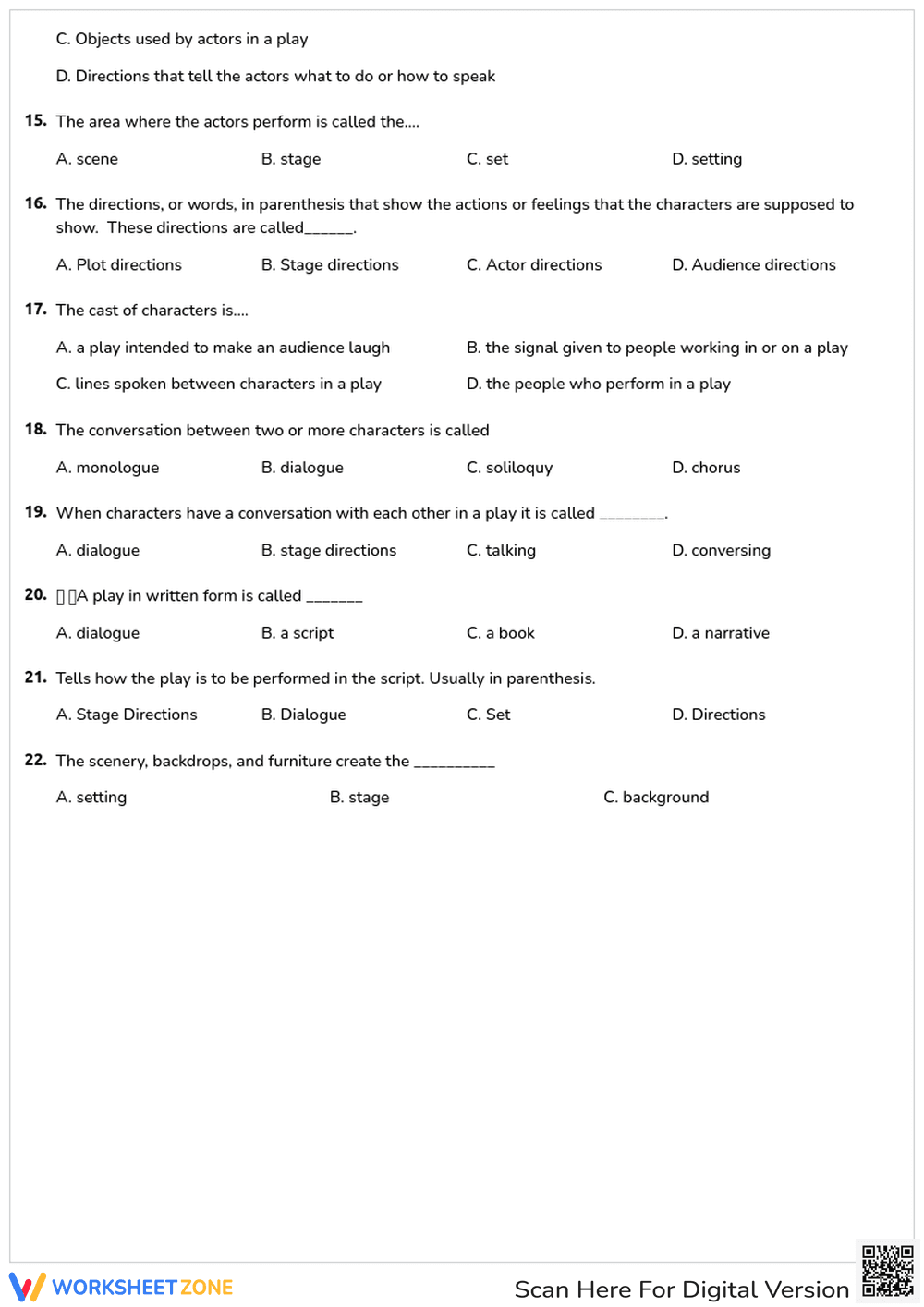
This comprehensive assessment features 22 multiple-choice questions spread across three pages. The questions cover a wide range of theatrical concepts, from identifying the purpose of props and stage directions to defining literary terms like fiction, nonfiction, and dialogue. Visual cues are included in early questions to support comprehension, making it an accessible tool for young readers exploring the performing arts.
- Print (1 minute): Simply download the PDF and print a copy for each student. The clean, multiple-choice format requires no special formatting or cutting.
- Distribute (1 minute): Hand out the three-page quiz after a unit on Reader's Theater or drama.
- Review (15 minutes): Students can complete the 22 questions independently. The straightforward layout makes grading quick and efficient for teachers. Total teacher prep time is under two minutes, making this an excellent option for emergency sub plans or quick end-of-week assessments.
Aligned to CCSS.ELA-LITERACY.RL.2.5, this resource supports students as they describe the overall structure of a story, including how different text types are organized. It also touches upon foundational vocabulary acquisition. Both standard codes can be copied directly into lesson plans, IEP goals, or district curriculum mapping tools.
Use this quiz as a summative assessment at the end of a Reader's Theater unit to gauge student understanding of play mechanics. Alternatively, it serves as an excellent pre-assessment before introducing a new drama project, allowing teachers to identify which vocabulary terms need direct instruction. While students work, observe whether they struggle with specific concepts like "stage directions" versus "dialogue" to inform future mini-lessons. Expected completion time is 15 to 20 minutes.
This resource is designed for Grade 2 students, though it can easily be used as a review for older elementary students exploring drama. It is particularly helpful for visual learners, as the clear multiple-choice structure reduces writing fatigue. Pair this quiz with a short, high-interest Reader's Theater script so students can immediately apply their newly assessed vocabulary in a real reading context.
Integrating drama and performance into reading instruction significantly boosts student engagement and fluency. According to Fisher & Frey (2014), incorporating structured collaborative activities like Reader's Theater helps students internalize complex text structures and vocabulary. By aligning with CCSS.ELA-LITERACY.RL.2.5 to understand the overall structure of literature and stories, this worksheet ensures learners can accurately identify and utilize theatrical terms. Explicitly assessing these elements through targeted questions allows educators to measure comprehension effectively, bridging the gap between passive reading and active, expressive performance.


