


























Views
Downloads

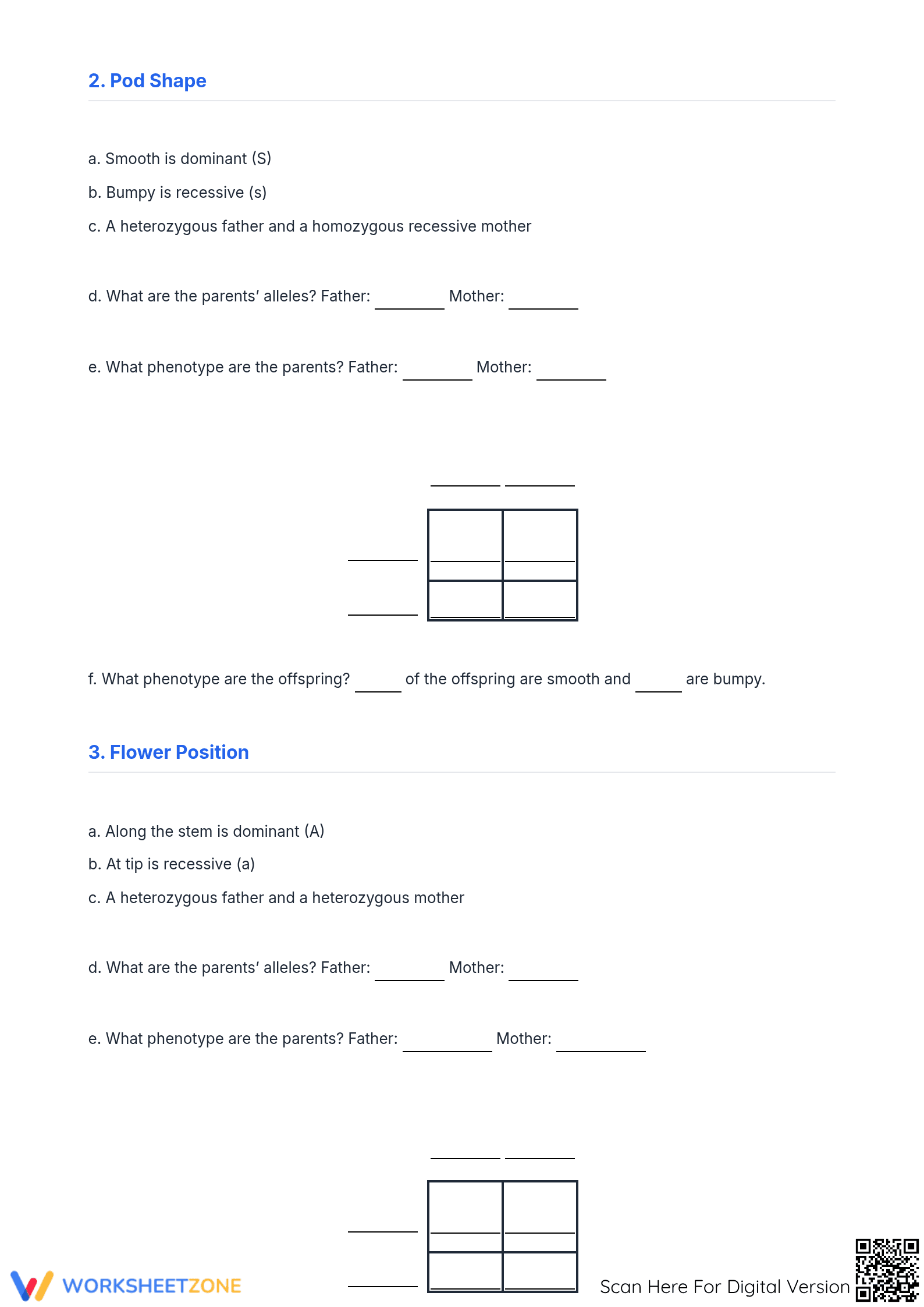


Punnett Square Practice Worksheet | Grade 8-9 Essential
Paste this activity's link or code into your existing LMS (Google Classroom, Canvas, Teams, Schoology, Moodle, etc.).
Students can open and work on the activity right away, with no student login required.
You'll still be able to track student progress and results from your teacher account.
This Grade 8-9 Punnett square worksheet provides students with targeted practice in predicting genetic outcomes. By analyzing dominant and recessive traits in pea plants, learners develop a concrete understanding of how alleles combine to determine physical characteristics. It is an effective tool for reinforcing the relationship between genotype and phenotype in introductory biology.
At a Glance
- Grade: 8-9 · Subject: Biology
- Standard:
MS-LS3-2— Develop a model to describe how genetic variation results from gene combinations- Skill Focus: Punnett Square Construction
- Format: 1 page · 12 tasks · Answer key included · PDF
- Best For: Reinforcing Mendelian inheritance patterns
- Time: 15–25 minutes
This single-page PDF features three distinct scenarios focusing on Mendelian traits: pod color, pod shape, and flower position. Each section includes a blank four-quadrant Punnett square and three multi-part questions. Students must identify parental alleles, determine parental phenotypes, and calculate the resulting offspring phenotype ratios. The layout is clean, providing ample space for student calculations and written responses.
Skill Progression
- Guided Practice: Students begin by identifying specific dominant and recessive alleles provided in the text for each trait.
- Supported Practice: Learners map these identified alleles into the Punnett square grid to visualize potential combinations.
- Independent Practice: Students interpret the completed grid to predict offspring phenotypes and calculate ratios without additional scaffolding.
This worksheet follows a gradual-release model to ensure students master the mechanics of genetic modeling across 12 total tasks.
Standards Alignment
The primary standard addressed is MS-LS3-2, which requires students to develop and use a model to describe why sexual reproduction results in offspring with genetic variation. This worksheet specifically targets the sexual reproduction component through Mendelian modeling. Both standard codes can be copied directly into lesson plans, IEP goals, or district curriculum mapping tools.
How to Use It
Use this worksheet during the elaborate phase of a lesson cycle after students have been introduced to homozygous and heterozygous traits. It serves as an excellent formative assessment tool; teachers should observe if students correctly place the maternal and paternal alleles on the axes. Expect completion within 20 minutes, making it ideal for a mid-lesson check or focused homework.
Who It's For
This resource is designed for middle school life science students and high school biology learners who need to solidify their understanding of probability in genetics. It is particularly helpful for students who benefit from repetitive, structured modeling. Pair this worksheet with a physical trait lab or an interactive digital simulation for a multi-modal experience.
According to the RAND AIRS 2024 report on secondary science instruction, the use of visual modeling tools like Punnett squares is critical for bridging the gap between abstract genetic concepts and observable biological traits. This worksheet aligns with these findings by requiring students to translate textual descriptions of homozygous recessive or heterozygous into symbolic allele representations. By completing the 12 tasks, students engage in the mathematical reasoning necessary to meet MS-LS3-2 requirements. Research from Fisher & Frey (2014) emphasizes that structured practice with immediate feedback significantly improves long-term retention of scientific nomenclature. This resource provides the necessary repetition for students to internalize the mechanics of Mendelian inheritance, ensuring they can accurately predict phenotypic ratios in more complex genetic scenarios. It is a reliable, evidence-based supplement for any standard-aligned biology curriculum.


