


























Views
Downloads

Pumpkin Life Cycle Worksheet | Grade 2 Essential
Paste this activity's link or code into your existing LMS (Google Classroom, Canvas, Teams, Schoology, Moodle, etc.).
Students can open and work on the activity right away, with no student login required.
You'll still be able to track student progress and results from your teacher account.
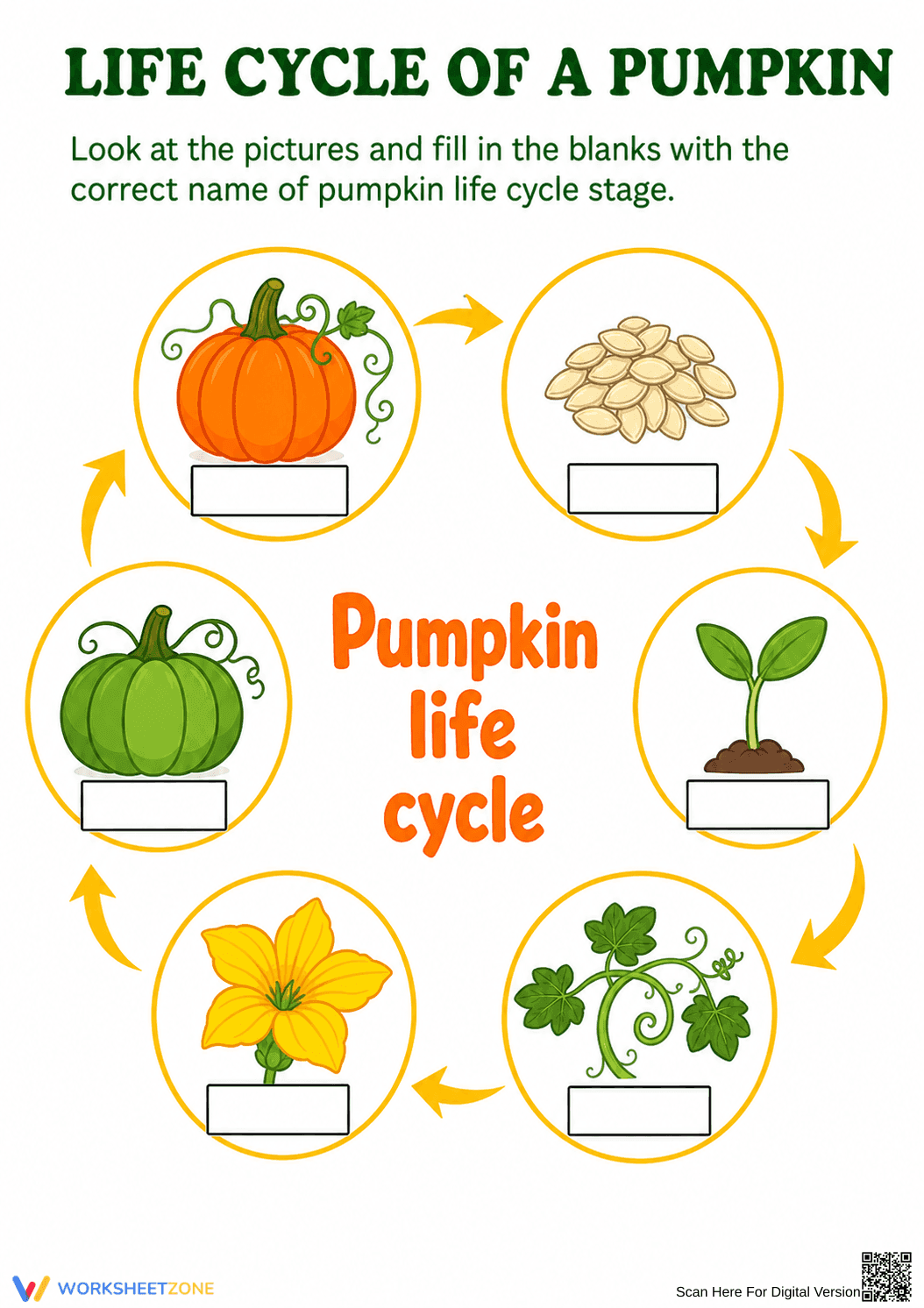
This Grade 2 pumpkin life cycle worksheet provides a clear, visual framework for students to identify and label the six primary stages of plant development. By connecting botanical vocabulary to high-quality illustrations, learners master the chronological sequence from germination to fruit production, reinforcing foundational biological concepts through active labeling and observation.
At a Glance
- Grade: 2 · Subject: Science
- Standard:
2-LS2-1— Develop models to describe how organisms have unique and diverse life cycles- Skill Focus: Sequencing & Labeling
- Format: 1 page · 6 problems · Answer key included · PDF
- Best For: Seasonal science centers or sub plans
- Time: 15–20 minutes
This single-page PDF features a circular flow diagram representing the pumpkin's growth journey. It includes six distinct illustrations: seeds, sprout, vine, flower, green pumpkin, and mature orange pumpkin. Each stage is accompanied by a dedicated text box for student input, supported by clear directional arrows that emphasize the cyclical nature of plant life. A full answer key is provided for rapid grading.
The zero-prep workflow is designed for maximum efficiency in busy classrooms. First, print the single-page PDF (under 1 minute). Second, distribute the worksheet as a warm-up or independent practice during your plant unit. Finally, review the answers as a whole group using the included key to provide immediate feedback. This resource is an ideal "grab-and-go" option for unexpected sub days or seasonal transitions.
This resource aligns with `2-LS2-1`, focusing on the observable growth patterns of plants. While Grade 2 standards emphasize the needs of plants, this activity serves as a critical bridge to `3-LS1-1`, which requires students to develop models of unique life cycles. Both standard codes can be copied directly into lesson plans, IEP goals, or district curriculum mapping tools.
Use this worksheet as a formative assessment after a read-aloud about autumn harvests. Observe if students can correctly sequence the "flower" and "green pumpkin" stages, as these are often confused. It also functions well as a science center activity where students can reference real pumpkin seeds and vines while completing their labels. Expected completion typically takes 15 to 20 minutes.
This activity is tailored for Grade 2 students but is highly effective for English Language Learners (ELLs) due to the heavy reliance on visual scaffolding. It pairs naturally with a classroom pumpkin carving demonstration or a botanical anchor chart. The clear illustrations ensure that students with varying reading levels can successfully participate in the science curriculum.
According to research by Fisher & Frey (2014) on the gradual release of responsibility, visual labeling tasks serve as essential scaffolds that transition students from teacher-led modeling to independent mastery. This worksheet utilizes the 2-LS2-1 standard to ground abstract biological processes in concrete, observable steps. By requiring students to produce the specific vocabulary for each stage—such as "sprout" and "vine"—the activity reinforces domain-specific language acquisition. Data from the NAEP suggests that students who engage with multi-modal representations of scientific cycles demonstrate higher retention of sequencing logic. This resource provides the structured practice necessary for young learners to internalize the concept of biological continuity, ensuring they are prepared for more complex life science standards in subsequent grades.


