


























Views
Downloads



Proven Evolutionary Mechanisms Worksheet | Grade 10 Biology
Paste this activity's link or code into your existing LMS (Google Classroom, Canvas, Teams, Schoology, Moodle, etc.).
Students can open and work on the activity right away, with no student login required.
You'll still be able to track student progress and results from your teacher account.
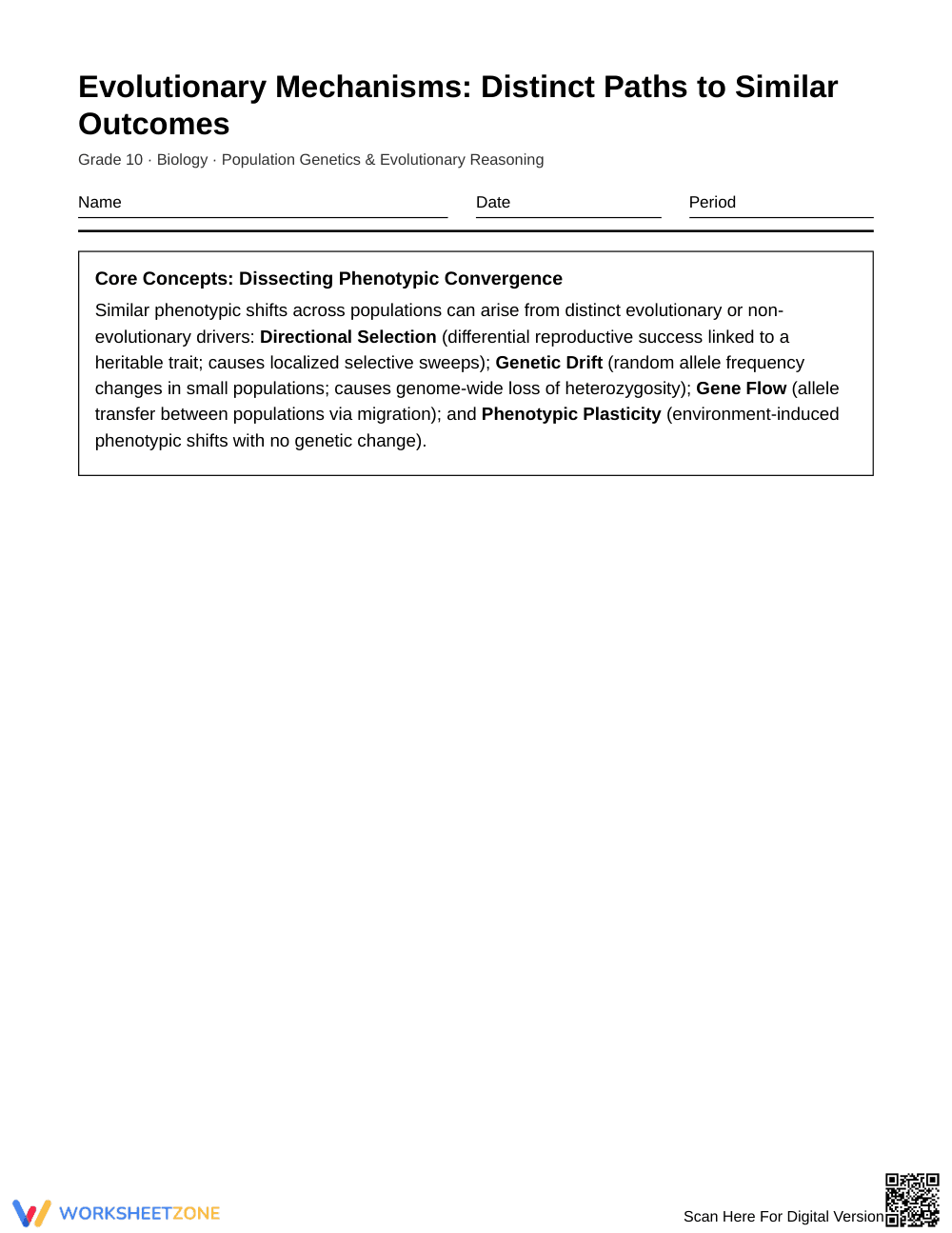
This Grade 10 biology worksheet guides students to evaluate how identical phenotypic outcomes arise from distinct evolutionary mechanisms. Learners analyze population data to differentiate directional selection, genetic drift, gene flow, and phenotypic plasticity across six complex scenarios, building rigorous analytical reasoning in evolutionary genetics.
At a Glance
- Grade: 10 · Subject: Biology
- Standard: High School Life Science — Explain how distinct evolutionary drivers produce convergent observable phenotypes
- Skill Focus: Differentiating selection, drift, plasticity, and gene flow
- Format: 5 pages · 6 problems · Answer key included · PDF
- Best For: Population genetics analysis and exam prep
- Time: 45–60 minutes
What's Inside: Across 5 pages, this resource presents six analytical tasks grounded in evolutionary case studies, supported by a 3-page teacher answer key. Students interpret synthetic population data tables, neutral heterozygosity values, common-garden breeding results, and genomic haplotype markers. A core concepts summary outlines four primary evolutionary drivers alongside targeted prompt constraints.
Skill Progression
- Guided Practice (Tasks 1–2): Students interpret data tables tracking floral reduction and stickleback armor loss, using heterozygosity values to contrast selection with drift.
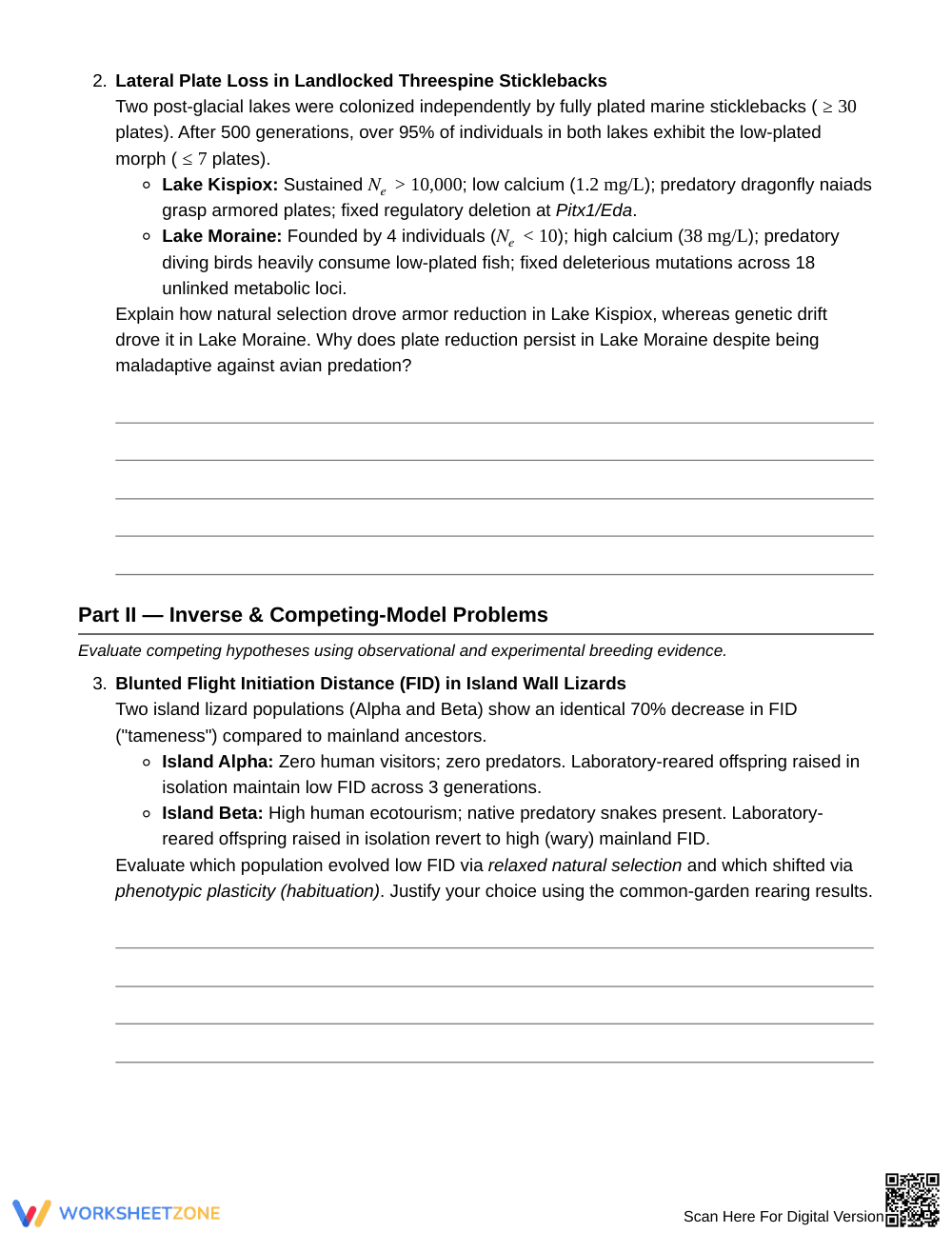
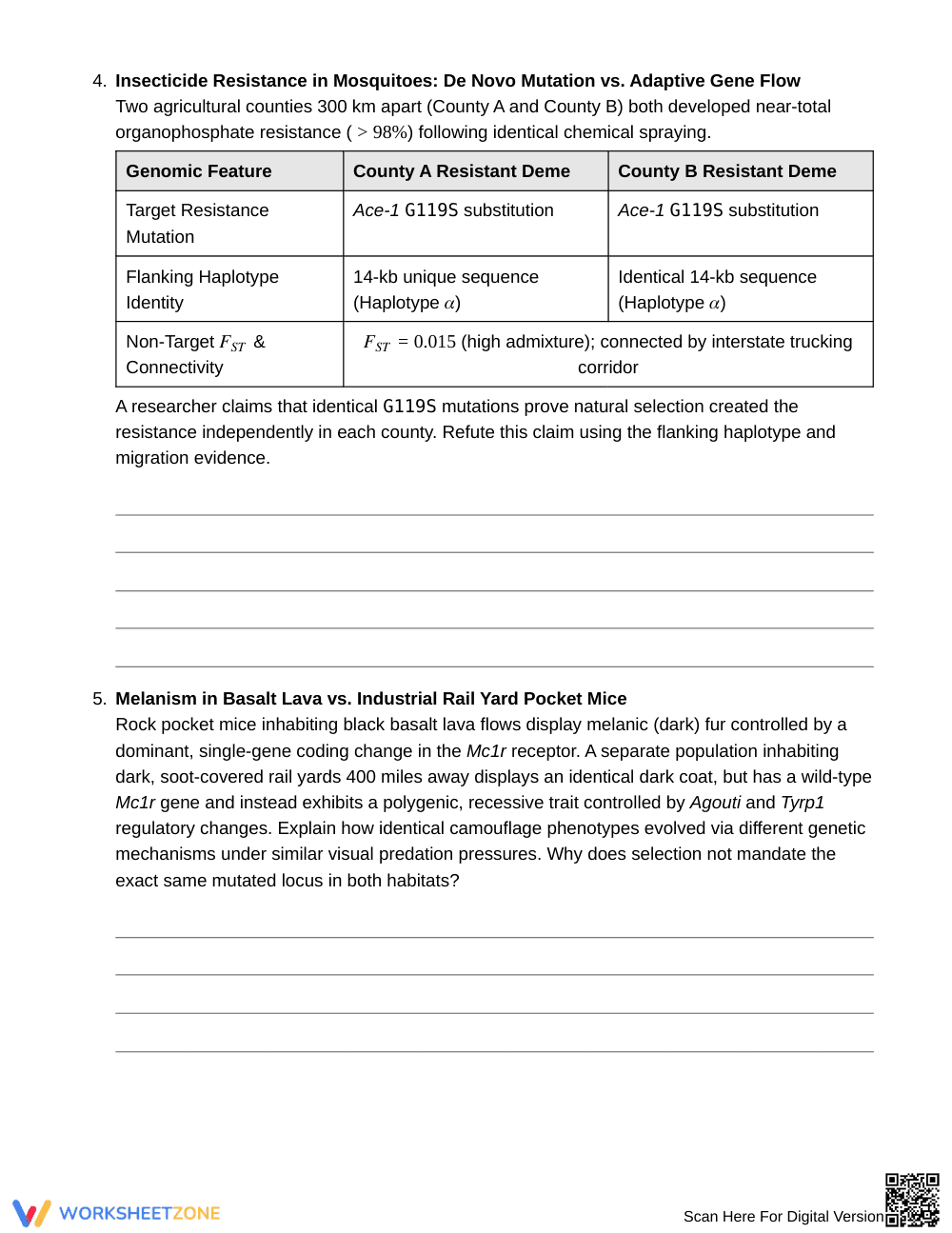
- Supported Practice (Tasks 3–5): Students evaluate competing models using common-garden lizard data, mosquito haplotype sharing, and pocket mouse melanism genetics.
- Independent Practice (Task 6): Students design an experimental diagnostic protocol for river minnow thermal tolerance shifts without scaffolds.
This sequence follows a gradual-release model, moving students from scaffolded data interpretation to autonomous scientific experimental design.
Standards Alignment
This worksheet aligns with high school life science standards addressing biological evolution and population genetics. Students construct explanations based on evidence that evolutionary change results from natural selection, genetic drift, gene flow, or environmental plasticity. A supporting standard addresses evaluating how demographic bottlenecks alter allele frequencies. Both standard descriptions can be copied directly into lesson plans, IEP goals, or district curriculum mapping tools.
How to Use It
Deploy this worksheet after direct instruction on the four forces of evolution. In class, assign student pairs to analyze Tasks 1 through 5, rotating between scenarios to contrast selection against drift. For formative assessment, review Task 3 to verify whether learners can distinguish non-genetic plasticity from inherited adaptation. Expected completion time is 45 to 60 minutes.
Who It's For
This resource serves Grade 10 general biology and honors cohorts preparing for advanced coursework. Teachers can differentiate by providing sentence frames for Part I justifications, while challenging advanced students to calculate selection coefficients. Pair this printable worksheet with an introductory slide presentation or an interactive genetic drift simulation.
Evolutionary biology education requires students to distinguish observable phenotypes from underlying microevolutionary drivers. According to Fisher & Frey (2014), structured cognitive progression through guided data analysis significantly reinforces conceptual understanding in secondary science classrooms. By analyzing synthetic demographic and genomic metrics across 6 distinct tasks, students examine why identical phenotypic outcomes do not imply shared evolutionary origins. The worksheet contrasts directional selection, genetic drift, gene flow, and phenotypic plasticity through explicit evidentiary thresholds, such as neutral heterozygosity, effective population size, and common-garden rearing experiments. This rigorous framework prevents the common teleological misconception that trait utility guarantees natural selection. The included 3-page answer key provides complete biological explanations and diagnostic protocols, enabling teachers to assess student mastery of population genetics standards efficiently and systematically while fostering deep scientific argumentation and evidence-based reasoning in high school biology instruction.


