































Proven Evolution Variables Worksheet | Grades 8–12 Science

Paste this activity's link or code into your existing LMS (Google Classroom, Canvas, Teams, Schoology, Moodle, etc.).
Students can open and work on the activity right away, with no student login required.
You'll still be able to track student progress and results from your teacher account.
This comprehensive science worksheet guides secondary students through experimental design and evidence analysis in evolutionary biology. Students evaluate variables in a classic predation simulation, interpret numerical survival data using claim-evidence-reasoning structures, and examine anatomical homologies to trace common ancestry across vertebrate species.
At a Glance
- Grade: Grades 8–12 · Subject: Science
- Standard: Plan investigations, analyze experimental data, and evaluate evolutionary evidence
- Skill Focus: Evolution: Investigation & Variables
- Format: 4 pages · 22 problems · Answer key included · PDF
- Best For: Lab follow-up or unit assessment
- Time: 45–60 minutes
What's Inside
The four-page printable resource includes 22 structured tasks divided into three distinct segments. Students encounter an experimental scenario modeling peppered moth predation, a full data table with percentage calculations, and anatomical comparison diagrams of vertebrate forelimbs, supported by a complete four-page teacher answer key.
Skill Progression
- Guided practice (Part A, 7 tasks): Students deconstruct an experimental simulation by identifying independent, dependent, and controlled variables with explicit contextual cues.
- Supported practice (Part B, 8 tasks): Learners calculate cumulative totals, determine survival percentages, and formulate evidence-based arguments using a structured Claim-Evidence-Reasoning (CER) framework.
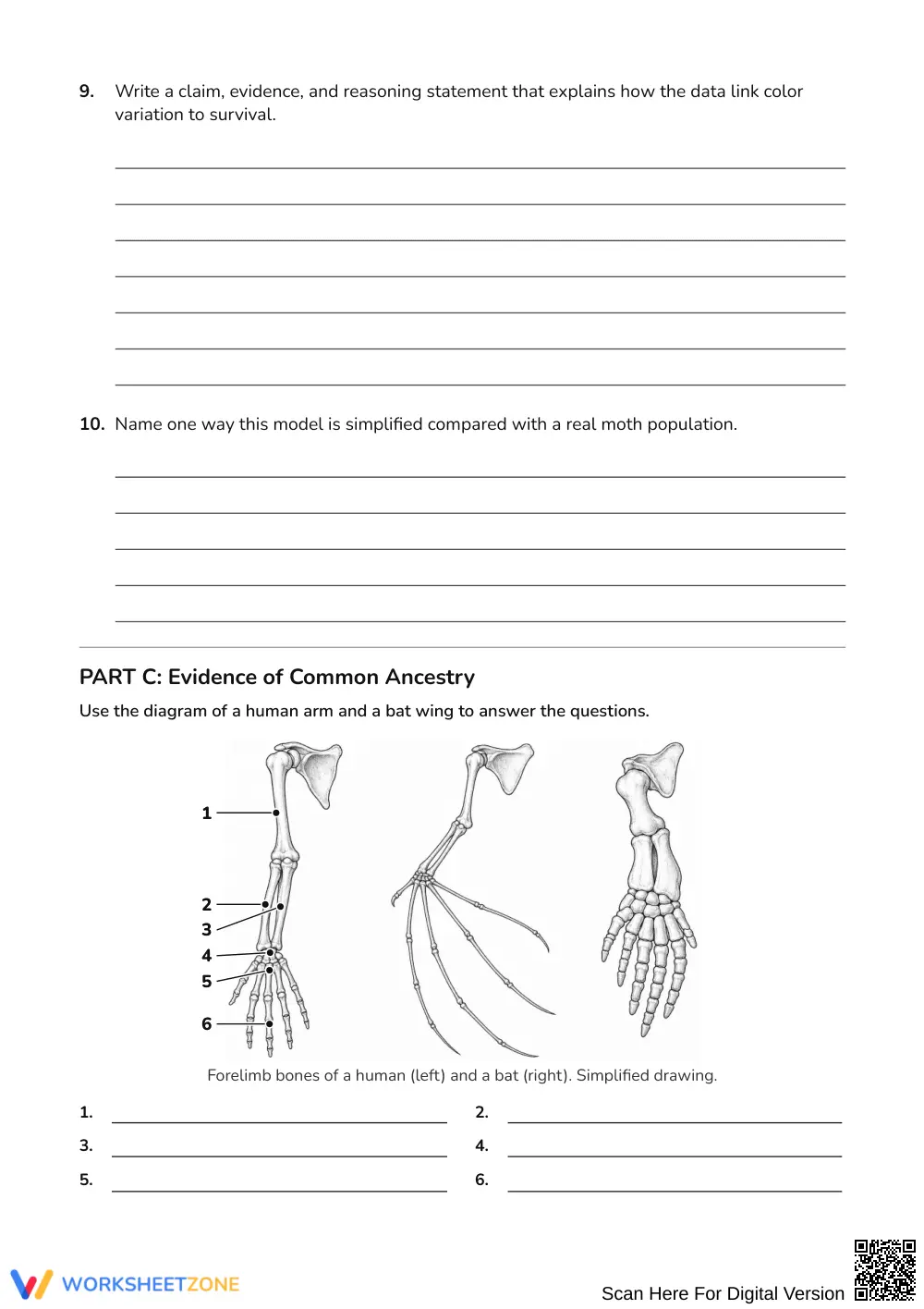
- Independent practice (Part C, 7 tasks): Students independently interpret comparative bone anatomy diagrams to connect structural homologies with evolutionary lineages.
This sequence embodies the gradual release of responsibility model, shifting students from guided experimental deconstruction to independent evolutionary analysis.
Standards Alignment
This activity aligns with middle and high school life science standards addressing natural selection, biological adaptation, and common ancestry. Students construct explanations based on evidence for how natural selection leads to adaptation of populations and analyze patterns in anatomical structures. Both standard concepts can be copied directly into lesson plans, IEP goals, or district curriculum mapping tools.
How to Use It
Administer this worksheet directly after introducing natural selection mechanisms or as an analytical follow-up to a physical predator-prey lab. During class, circulate while students complete Part B to monitor whether they support claims with specific numerical evidence rather than generic assertions. Most classes finish the entire 22-task sequence in 45 to 60 minutes.
Who It's For
Designed for life science and biology learners in grades 8 through 12, this resource provides targeted support through defined scenario parameters while offering rigorous quantitative analysis. Pair this practice packet directly with an introductory slide deck on morphological evidence or a hands-on camouflage simulation.
According to EdReports 2024 evaluation guidelines for secondary science materials, high-quality biology instruction must intentionally merge core disciplinary concepts with authentic empirical practices rather than presenting biological mechanisms in isolation. This four-page instructional resource operationalizes those rigorous curriculum design benchmarks across twenty-two distinct prompts by challenging secondary students to isolate experimental variables, process complex predator-prey data tables, and interpret structural homologies across vertebrate forelimbs. By requiring students to calculate survival rates and justify their conclusions using an explicit claim, evidence, and reasoning framework, the assignment reinforces rigorous analytical habits essential for lifelong scientific literacy. Grounding natural selection principles in measurable simulation metrics ensures that adolescent learners build durable conceptual comprehension while actively mastering quantitative data interpretation techniques. Incorporating these focused analytical tasks directly into your evolution unit prepares students for advanced laboratory investigations and rigorous district-wide performance assessments throughout the academic school year.


