


























Views
Downloads




Proven Ethical Persuasion Worksheet | Grade 10 English II
Paste this activity's link or code into your existing LMS (Google Classroom, Canvas, Teams, Schoology, Moodle, etc.).
Students can open and work on the activity right away, with no student login required.
You'll still be able to track student progress and results from your teacher account.
This Grade 10 English II worksheet trains students to delineate and evaluate ethical persuasion versus manipulative rhetoric in public discourse. Working through paired civic testimonies, high school learners analyze argument validity, detect informal fallacies, evaluate empirical evidence, and articulate the broader civic consequences of deceptive appeals to master critical rhetorical analysis.
At a Glance
- Grade: 10 · Subject: English II
- Standard:
RI.9-10.8— Evaluate argument reasoning, evidentiary sufficiency, and rhetorical appeals- Skill Focus: Compare Ethical and Manipulative Appeals
- Format: 6 pages · 10 problems · Answer key included · PDF
- Best For: Argument evaluation and rhetorical analysis units
- Time: 45–60 minutes
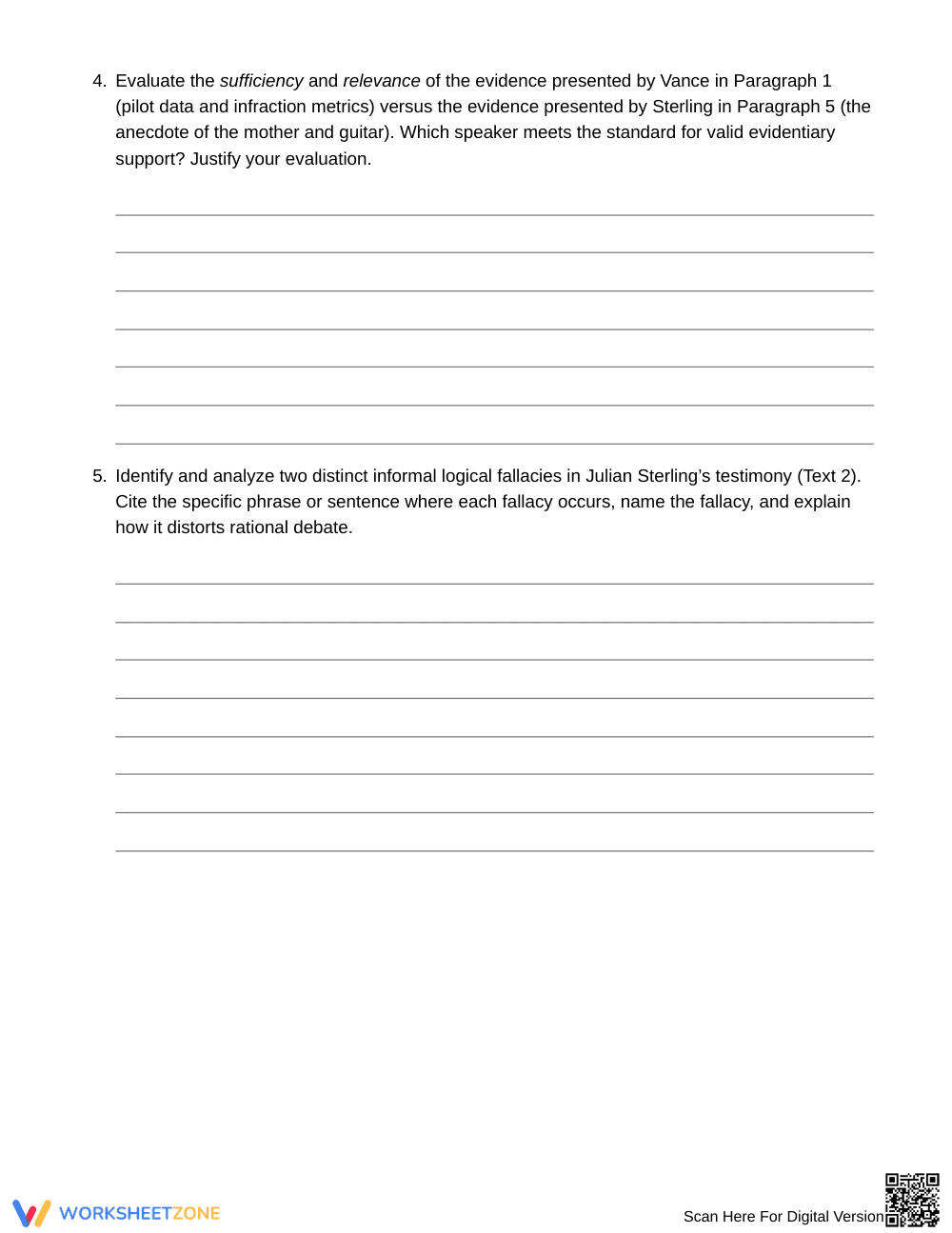
This 6-page printable resource features two complete mock public hearing testimonies regarding municipal youth arts funding, followed by 10 text-dependent analytical tasks. A foundational core concepts reference box defines ethical versus manipulative persuasion, while a detailed 4-page answer key provides complete model analytical responses, fallacy identifications, and sample textual evidence for teacher grading.
Skill Progression
- Guided practice (Tasks 1–2): Students define valid emotional appeals and contrast claim qualification against false dichotomies using the concept guide.
- Supported practice (Tasks 3–8): In paired-text analysis, students evaluate evidence, identify two logical fallacies, and contrast manipulative tone with reasoned debate.
- Independent practice (Tasks 9–10): Learners synthesize findings to explain how manipulative appeals degrade public trust and civic institutions.
This sequence mirrors the gradual release of responsibility model, shifting from conceptual analysis to critical evaluation.
Standards Alignment
The primary focus aligns to `RI.9-10.8`: Delineate and evaluate argument claims, assessing whether reasoning is valid and evidence is relevant and sufficient while identifying fallacies. Supporting instruction addresses `SL.9-10.3` by evaluating speaker rhetoric and distortion. Both standard codes can be copied directly into lesson plans, IEP goals, or district curriculum mapping tools.
How to Use It
Use this worksheet after direct instruction on informal fallacies and rhetorical appeals. During a 50-minute class, have students read the testimonies and complete Part B in pairs. Circulate formatively to check whether students distinguish Sterling's false dichotomy from legitimate civic urgency. Use Part C as an independent synthesis exit ticket.
Who It's For
Designed for Grade 10 English II students, this activity builds close-reading stamina for argument evaluation. For emerging writers, provide an anchor chart of common logical fallacies. The worksheet pairs naturally with argumentative writing units, civic debate exercises, and primary source speech analysis.
According to Fisher & Frey (2014), student mastery of complex informational texts requires deliberate instruction moving from foundational knowledge through collaborative inquiry to independent evaluation. This Grade 10 English II curriculum resource operationalizes that architecture under standard RI.9-10.8, targeting students' ability to compare ethical persuasion against manipulative rhetorical appeals. By presenting two authentic, opposing public hearing testimonies, the resource requires learners to interrogate argument validity, identify deceptive rhetorical tactics such as false dichotomies and ad hominem attacks, and assess the evidentiary sufficiency of empirical metrics versus emotional anecdotes. Analytical writing prompts challenge high school scholars to articulate how manipulative demagoguery destabilizes civic institutions over time. Complete with 10 structured analytical items and a thorough 4-page answer key, this 6-page text study equips high school educators to cultivate critical literacy, rigorous textual evidence gathering, and reasoned civic deliberation across diverse secondary language arts classrooms.


