































Proven Cellular Respiration Worksheet | Grade 7-12 Science

Paste this activity's link or code into your existing LMS (Google Classroom, Canvas, Teams, Schoology, Moodle, etc.).
Students can open and work on the activity right away, with no student login required.
You'll still be able to track student progress and results from your teacher account.
This cellular respiration cumulative assessment builds secondary science mastery through structured modeling, biochemical pathway tracking, and experimental data interpretation. Students evaluate mitochondrial anatomy, trace aerobic energy pathways from glycolysis to the electron transport chain, and interpret yeast respiration data to demonstrate how cells transform chemical energy into usable ATP.
At a Glance
- Grade: 7–12 · Subject: Science
- Standard: Model how cells break down glucose and oxygen molecules to generate usable ATP energy
- Skill Focus: Cellular Respiration Mechanisms and Data
- Format: 4 pages · 15 problems · 4-page answer key included · Printable PDF
- Best For: Cumulative unit assessment and structured review
- Time: 40–50 minutes
What's Inside
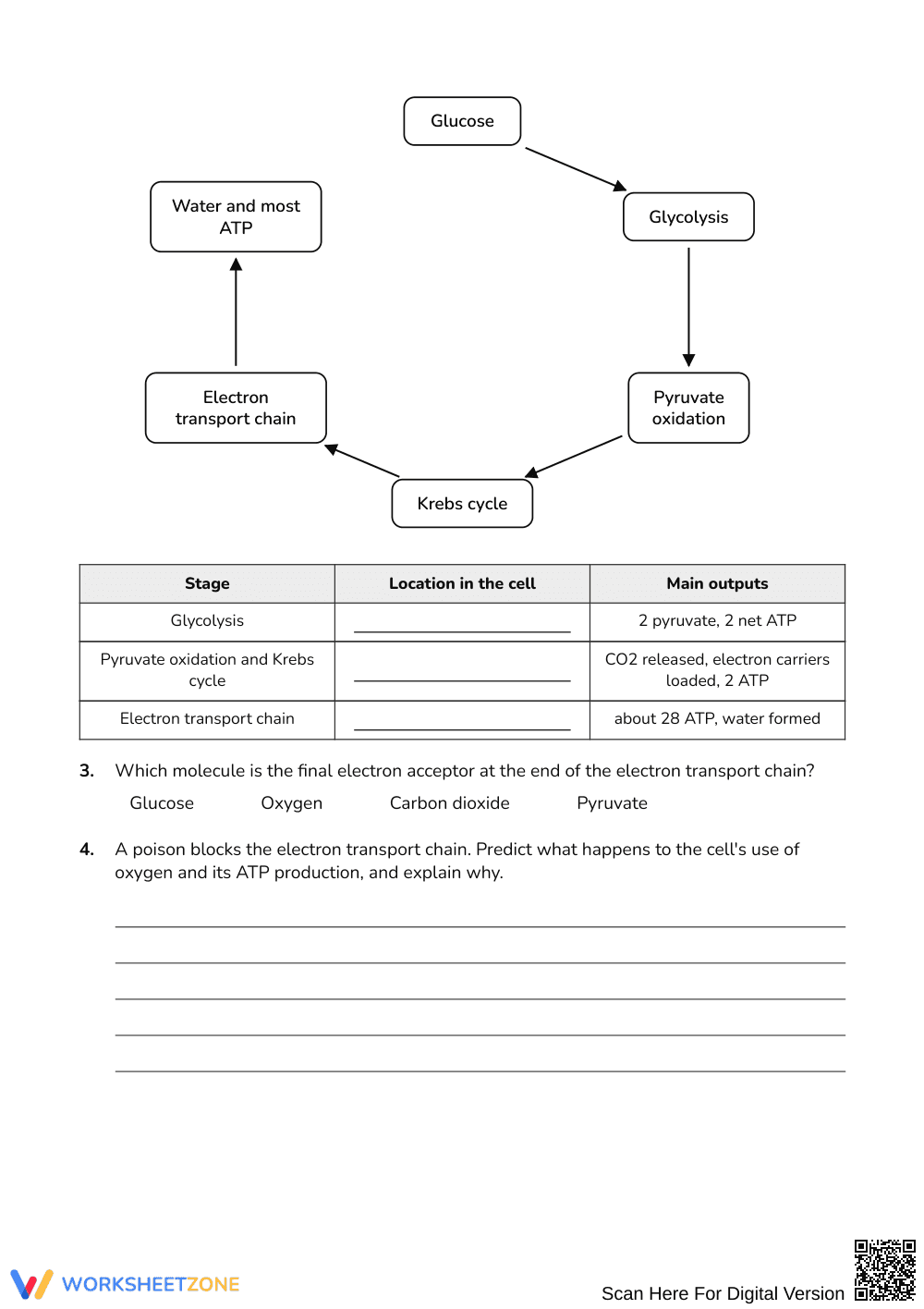
This 4-page assessment contains 15 multi-part problems divided into three distinct investigative domains. Students engage with an anatomical cutaway diagram of a mitochondrion, an overall chemical equation reference with pathway flowcharts, and a controlled experimental data table tracking yeast respiration across four temperature conditions. A matching 4-page teacher answer key provides complete explanations, biochemical mechanisms, and expected student reasoning.
Skill Progression
- Guided practice (Part A — 4 tasks): Students identify mitochondrial structures using visual cues and connect cristae surface area to ATP synthase capacity.
- Supported practice (Part B — 5 tasks): Reaction tables and flowcharts scaffold tracking chemical inputs, net ATP yields, and oxygen's role as the final electron acceptor.
- Independent practice (Part C — 6 tasks): Learners autonomously analyze comparative yield graphs and evaluate yeast respiration rates to identify enzyme denaturation.
This sequence follows a gradual-release framework, moving learners from anatomical identification to independent, evidence-based data analysis.
Standards Alignment
This resource aligns directly with secondary life science performance expectations concerning cellular energy conversion and matter transformation. Students construct models to explain how chemical energy stored in glucose transfers into ATP through sequential metabolic pathways. Both standard codes can be copied directly into lesson plans, IEP goals, or district curriculum mapping tools.
How to Use It
Administer this 4-page packet after completing direct instruction on metabolic pathways as a summative assessment or end-of-unit review. During administration, conduct a formative check on Part B by observing whether students correctly identify oxygen's role as the terminal electron acceptor before attempting the enzyme disruption question. Most middle and high school students complete all 15 tasks in 40 to 50 minutes.
Who It's For
Designed for middle and high school biology students, this resource includes scaffolded charts that assist emerging bilingual students and learners with IEPs while maintaining rigorous analytical tasks for advanced learners. For optimal instruction, pair this assessment with an introductory cell transport unit or an interactive mitochondrial membrane anchor chart.
According to Fisher & Frey (2014), structured scaffolds within cumulative science assessments systematically reinforce conceptual mastery by shifting cognitive responsibility from initial visual prompts to independent analytical synthesis. This Grade 7–12 cellular respiration resource exemplifies this architecture through a 15-problem progression covering organelle structure, metabolic pathways, and empirical data interpretation. Secondary students examine mitochondrial cristae, track energy transfers across glycolysis and the electron transport chain, and evaluate experimental respirometry data to determine enzyme denaturation thresholds. By integrating cutaway models, biochemical reaction tables, and authentic yeast investigation metrics, the 4-page worksheet guides learners to explain how aerobic respiration transforms glucose into usable cellular energy. Complete with an exhaustive 4-page answer key, this assessment equips educators to evaluate mechanistic reasoning, diagnose biochemical misconceptions, and confirm mastery of core cellular energetics standards without requiring extraneous instructional preparation.


