


























Views
Downloads


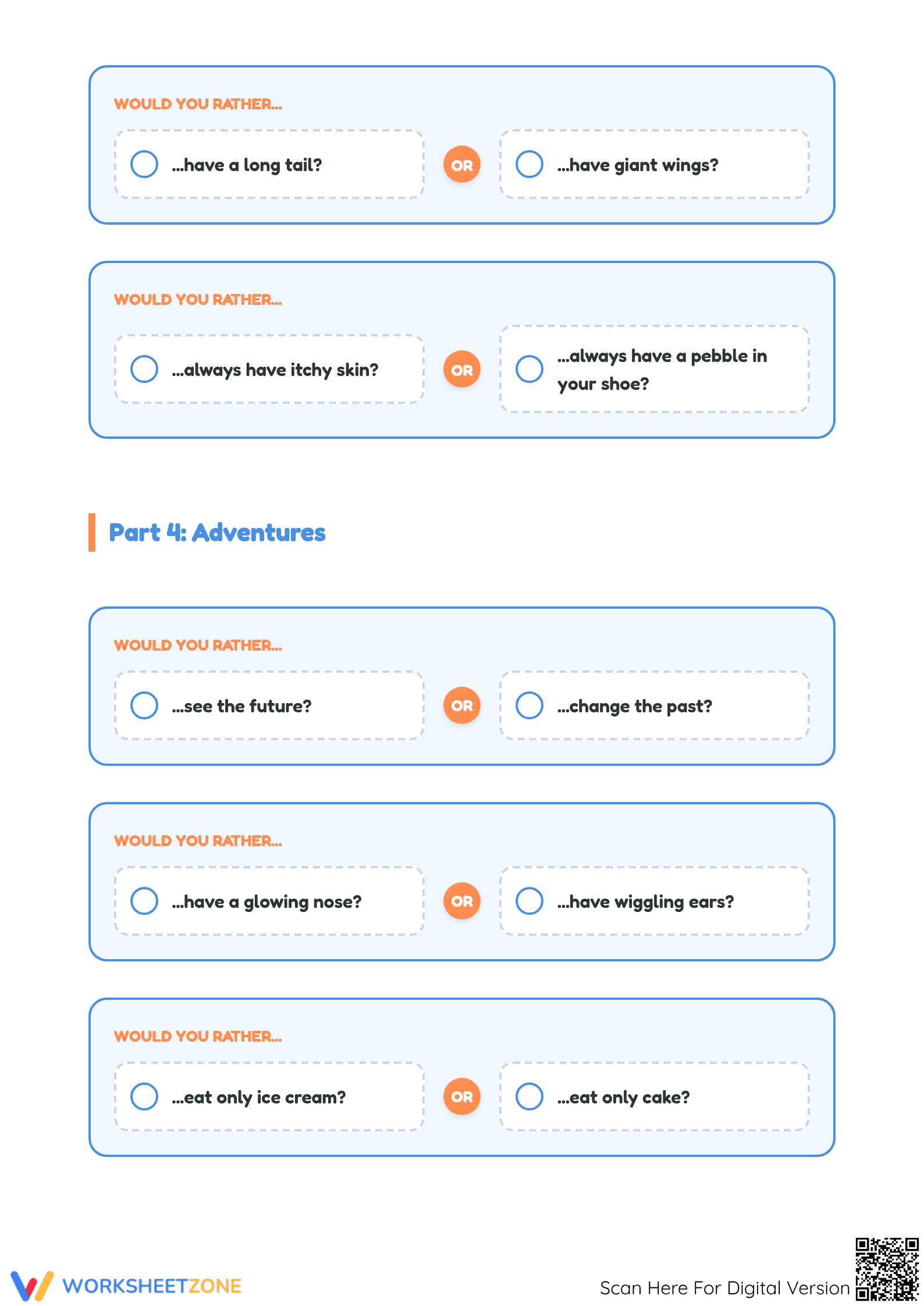


Grade 2 & 3 Would You Rather — Printable No-Prep Worksheet
Paste this activity's link or code into your existing LMS (Google Classroom, Canvas, Teams, Schoology, Moodle, etc.).
Students can open and work on the activity right away, with no student login required.
You'll still be able to track student progress and results from your teacher account.
This engaging Would You Rather worksheet gets students talking and defending their choices. Designed to spark lively classroom discussions, it helps young learners practice expressing opinions. The fun, low-stakes format builds confidence in oral communication while serving as an excellent community-building activity.
At a Glance
- Grade: 2–3 · Subject: ELA
- Standard:
CCSS.ELA-LITERACY.SL.2.1— Participate in collaborative conversations with peers- Skill Focus: Expressing opinions and critical thinking
- Format: 5 pages · 23 problems · No answer key · PDF
- Best For: Icebreakers and morning meetings
- Time: 15–20 minutes
This five-page packet features 23 unique "Would You Rather" scenarios divided into five thematic sections: Silly Choices, Food & Fame, Magic & Pets, Adventures, and Even More. Each prompt presents two options, requiring students to weigh preferences. Because questions are opinion-based, no answer key is needed, letting students focus on reasoning.
This resource is designed for immediate classroom implementation with zero teacher preparation required.
- Print (1 min): Print the PDF. Select specific thematic pages based on available time.
- Distribute (1 min): Hand out during morning meeting or ELA blocks.
- Review (15 mins): Students circle choices independently, then pair up to discuss reasoning.
With under two minutes of prep, this is an ideal sub plan or quick filler activity.
This activity aligns with CCSS.ELA-LITERACY.SL.2.1, requiring students to participate in collaborative conversations with diverse partners about grade-level topics. It also supports third-grade expectations by encouraging students to explain their ideas. Both standard codes can be copied directly into lesson plans, IEP goals, or district curriculum mapping tools.
Use this game as a morning meeting icebreaker to set a positive tone. Alternatively, use it as a pre-writing activity for opinion essays; have students write a paragraph defending one choice. As a formative assessment tip, observe students during pair-shares to evaluate their turn-taking and respectful listening. Expect completion in 15 to 20 minutes.
Ideal for second and third-grade students developing oral communication skills. It naturally differentiates, as students engage at their own cognitive levels. For extra support, provide sentence frames like "I would rather ___ because ___." Pair this with an anchor chart on respectful listening.
Integrating structured discussion prompts like this worksheet supports essential communication milestones in the elementary classroom. Aligned with CCSS.ELA-LITERACY.SL.2.1 to help students participate in collaborative conversations with peers, this activity fosters both expressive language and active listening. According to Fisher & Frey (2014), providing students with dedicated, low-stakes opportunities for peer-to-peer dialogue significantly increases their academic vocabulary acquisition and overall classroom engagement. When students are given engaging, relatable scenarios to discuss, they are more likely to take linguistic risks and practice articulating complex reasoning. This specific "Would You Rather" format removes the pressure of finding a single correct answer, thereby lowering the affective filter and encouraging participation from hesitant speakers. Regular use of such structured speaking activities builds the foundational skills necessary for more advanced academic debates and collaborative problem-solving tasks in later grades.


