































Printable Tracing Information Gaps Worksheet | Grade 8 ELA

Paste this activity's link or code into your existing LMS (Google Classroom, Canvas, Teams, Schoology, Moodle, etc.).
Students can open and work on the activity right away, with no student login required.
You'll still be able to track student progress and results from your teacher account.
This Grade 8 worksheet teaches students to trace an information gap, the difference between what the reader knows and what each character knows. Students then explain how that gap creates suspense and humor. They practice with one original short story across 10 tasks.
At a Glance
- Grade: 8 · Subject: ELA
- Standard:
RL.8.6— Explain how what characters and readers know differently creates suspense or humor.- Skill Focus: Tracing an information gap
- Format: 6 pages · 10 problems · Answer key included · PDF
- Best For: Point of view and irony units
- Time: 35–45 minutes
What's Inside
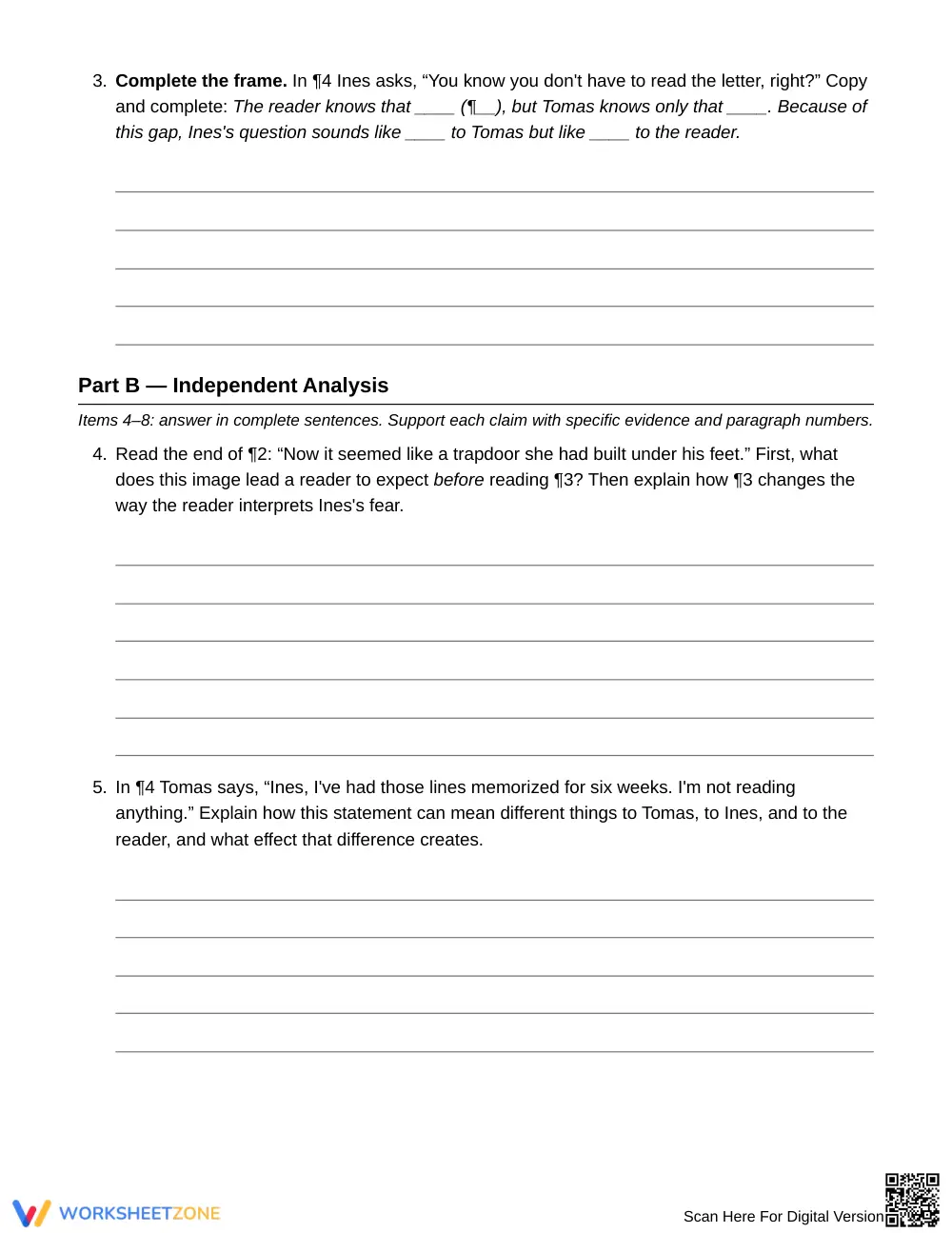
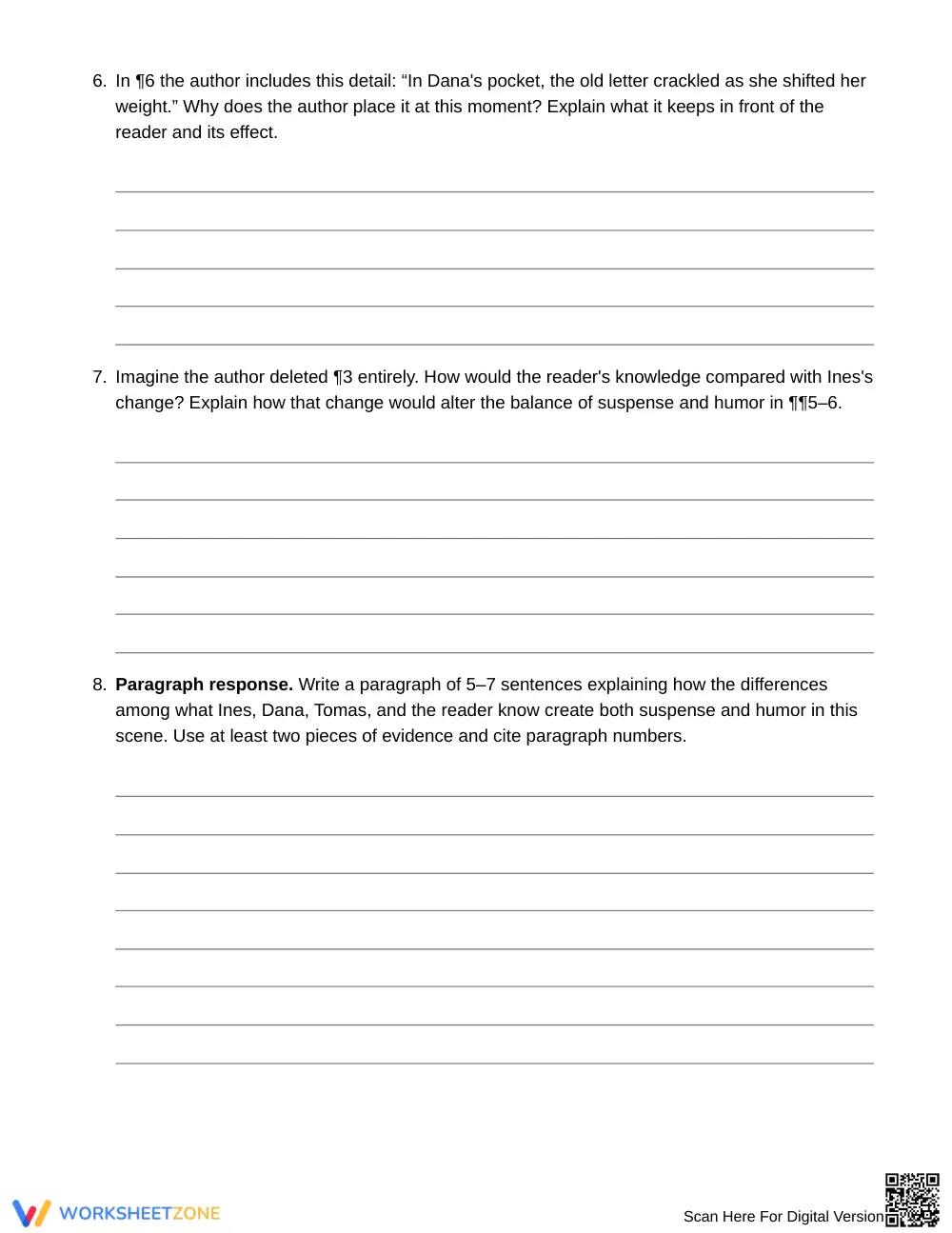
Six pages hold 10 tasks in three parts. Part A has a knowledge chart, a strongest-evidence multiple choice item, and a sentence frame. Part B has five written analysis items, including a 5–7 sentence paragraph. Part C has two interpretation checks. A Key Ideas box, the short story “The Letter in the Chest,” and a worked example support the work. A three-page answer key is included.
Skill Progression
- Guided practice (Items 1–3): a knowledge chart, evidence selection, and a sentence frame give heavy scaffolding.
- Supported practice (Items 4–8): students write complete sentences and cite paragraph numbers, with the worked example still on the page.
- Independent practice (Items 9–10): students weigh competing readings and defend a position with their single strongest evidence.
The sequence follows gradual release: I Do, We Do, You Do.
Standards Alignment
RL.8.6 — Analyze how differences in the points of view of the characters and the audience or reader create such effects as suspense or humor. The standard code can be copied directly into lesson plans, IEP goals, or district curriculum mapping tools.
How to Use It
Use it during instruction on dramatic irony. Students complete Part A in pairs, then finish Parts B and C alone. You can also assign it after direct instruction as a check on independent analysis. While students work on Item 1, watch whether they cite ¶3 for the letter swap. A student who marks “Yes” for Ines on the swap is likely mixing up her knowledge with the reader's. Expect 35–45 minutes.
Who It's For
The worksheet suits Grade 8 students learning to separate character point of view from reader knowledge. Part A's frames and chart support students who need structure, and Part C's debate item stretches stronger readers. Pair it with a point-of-view anchor chart or a short read-aloud of a suspense scene.
RL.8.6 asks eighth graders to analyze how differences between characters' points of view and the reader's point of view create suspense or humor. This worksheet, Tracing an Information Gap, turns that standard into a repeatable routine: map who knows what, cite the paragraph that proves it, and explain the effect. Students work through a 10-task sequence on an original short story, moving from a knowledge chart and sentence frame to paragraph-length analysis and a debate between competing readings. Fisher & Frey (2014) describe gradual release of responsibility as a framework in which teachers shift from modeling to guided work to independent performance, and this worksheet follows that arc across six pages with a three-page answer key. Teachers can use it to assess whether students can separate dramatic irony from plain surprise and support claims with specific textual evidence.


