





























Paste this activity's link or code into your existing LMS (Google Classroom, Canvas, Teams, Schoology, Moodle, etc.).
Students can open and work on the activity right away, with no student login required.
You'll still be able to track student progress and results from your teacher account.


Printable Thanksgiving Color by Code: Tens and Ones

Paste this activity's link or code into your existing LMS (Google Classroom, Canvas, Teams, Schoology, Moodle, etc.).
Students can open and work on the activity right away, with no student login required.
You'll still be able to track student progress and results from your teacher account.
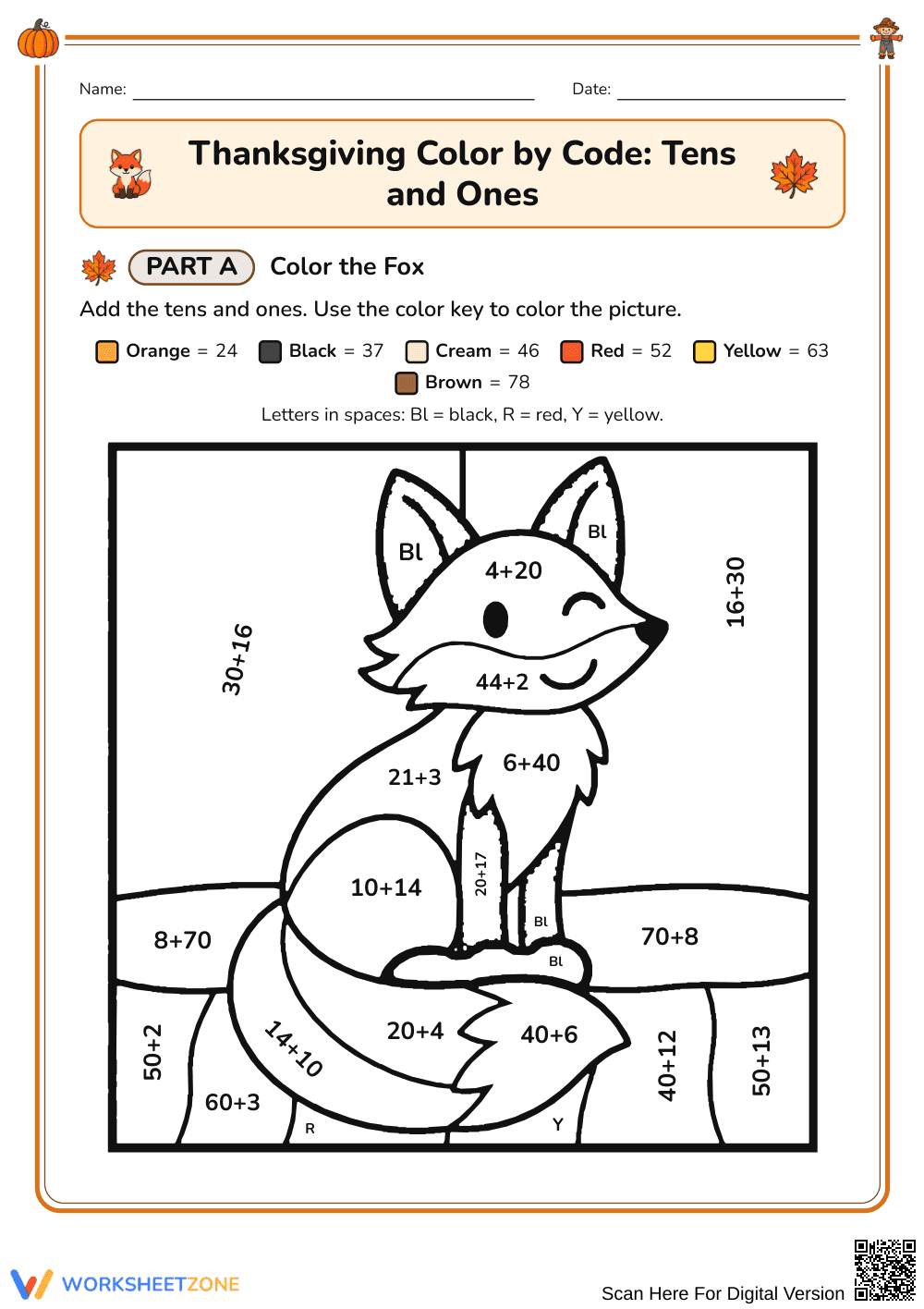
This Thanksgiving math worksheet builds two-digit addition fluency by guiding second-grade students to combine tens and ones within 100. Learners solve 24 arithmetic problems to color an autumn fox, reinforcing place-value decomposition, mental strategies, and sum verification through a self-correcting activity that strengthens computational confidence.
At a Glance
- Grade: 2 · Subject: Math
- Standard:
2.NBT.B.5— Fluently add two-digit numbers within 100 using place value strategies and mental math properties- Skill Focus: Adding tens and ones place value facts
- Format: 1 page · 24 problems · Full answer key included · PDF
- Best For: Independent practice, holiday math centers, and sub plans
- Time: 20–30 minutes
What's Inside
The single-page printable features 24 targeted addition expressions pairing single-digit numbers with multiples of ten (such as 7 + 30) and two-digit combinations (such as 44 + 2). A six-color key links specific sums—24, 37, 46, 52, 63, and 78—to colors that complete an autumn fox illustration. A matching one-page answer key allows instant verification.
Zero-Prep Classroom Workflow
Requiring under 2 minutes of teacher prep, this resource fits emergency sub plans or quick holiday rotations:
- Print (30 seconds): Send the single student page directly to the copier without collating.
- Distribute (30 seconds): Hand out copies with crayons or colored pencils in the six indicated colors.
- Review (60 seconds): Display the answer key for quick self-checking or scan finished sheets visually.
Standards Alignment
This worksheet aligns directly to `2.NBT.B.5`: Fluently add and subtract within 100 using strategies based on place value, properties of operations, and the relationship between operations. It also supports `2.OA.B.2` by reinforcing basic addition facts within multi-digit operations. Both standard codes can be copied directly into lesson plans, IEP goals, or district curriculum mapping tools.
How to Use It
Deploy this worksheet after direct instruction on place value addition to reinforce combining tens and ones. In a November math center, students complete problems independently while coloring. It also serves as an effective post-lesson check. Formatively observe whether learners decompose addends mentally (such as treating 30 + 16 as 40 + 6) rather than counting on by ones. Expected completion time is 20 to 30 minutes.
Who It's For
Designed for second graders mastering two-digit addition, this activity also provides extension for advanced first graders and intervention for third graders. For extra support, offer base-ten blocks so students can model tens and ones physically before coloring. Pair this activity with a place-value anchor chart illustrating expanded form and mental addition strategies.
According to the RAND AIRS 2024 report on elementary mathematics instruction, structured fluency practice that integrates visual feedback substantially increases student engagement and retention of core numerical concepts. Grade 2 standard 2.NBT.B.5 requires students to fluently add within 100 using strategies based on place value, properties of operations, and the relationship between operations. This Thanksgiving color-by-code worksheet operationalizes standard 2.NBT.B.5 by engaging young learners in calculating 24 distinct addition problems combining tens and ones. Because each solved arithmetic expression maps to a specific color key that reveals an autumn fox, students receive immediate visual self-correction cues. This visual mechanism prevents the repetition of procedural errors and fosters mathematical self-monitoring. Research confirms that combining purposeful repetition with self-checking gamified elements helps diverse elementary learners solidify place-value foundations while reducing math anxiety during independent classroom practice.


