


























Views
Downloads




Printable Situational Fit Worksheet | Grade 11 English III
Paste this activity's link or code into your existing LMS (Google Classroom, Canvas, Teams, Schoology, Moodle, etc.).
Students can open and work on the activity right away, with no student login required.
You'll still be able to track student progress and results from your teacher account.
This worksheet teaches Grade 11 students to defend whether a rhetorical appeal fits a specific audience and moment, not just whether it is a good technique. Students read one town-meeting speech, choose relevant evidence, argue interpretations, and weigh counterevidence in writing.
At a Glance
- Grade: 11 · Subject: English III
- Standard:
RI.11-12.6— Explain how a speaker's content and style persuade a particular audience- Skill Focus: Defending an appeal's situational fit with quotations and reasoning
- Format: 6 pages · 8 problems · Answer key included · PDF
- Best For: Analytical writing after rhetoric instruction
- Time: 50–70 minutes
What's Inside
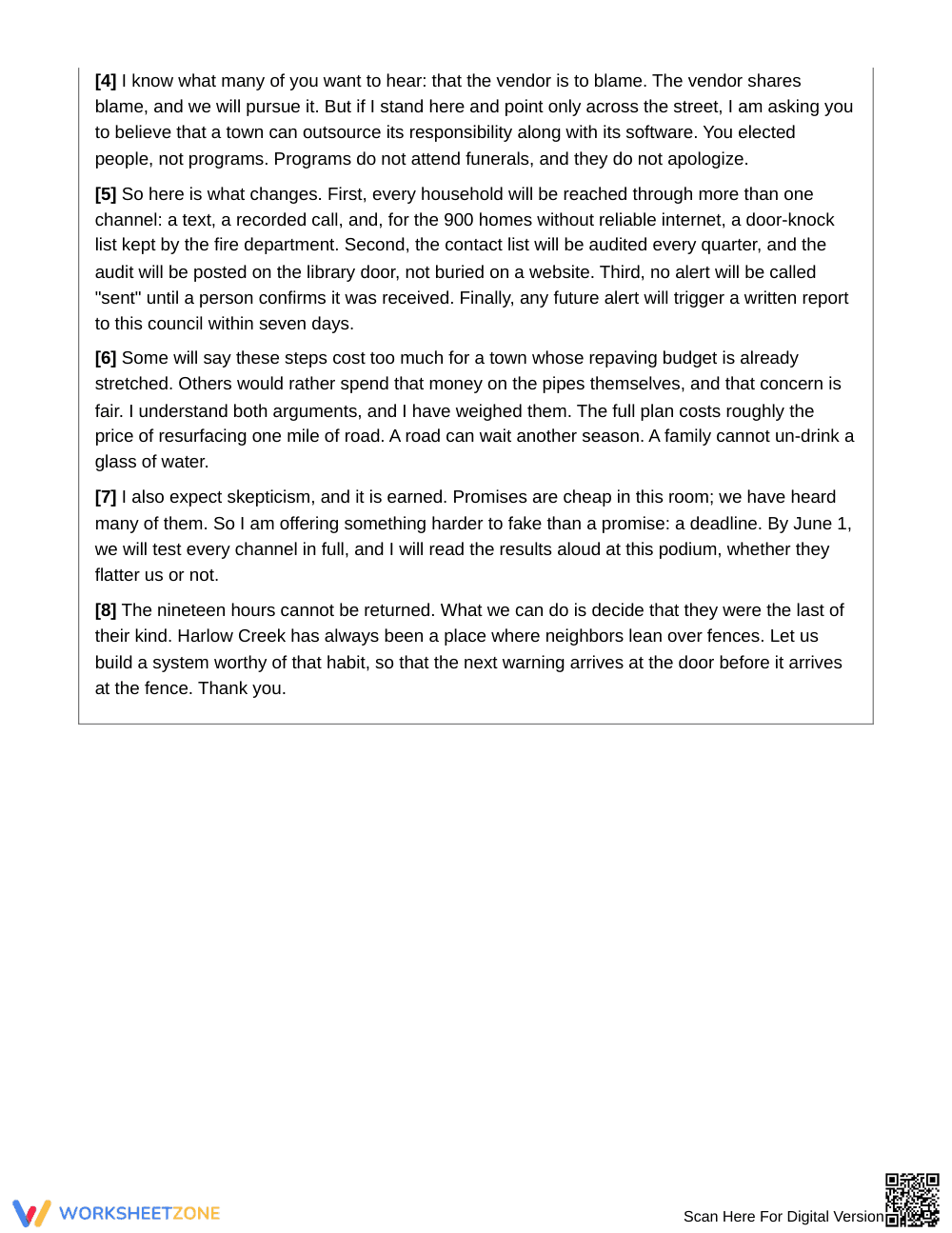
Eight tasks across three parts accompany a one-speech reading, Remarks to the Harlow Creek Town Meeting, a fictional address given after a water-alert failure. A reasoning reminder box defines the rhetorical situation, the three appeals, and a Claim, Evidence, Reasoning, Limit chain. The six-page PDF includes an answer key.
Skill Progression
- Guided practice (2 tasks): Part A uses a multiple-choice item and short written explanations to anchor evidence in the rhetorical situation.
- Supported practice (4 tasks): Part B applies the reminder box's chain to ethos, pathos, layered appeal, and style.
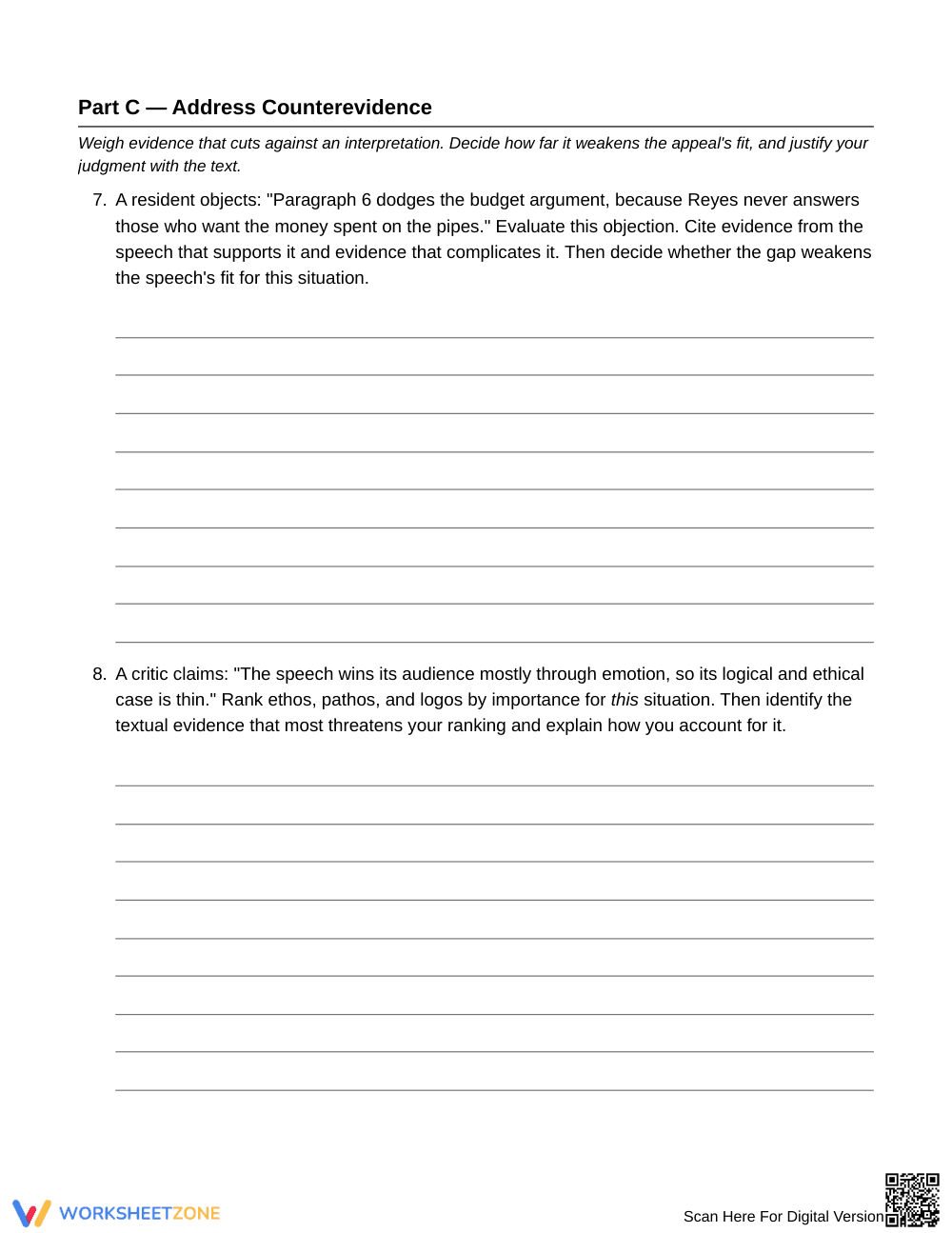
- Independent practice (2 tasks): Part C asks students to evaluate objections and rank the appeals without a model.
This follows a gradual-release model: I Do, We Do, You Do.
Standards Alignment
RI.11-12.6: Determine an author's point of view or purpose in a text in which the rhetoric is particularly effective, analyzing how style and content contribute to the power, persuasiveness, or beauty of the text. This standard code can be copied directly into lesson plans, IEP goals, or district curriculum mapping tools.
How to Use It
- After direct instruction on appeals: assign Parts A and B as in-class writing so students practice evidence selection and interpretation.
- As a discussion or assessment task: use Part C for a seminar or timed written response.
While students work, watch whether they cite paragraph numbers and name a limit. Those two habits show whether they argue from the text. Expect 50–70 minutes, or split the work across two class periods.
Who It's For
Written for Grade 11 English III students who can name ethos, pathos, and logos and are ready to judge how well an appeal suits an audience. The reminder box supports students who need a reasoning routine. Pair it with an anchor chart on the rhetorical situation or a direct instruction lesson on exigence.
RI.11-12.6 asks students to explain how an author's style and content make rhetoric powerful, persuasive, or beautiful. This Grade 11 English III worksheet turns that standard into eight written tasks on one fictional town-meeting speech. Students select evidence that establishes the exigence, defend interpretations of ethos, pathos, logos, and style, and weigh counterevidence against their own judgments. Each response follows a Claim, Evidence, Reasoning, Limit chain, so students must cite paragraph numbers and name what an appeal cannot do. Fisher & Frey (2014) describe gradual release of responsibility, moving from modeling to guided to independent work, as a strong structure for building complex analytical skills, and the worksheet's three parts follow that sequence. The six-page PDF includes an answer key for consistent scoring.


