































Printable Schedules & Elapsed Time Worksheet | Grade 3 Math

Paste this activity's link or code into your existing LMS (Google Classroom, Canvas, Teams, Schoology, Moodle, etc.).
Students can open and work on the activity right away, with no student login required.
You'll still be able to track student progress and results from your teacher account.
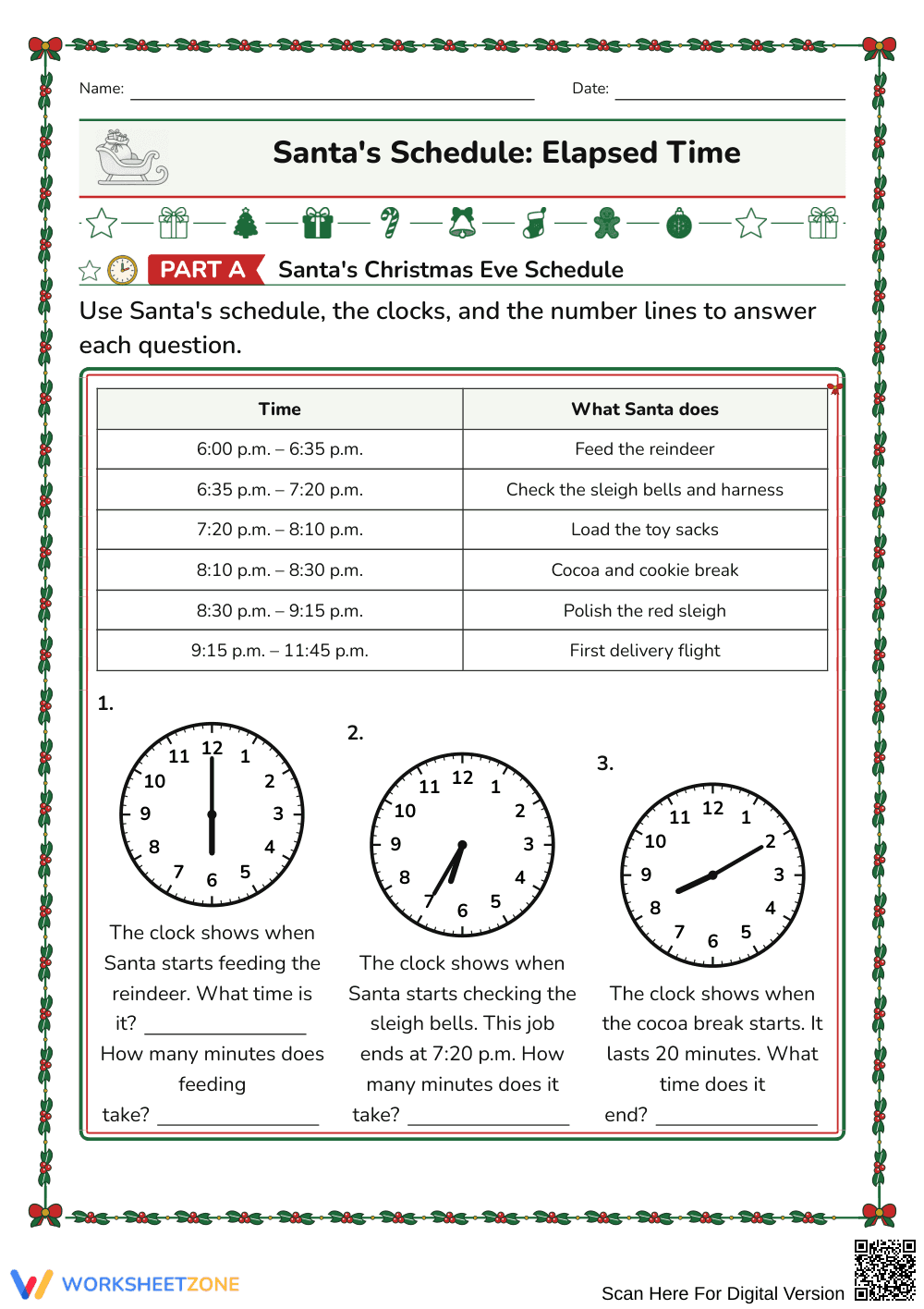
This Grade 3 math worksheet builds fluency in reading schedules and solving elapsed-time word problems to the nearest 5 minutes. Across 24 structured tasks set around Santa's Christmas Eve schedule, students read analog clocks, interpret time number lines, and calculate start times, end times, and durations accurately.
At a Glance
- Grade: 3 · Subject: Math
- Standard:
3.MD.A.1— Tell time to the nearest minute and solve elapsed-time problems- Skill Focus: Elapsed time and schedule reading to 5 minutes
- Format: 2 pages · 24 problems · Answer key included · PDF
- Best For: Independent practice or seasonal math centers
- Time: 25–35 minutes
What's Inside
This 2-page printable resource features 24 problems anchored by a six-event Christmas Eve schedule table running from 6:00 p.m. to 11:45 p.m. Students work through analog clock reading tasks, 5-minute and 10-minute interval number lines, and multi-step word problems that require finding elapsed minutes, hours, and end times. A matching 2-page answer key is included for quick grading.
Skill Progression
- Guided practice (8 problems): Students read analog clocks paired directly with schedule entries to identify start times and calculate single-event durations.
- Supported practice (8 problems): Pre-labeled time number lines with 5-minute and 10-minute tick marks scaffold students as they count forward to find elapsed minutes.
- Independent practice (8 problems): Text-only word problems challenge students to bridge multiple schedule events, convert minutes into hours, and compute finish times without visual cues.
This sequence follows a gradual-release I Do, We Do, You Do model that moves learners from concrete clock visuals to abstract time calculations.
Standards Alignment
Aligned to 3.MD.A.1, students tell and write time to the nearest minute and measure time intervals in minutes while solving word problems involving addition and subtraction of time intervals. The number-line tasks also reinforce skip-counting strategies foundational to third-grade measurement. This standard code can be copied directly into lesson plans, IEP goals, or district curriculum mapping tools.
How to Use It
Assign this worksheet during small-group guided math after introducing time number lines, or use it after direct instruction as a 25-to-35-minute independent practice center. As students work, observe whether they count by 5s and 10s accurately across the hour mark—errors at 60-minute boundaries signal a need to reteach regrouping minutes into hours.
Who It's For
Designed for Grade 3 students building fluency with elapsed time, this worksheet also works well for Grade 4 intervention groups. Provide students who need extra support with a geared demonstration clock, and pair the packet with an anchor chart showing how to jump by hours and 5-minute intervals on an open number line.
This Grade 3 math worksheet targets Common Core standard 3.MD.A.1 by teaching students to read a multi-event schedule, interpret analog clocks, and solve elapsed-time word problems to the nearest 5 minutes using time number lines. Across 24 structured problems and a 2-page answer key, learners progress from visual clock reading to calculating multi-hour intervals and end times without scaffolds. According to Fisher & Frey (2014), structured gradual-release instruction that moves students from modeled visual supports to independent problem solving strengthens conceptual retention and procedural accuracy. By pairing a relatable Christmas Eve schedule with 5-minute and 10-minute number-line intervals, the resource helps third graders visualize how minutes accumulate across hour boundaries, making it a reliable 25-to-35-minute practice activity for whole-group lessons, math centers, or targeted intervention while giving teachers clear evidence of student mastery.


