































Printable Reversed Unit-Rate Quotients Worksheet

Paste this activity's link or code into your existing LMS (Google Classroom, Canvas, Teams, Schoology, Moodle, etc.).
Students can open and work on the activity right away, with no student login required.
You'll still be able to track student progress and results from your teacher account.
This Grade 6 worksheet builds students' ability to identify and correct reversed-quotient errors in unit-rate problems across three real-world contexts: unit prices, reading rates, and purchasing comparisons. Students analyze pre-worked student errors, explain what the wrong quotient actually represents, and calculate the correct unit rate — developing both procedural accuracy and conceptual understanding of division order.
At a Glance
- Grade: 6 · Subject: Math
- Standard:
6.RP.A.2— Understand a unit rate and use rate language to describe a ratio relationship- Skill Focus: Correcting reversed unit-rate quotients across real-world contexts
- Format: 5 pages · 10 problems · Answer key included · PDF
- Best For: Targeted error-analysis practice after direct instruction
- Time: 30–45 minutes
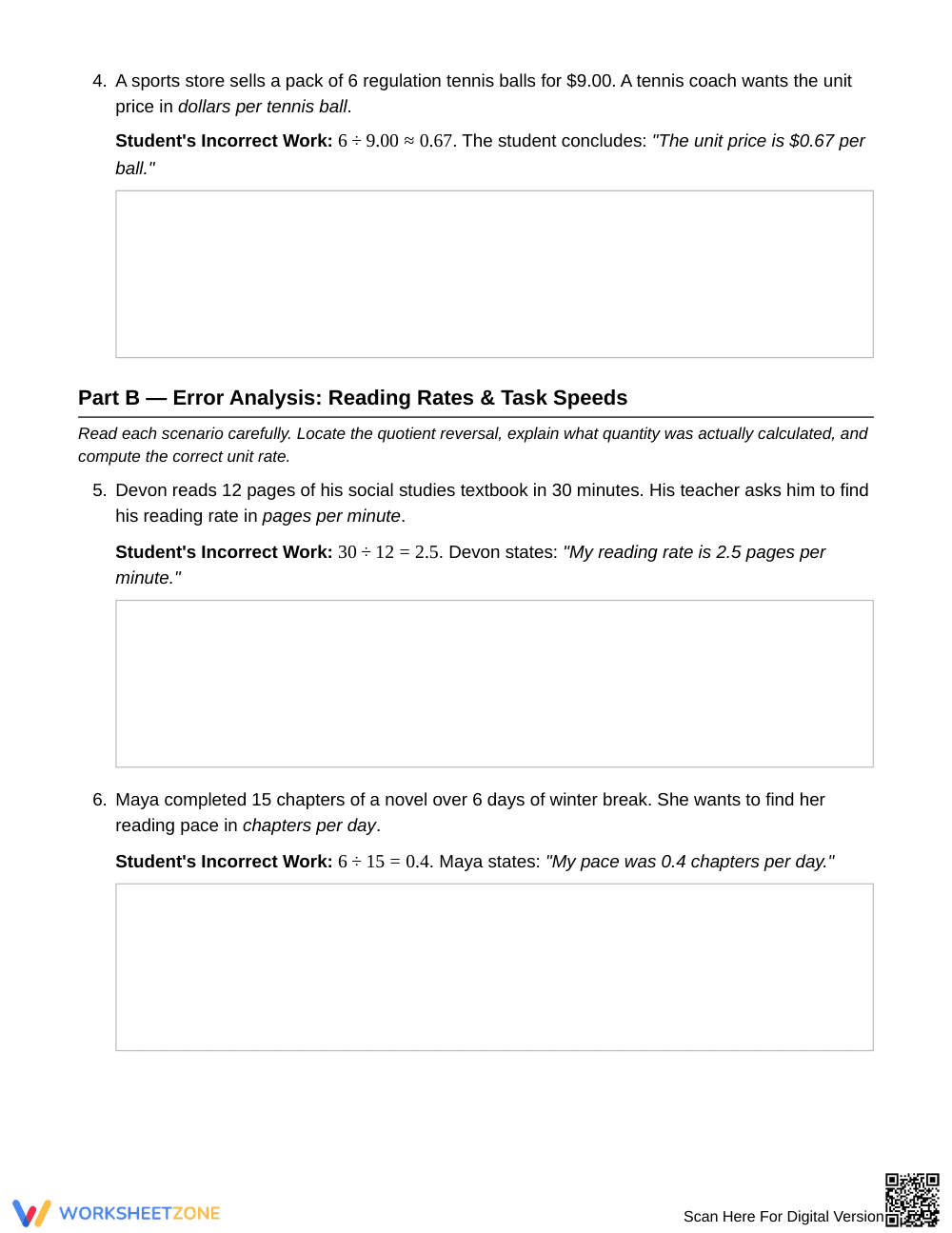
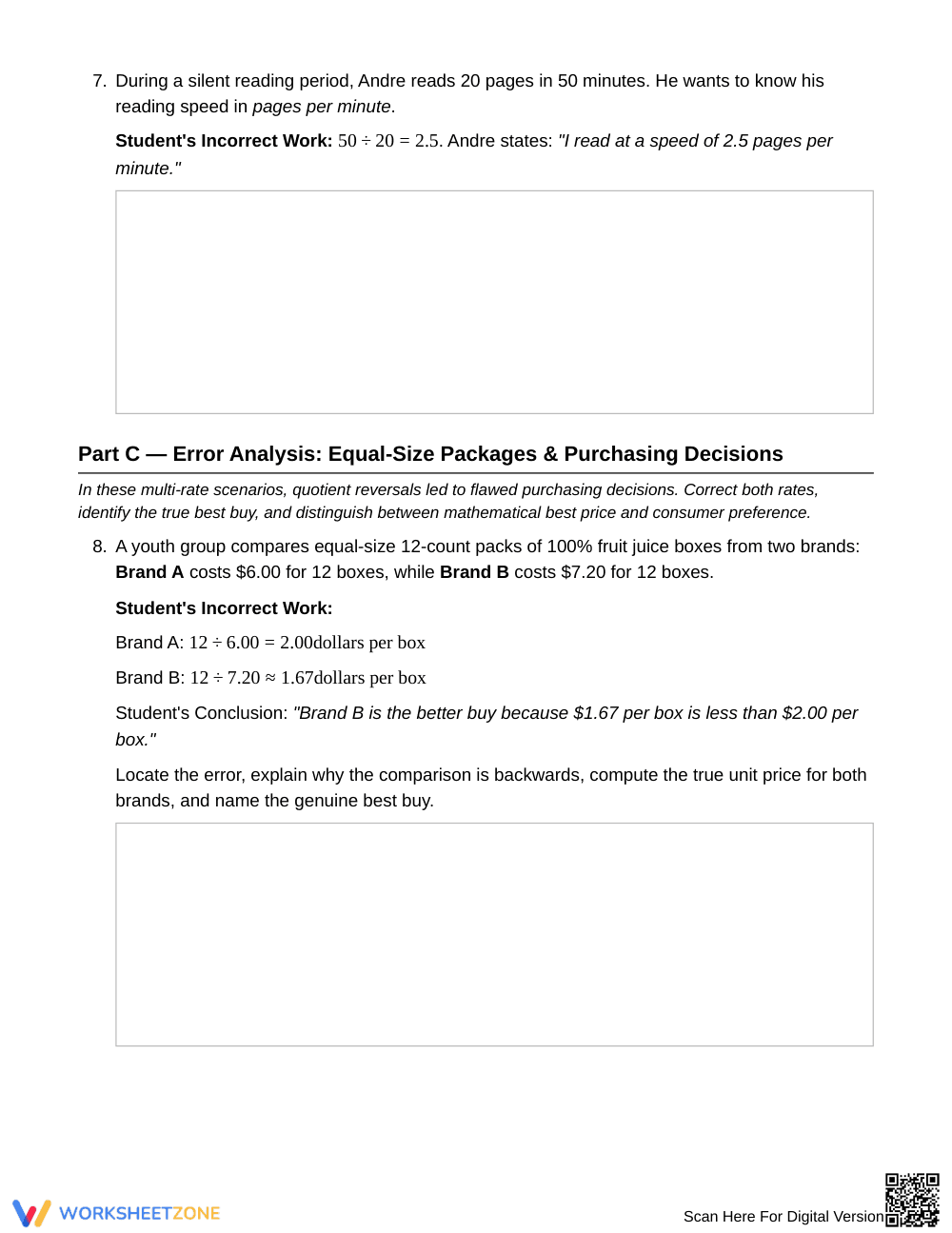
The worksheet spans 5 pages and opens with a Core Concept rule box defining dividend and divisor roles in unit-rate expressions, followed by a fully modeled three-step error-analysis example using a wall-coverage scenario. Part A presents 4 unit-price problems (muffins, peanut butter, apples, tennis balls). Part B offers 3 reading-rate problems requiring students to locate the reversal and state the correct pages-per-minute or chapters-per-day rate. Part C contains 3 multi-rate purchasing scenarios where reversed quotients led to flawed best-buy conclusions; students correct both rates and name the true best buy. A complete answer key covers all 10 problems.
Skill Progression
- Guided practice (modeled example): The worked wall-coverage model walks through all three correction steps — locating the error, explaining the reversed meaning, and recalculating — before students attempt any problems independently.
- Supported practice (Parts A & B, 7 problems): Students apply the three-step framework to familiar contexts (prices, reading speeds) with the rule box visible as a scaffold.
- Independent practice (Part C, 3 problems): Students handle two-rate comparisons without step-by-step prompts and evaluate a flawed purchasing decision.
This gradual-release structure mirrors the I Do, We Do, You Do framework, moving students from observation to application to independent analysis within a single sitting.
How to Use It
Assign after direct instruction on unit rates as a formative check: circulate during Part B and note which students explain the reversed meaning correctly — this reveals whether the misconception is procedural or conceptual. Alternatively, use Part A alone as a 15-minute warm-up before a best-buy comparison lesson, then assign Parts B and C the following day. Expected completion time is 30–45 minutes for the full worksheet.
Who It's For
Designed for Grade 6 students encountering unit rates for the first time, this worksheet is especially useful for learners who can compute quotients correctly but consistently divide in the wrong order. The rule box and modeled example provide enough scaffolding for students who need additional support, while Part C challenges students who finish early.
This worksheet addresses 6.RP.A.2, the Grade 6 standard requiring students to understand unit rates and apply rate language accurately. The core skill — correcting reversed-quotient errors — targets a documented and persistent misconception: students divide in the wrong order because they do not connect the unit label to the dividend position. Fisher & Frey (2014) identify error analysis as a high-leverage instructional routine that makes student thinking visible and accelerates conceptual repair. Across 10 structured problems, students locate the reversal, articulate what the wrong quotient actually measures, and recalculate the correct rate in contexts ranging from grocery unit prices to multi-vendor purchasing decisions. The three-part progression — modeled example, supported practice, independent analysis — ensures that correction becomes a transferable strategy rather than a one-time fix. Answer key included for all 10 items.


