































Printable Respiration Data Worksheet | Grades 7–12 Science

Paste this activity's link or code into your existing LMS (Google Classroom, Canvas, Teams, Schoology, Moodle, etc.).
Students can open and work on the activity right away, with no student login required.
You'll still be able to track student progress and results from your teacher account.
This cellular respiration worksheet equips middle and high school science students to analyze experimental data, interpret diagrams, and calculate metabolic rates. Working through structured prompts, learners connect organelle structures to biochemical stages and evaluate empirical evidence from pea respirometry experiments to understand how cells produce usable ATP.
At a Glance
- Grade: Grades 7–12 · Subject: Science
- Standard: Scientific Evidence — Interpret laboratory respirometer data and cellular respiration models
- Skill Focus: Graph and evidence interpretation in cellular respiration
- Format: 4 pages · 24 problems · Answer key included · PDF
- Best For: Lab follow-up and unit review
- Time: 45–60 minutes
What's Inside
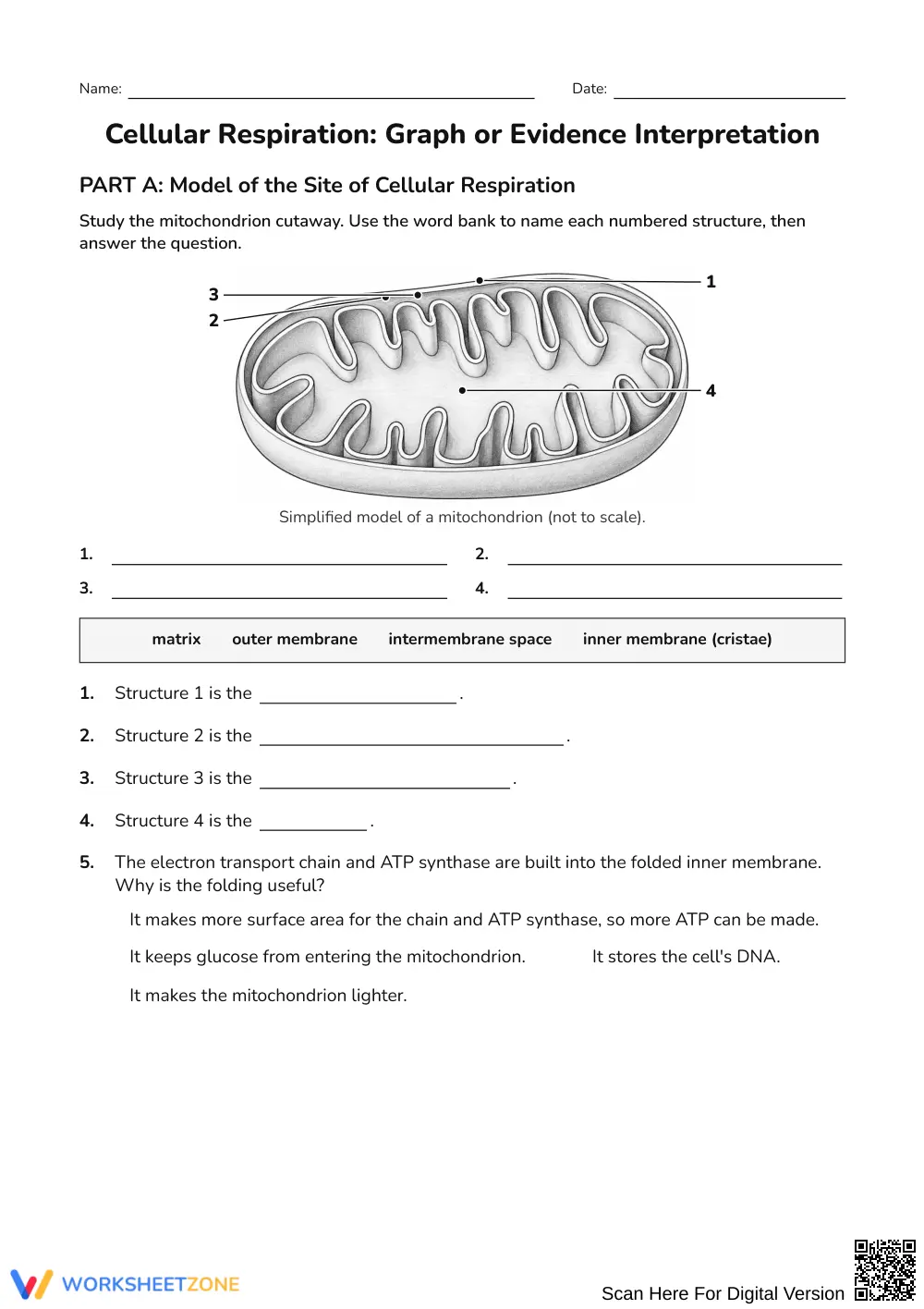
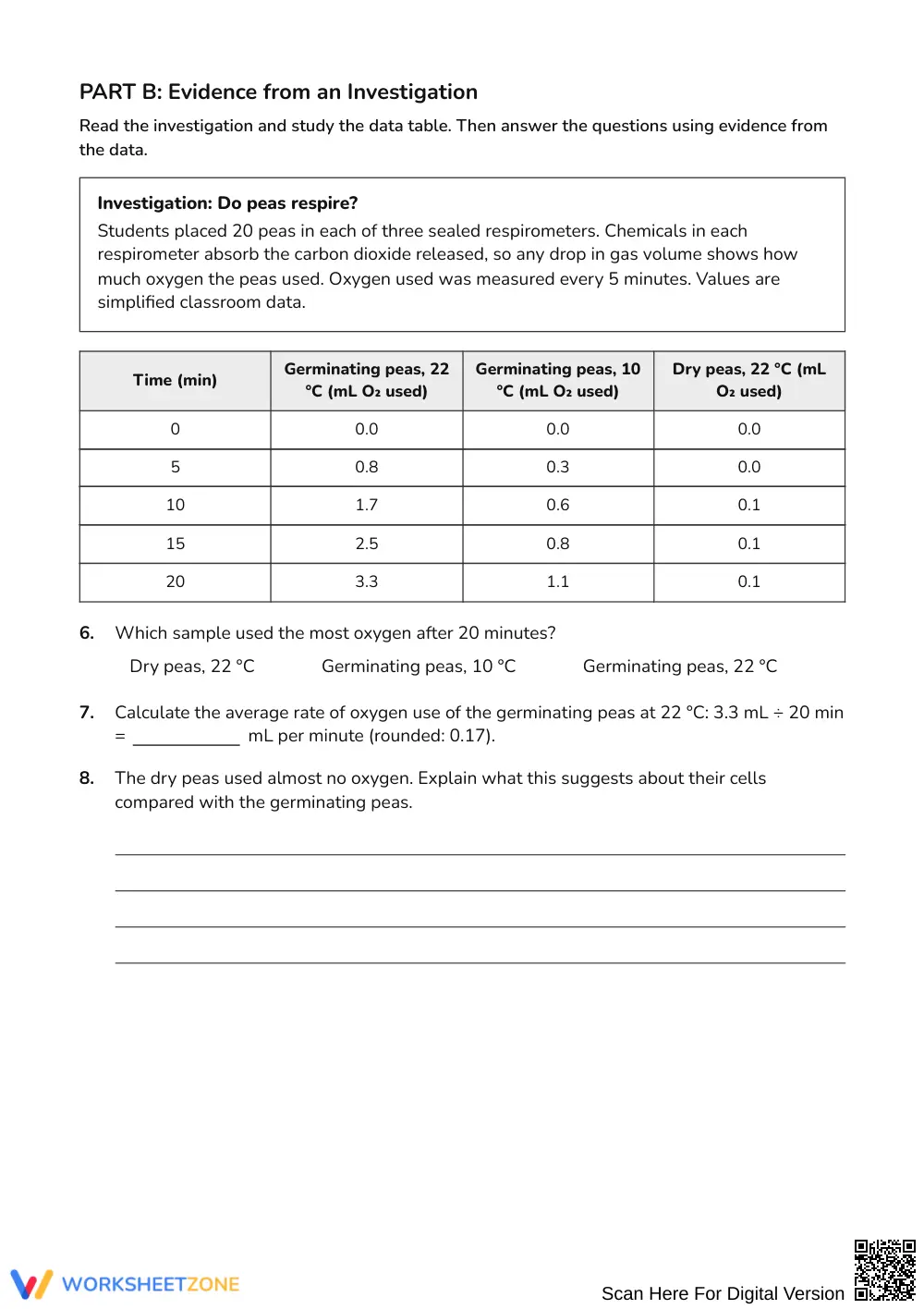
This 4-page resource features 24 targeted tasks organized across three focused sections. Students work with a labeled mitochondrion structural model with a word bank, analyze a multi-variable respirometer data table, and calculate ATP yields using biochemical pathway equations and graphs. A complete 4-page answer key provides worked calculations and sample explanations.
Skill Progression
- Guided practice (Part A): Students label mitochondrial structures using a supportive word bank and explain cristae surface area.
- Supported practice (Part B): Learners interpret germinating pea respirometer data across temperatures, calculate oxygen consumption rates, and relate cellular activity to gas exchange.
- Independent practice (Part C): Students analyze ATP production stages, perform percentage calculations, and critically evaluate an erroneous student claim.
This sequence follows an intentional gradual-release model, advancing from anatomical identification to complex data evaluation and claim critique.
Standards Alignment
Aligned with secondary life science standards for matter and energy in organisms, this worksheet requires students to use models and empirical evidence to explain how cellular respiration releases energy through chemical reactions. These standard alignments can be copied directly into lesson plans, IEP goals, or district curriculum mapping tools.
How to Use It
Deploy this worksheet after direct instruction on mitochondrial respiration or as a dry lab data analysis following a respirometer demonstration. During independent or partner work, circulate to observe Part B calculations; students who confuse total oxygen volume with rate often need prompting to divide volume by elapsed time. Typical completion requires 45 to 60 minutes.
Who It's For
Designed for middle and high school biology students, this activity provides built-in scaffolds like word banks and equations alongside rigorous quantitative analysis suitable for honors differentiation. Pair this worksheet directly with a cell energetics anchor chart or an interactive lab simulation to reinforce respiration mechanics.
Interpreting empirical data and diagrams in cellular respiration bridges abstract biochemical formulas and observable biological phenomena. According to Fisher & Frey (2014), structuring science tasks with an intentional gradual-release framework—moving purposefully from guided structural identification to independent quantitative evaluation—measurably deepens conceptual retention and advanced scientific reasoning skills across diverse middle and high school science classrooms. This 24-task worksheet embodies that evidence-based instructional design by requiring students to extract meaning from laboratory respirometer data tables, metabolic flowcharts, and ATP yield graphs rather than relying on rote memorization. Learners calculate precise respiration rates, determine metabolic yield percentages, and construct evidence-based arguments to evaluate scientific claims. By systematically scaffolding data interpretation alongside core biochemical principles, this resource enables educators to measure students' ability to synthesize experimental results and communicate rigorous scientific conclusions accurately across everyday classroom and summative testing environments.


