

































Printable Public Info Brief Worksheet | Grade 9 English I

Paste this activity's link or code into your existing LMS (Google Classroom, Canvas, Teams, Schoology, Moodle, etc.).
Students can open and work on the activity right away, with no student login required.
You'll still be able to track student progress and results from your teacher account.
This high school informational writing worksheet guides Grade 9 English I students to translate archival data and municipal planning documents into an objective, balanced public information brief. Learners evaluate conflicting stakeholder viewpoints, revise biased language, structure community-facing signage, and draft an evidence-based narrative suited for a public museum installation.
At a Glance
- Grade: 9 · Subject: English I
- Standard: Informational Writing — Synthesize informational texts into clear, objective public briefs
- Skill Focus: Public Information Brief Writing
- Format: 6 pages · 8 problems · Answer key included · PDF
- Best For: Informational text synthesis and civic writing
- Time: 45–60 minutes
What's Inside
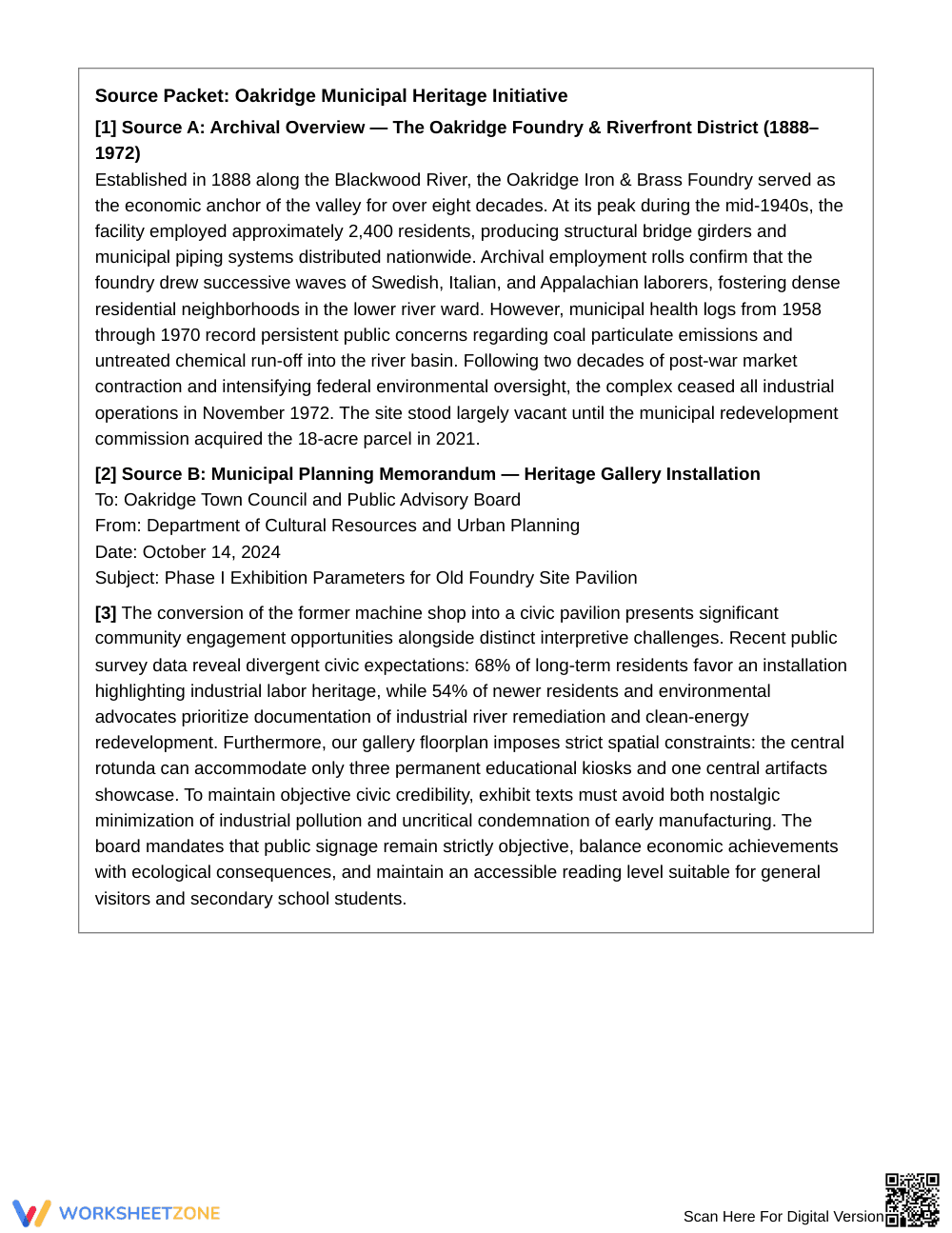
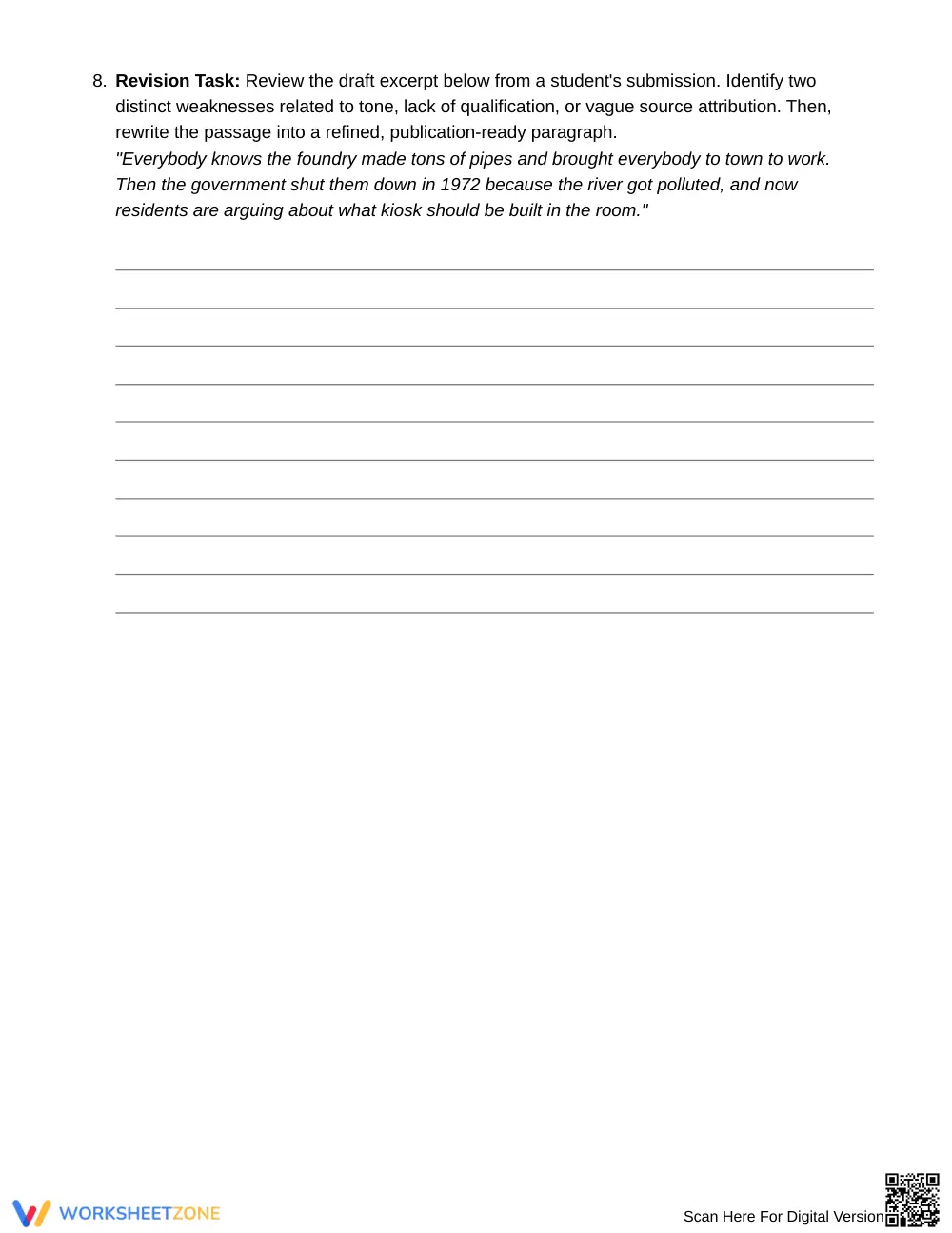
The 6-page printable packet centers on a realistic civic scenario: the Oakridge Municipal Heritage Initiative. It includes two foundational texts—an archival industrial overview and a municipal planning memorandum. Across 8 sequential tasks, students analyze source evidence, complete a rhetorical planning chart, rephrase biased assertions into qualified statements, draft a multi-paragraph brief (300–400 words), and refine an unpolished draft. A 4-page detailed answer key provides complete model responses and evaluation criteria.
Skill Progression
- Guided Practice (Tasks 1–2): Students examine source data to isolate critical demographic evidence and evaluate divergent community viewpoints without adopting subjective bias.
- Supported Practice (Tasks 3–6): Learners revise inflammatory draft statements into neutral claims, populate a rhetorical planning organizer balancing accessibility and rigor, establish a 3-part exhibit structure, and synthesize an introductory focus statement.
- Independent Practice (Tasks 7–8): Students draft a complete 300- to 400-word public information brief incorporating integrated evidence and qualified claims, followed by a targeted line-by-line revision exercise.
This scaffolded progression adheres to the gradual release of responsibility model, ensuring students master objective tone and source integration before drafting continuous prose.
Standards Alignment
This worksheet targets Grade 9 informational writing standards, requiring students to synthesize information from multiple print sources, address audience awareness, and maintain an objective style with precise technical terminology. The learning sequence directly reinforces evidence citation and expository structure. The concepts align directly with high school curriculum expectations and can be copied directly into lesson plans, IEP goals, or district curriculum mapping tools.
How to Use It
Use this resource during the mid-to-late stages of an informational or non-fiction writing unit. Introduce the core conventions of public writing as direct instruction before having students complete Parts A and B collaboratively or in pairs. For formative assessment, check Task 3 to ensure students understand how to replace absolute claims with qualified phrasing before they begin their independent draft in Part C. Expected completion time is 45 to 60 minutes.
Who It's For
Designed for Grade 9 English I students, this worksheet supports general education, honors, and introductory technical writing courses. It pairs naturally with lessons on rhetorical appeals, secondary source evaluation, and civic media literacy.
According to research by Fisher & Frey (2014) on disciplinary literacy and informational text production, structured instructional scaffolds—such as rhetorical organizers, targeted sentence revision, and source synthesis protocols—significantly improve high school writers' ability to construct balanced, audience-appropriate technical documents. This Grade 9 English I informational writing worksheet provides 8 scaffolded tasks grounded in municipal and archival case studies. By guiding students through evidence selection, tone qualification, structural planning, and independent synthesis, the 6-page resource enables learners to meet rigorous expository standards. Teachers can deploy this print-ready worksheet during informational units to evaluate how effectively students translate technical municipal records into clear, objective public briefs.


