































Printable Mythical Guardians Word Search | Grades 6–7 ELA

Paste this activity's link or code into your existing LMS (Google Classroom, Canvas, Teams, Schoology, Moodle, etc.).
Students can open and work on the activity right away, with no student login required.
You'll still be able to track student progress and results from your teacher account.
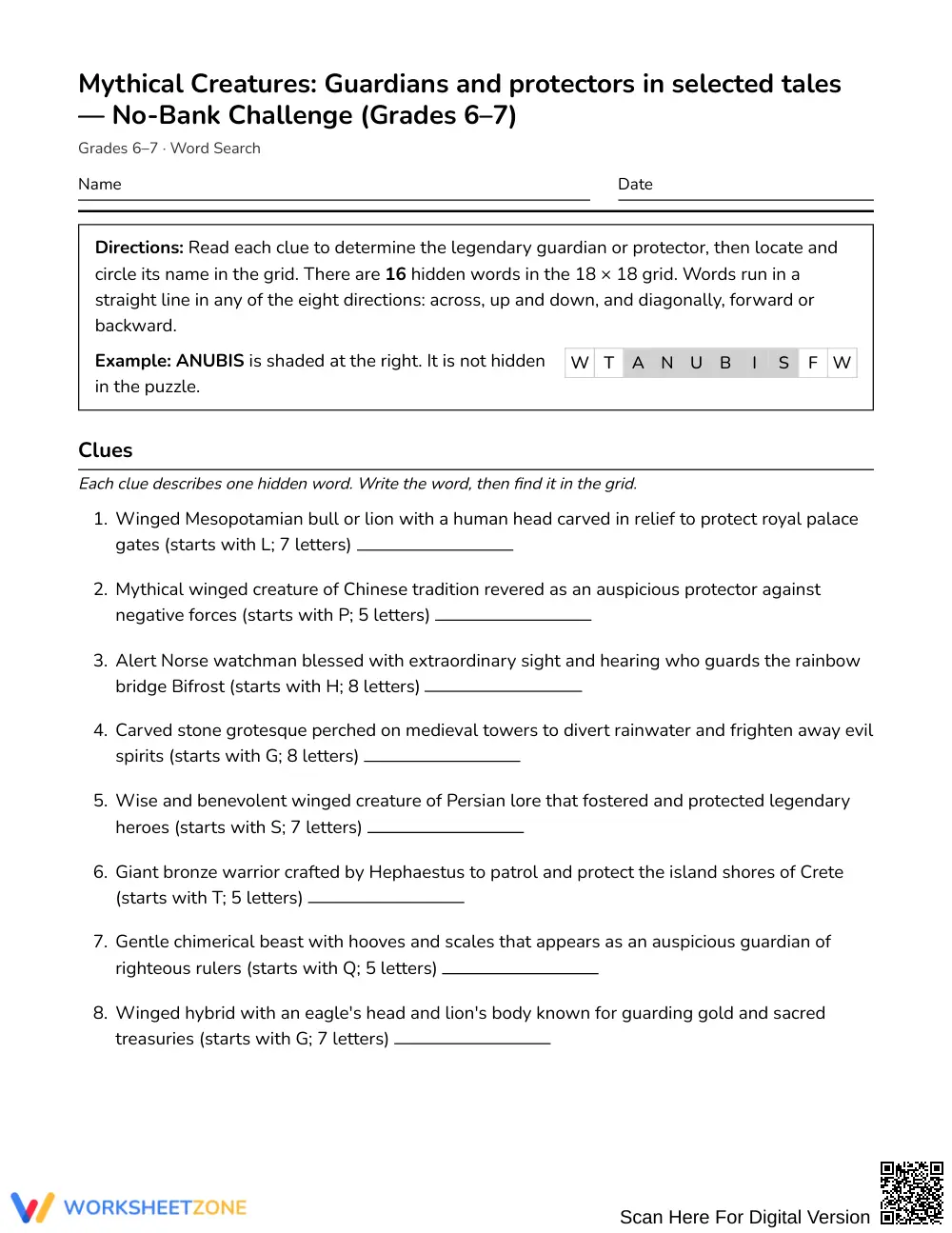
This mythical creatures word search reinforces vocabulary and cultural literacy across global folktales for middle school students. Learners analyze 16 descriptive clues detailing legendary protectors—from Greek mythology's Cerberus to Mesopotamian Lamassu—before tracking each term down within the puzzle grid, deepening their conceptual recall of world folklore traditions without relying on a passive word list.
At a Glance
- Grade: Grades 6–7 · Subject: English Language Arts (ELA)
- Standard: Not standards-assessed — vocabulary enrichment
- Skill Focus: Guardians and protectors in selected tales
- Format: 3 pages · 16 words · Answer key included · PDF
- Best For: Folktale unit vocabulary reinforcement and review
- Time: 20–30 minutes
What's Inside
The 3-page printable activity presents a challenging clue-based puzzle format paired with a full 4-page answer key. Instead of a pre-populated word list, students read 16 distinct folklore clues highlighting specific guardian figures, determine each creature's name from memory or contextual hints, and search the grid. The clean layout keeps student attention focused on mythological terminology and cultural connections.
Puzzle Mechanics
This challenge centers on a dense 18 by 18 letter grid containing 16 hidden guardian names. Words are arranged in all eight possible directions: horizontally, vertically, and diagonally, running both forward and backward (N, NE, E, SE, S, SW, W, and NW). Because the page omits a traditional word bank, students must actively deduce names from the provided cultural clues before scanning the grid.
Standards Alignment
This activity serves strictly as cross-curricular vocabulary enrichment and is not aligned to a specific state or national academic standard. Rather than targeting standards-based testing benchmarks, it enriches foundational reading comprehension and world folklore studies through deep exposure to mythological terminology, etymology, and diverse cultural narratives across ancient societies.
How to Use It
Deploy this word search after direct instruction on world folktale archetypes or as an independent early-finisher task during a broader myths and legends unit. For formative assessment, circulate as students analyze the clues to observe whether they can match cultural origins—such as Shinto Komainu or Jewish Golem narratives—without external research aids. Most learners complete the full search in 20 to 30 minutes.
Who It's For
This activity is designed for Grades 6–7 English Language Arts students studying world literature, mythology, or folklore archetypes. Teachers can support developing readers by pairing students to co-read clues or providing a reference glossary, while advanced learners can research the cultural context behind figures like the Persian Simurgh or Indian Yali. It pairs naturally with an introductory anchor chart on protective mythical archetypes.
According to Fisher & Frey (2014), domain-specific vocabulary acquisition strengthens substantially when students actively retrieve word meanings through contextual clues rather than rote memorization. This word search engages middle school learners in analyzing guardian and protector figures across world folktales, requiring them to decipher 16 descriptive clues before identifying terms within an 18 by 18 grid. By withholding a visible word bank, the activity demands active cognitive recall of mythical nomenclature spanning Greek, Norse, Hindu, and Mesopotamian traditions. Integrating clue-driven vocabulary puzzles during folktale units provides structured retrieval practice that reinforces thematic literacy without superficial guessing. Because learners must synthesize cultural descriptions with precise orthographic patterns across eight distinct grid directions, they solidify their retention of cross-curricular terms. This targeted approach transforms routine vocabulary enrichment into a rigorous exploration of global literary archetypes.


