


























Views
Downloads
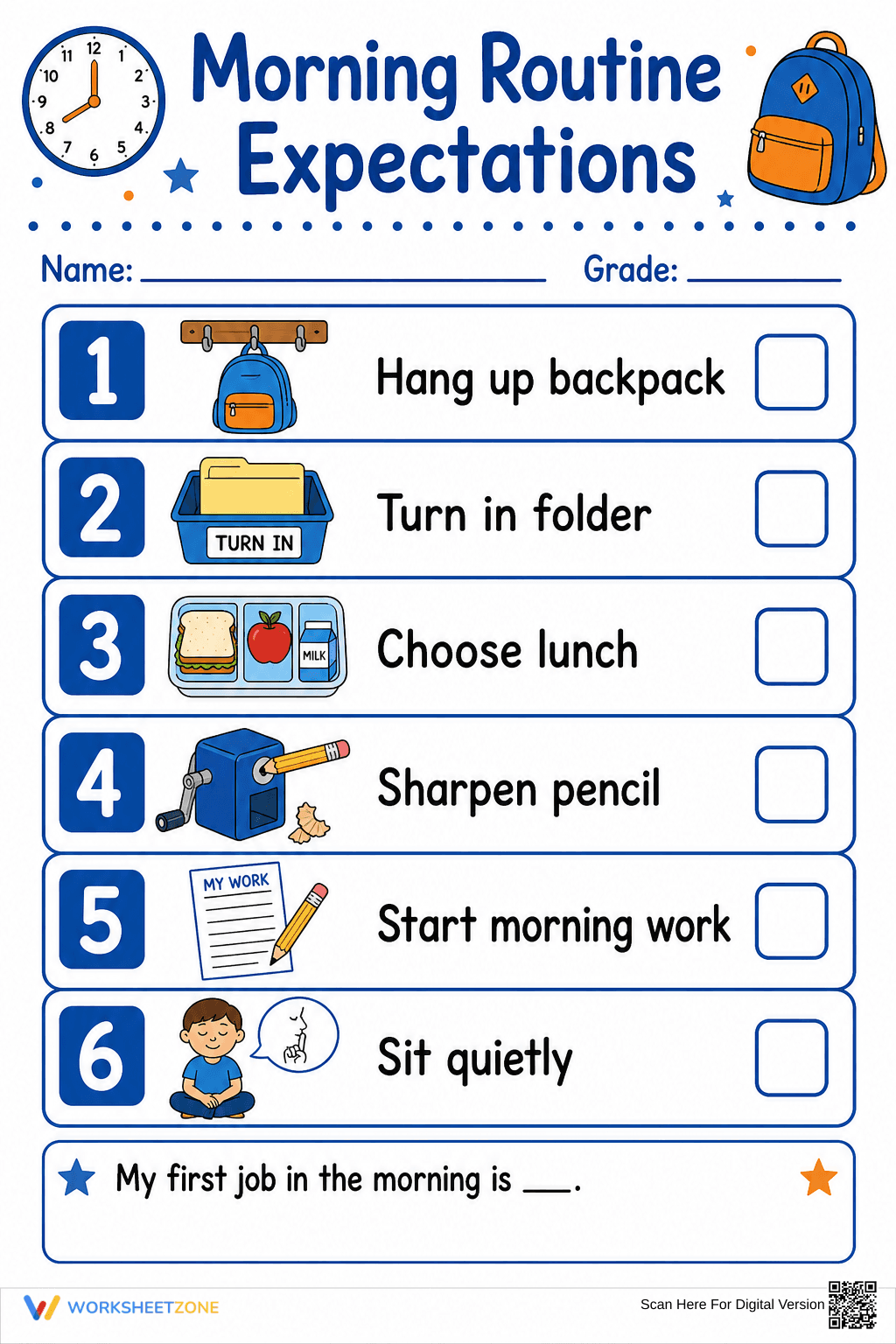

Printable Morning Routine Expectations | Grade 1 Ready
Paste this activity's link or code into your existing LMS (Google Classroom, Canvas, Teams, Schoology, Moodle, etc.).
Students can open and work on the activity right away, with no student login required.
You'll still be able to track student progress and results from your teacher account.
This morning routine expectations worksheet helps early elementary students independently manage their start-of-day tasks. By providing a clear, visual checklist, the resource guides learners through essential classroom procedures, from hanging up backpacks to starting morning work, fostering independence and reducing teacher redirection.
At a Glance
- Grade: 1 · Subject: Classroom Management
- Standard:
CCSS.ELA-LITERACY.SL.1.1.A— Follow agreed-upon rules for classroom activities- Skill Focus: Following morning routines
- Format: 1 page · 7 tasks · No answer key needed · PDF
- Best For: Beginning of year procedures
- Time: 10–15 minutes
Inside this single-page resource, educators will find a highly visual, numbered checklist featuring six core morning tasks. Each step includes a clear icon, simple text, and a checkbox for students to mark upon completion. The sequence covers hanging up a backpack, turning in a folder, choosing lunch, sharpening a pencil, starting morning work, and sitting quietly. A brief fill-in-the-blank prompt at the bottom reinforces the very first action students must take upon entering the room.
This resource is designed for immediate classroom implementation with a zero-prep workflow:
- Print (1 minute): Generate copies for the class or print a single color version to laminate as a poster.
- Distribute (1 minute): Place on desks before the bell rings or display near the classroom door.
- Review (3 minutes): Walk through the six visual steps, modeling each action for the students.
Total teacher preparation requires under two minutes, making this an excellent addition to any substitute teacher binder or back-to-school toolkit.
This routine-building tool aligns with CCSS.ELA-LITERACY.SL.1.1.A: "Follow agreed-upon rules for discussions (e.g., listening to others with care, speaking one at a time about the topics and texts under discussion)." While primarily focused on behavioral expectations, establishing these foundational procedures directly supports a structured environment where collaborative learning can thrive. Both standard codes can be copied directly into lesson plans, IEP goals, or district curriculum mapping tools.
Teachers can utilize this checklist during the first weeks of school to explicitly teach morning procedures. Have students keep a copy in their folders, checking off items as they arrive. Alternatively, laminate the sheet for desks, allowing use of a dry-erase marker. As a formative assessment observation tip, monitor which students complete all six steps independently versus those requiring reminders. Expected completion time ranges from 10 to 15 minutes.
This visual checklist is ideal for kindergarten through second-grade students who benefit from explicit, step-by-step instructions. The inclusion of clear icons makes it highly accessible for English Language Learners and students who require visual scaffolds to process multi-step directions. It pairs perfectly with an interactive anchor chart detailing classroom rules or a direct instruction lesson on community expectations.
Establishing predictable procedures is a foundational element of effective classroom management. By aligning with CCSS.ELA-LITERACY.SL.1.1.A to follow agreed-upon rules for classroom activities, this resource provides structure for young learners. According to Fisher & Frey (2014), explicit instruction in classroom routines significantly increases instructional time by minimizing behavioral disruptions. When students understand exactly what is expected upon entering the room, they experience lower anxiety and demonstrate higher engagement. This visual checklist translates abstract expectations into concrete steps, empowering students to take ownership of their morning responsibilities. Consistent use of visual supports fosters a positive climate and builds essential self-management skills.


