





























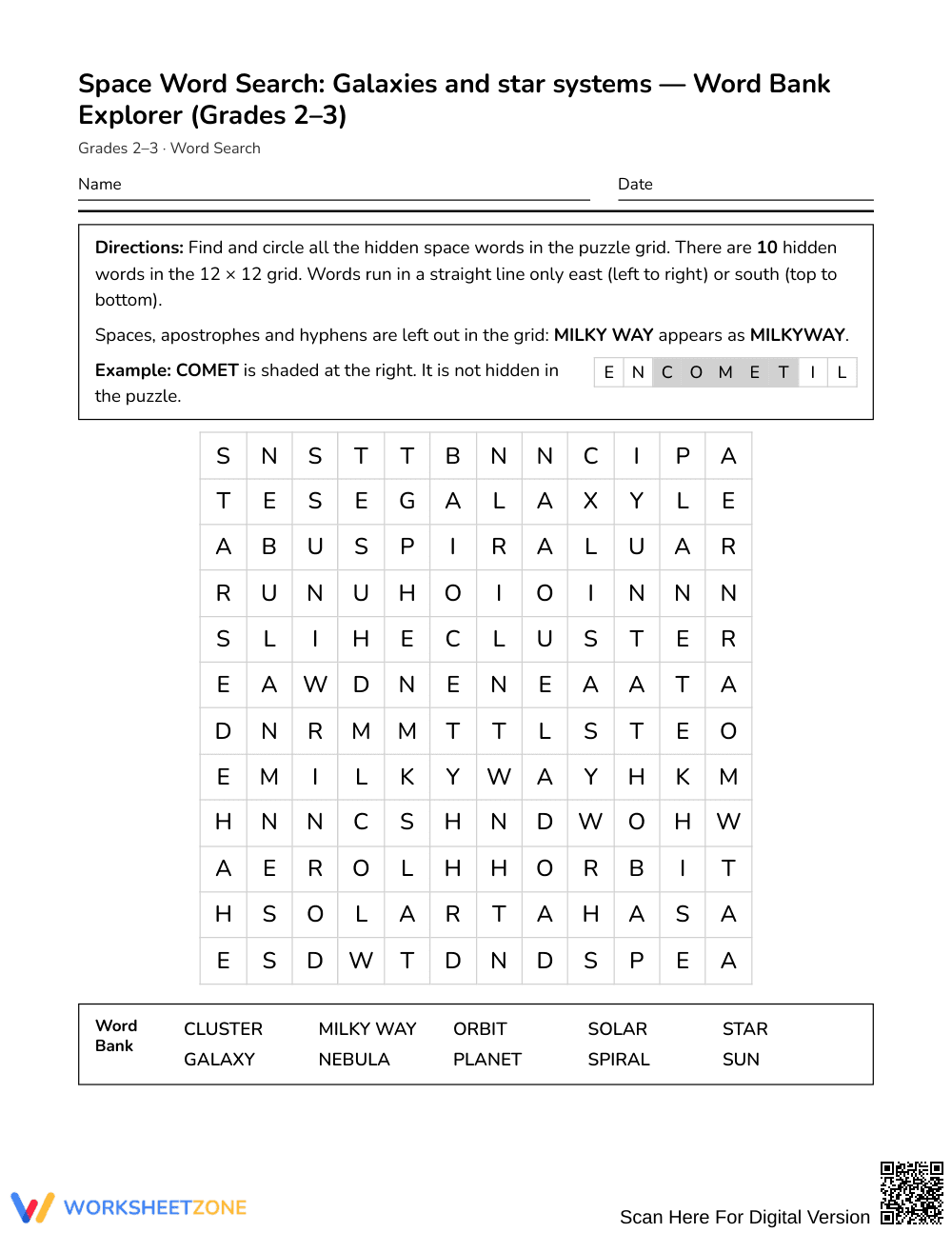


Printable Galaxies & Stars Word Search | Grades 2–3 Science

Paste this activity's link or code into your existing LMS (Google Classroom, Canvas, Teams, Schoology, Moodle, etc.).
Students can open and work on the activity right away, with no student login required.
You'll still be able to track student progress and results from your teacher account.
This Grades 2–3 astronomy word search introduces young learners to galaxies and star systems through focused vocabulary discovery. Students locate key space science terms hidden within an accessible puzzle grid, building foundational domain-specific literacy while reinforcing correct spelling and recognition of essential cosmic concepts.
At a Glance
- Grade: Grades 2–3 · Subject: Science
- Standard: Not standards-assessed — vocabulary enrichment
- Skill Focus: galaxies and star systems
- Format: 1 pages · 10 words · Answer key included · PDF
- Best For: Independent science vocabulary practice
- Time: 15–20 minutes
What's Inside: The single-page activity features a 12 by 12 letter grid containing 10 target astronomy vocabulary words. An alphabetical word bank guides student scanning, supported by kid-friendly descriptive definitions for terms like cluster, nebula, and spiral. The resource includes a complete multi-page answer key showing exact word placements for quick visual verification.
Puzzle Mechanics: The activity utilizes a straightforward 12 by 12 grid constructed specifically for early elementary learners. All 10 hidden words run in only two directions: horizontally from left to right (East) and vertically from top to bottom (South). There are no backward or diagonal placements, ensuring an engaging, low-frustration search experience that lets students concentrate on letter sequences and scientific terminology.
Standards Alignment: This activity serves as vocabulary enrichment and is not aligned to a standard. It reinforces essential science terminology across core elementary space topics, providing contextual exposure to fundamental astronomy concepts before or alongside formal unit instruction.
How to Use It: Deploy this printable puzzle during an introductory astronomy lesson or as an independent early finisher task after direct instruction on the solar system. Teachers can circulate to check word identification strategies, prompting students to read the provided scientific definitions aloud as they locate each term. Expect completion in approximately 15 to 20 minutes.
Who It's For: Designed specifically for second and third-grade elementary students exploring space science, this puzzle supports emerging readers through its strictly left-to-right and top-to-bottom layout. Pair this vocabulary sheet with an illustrated trade book about our solar system or a class anchor chart displaying pictures of nebulae and spiral galaxies.
According to research from Fisher & Frey (2014), intentional exposure to domain-specific vocabulary establishes the cognitive framework necessary for complex content comprehension in early science instruction. When primary grade learners encounter specialized terminology within an organized format, they build stronger memory pathways that connect written graphemes to scientific meaning. This Grades 2–3 astronomy word search provides structured vocabulary enrichment focused on galaxies and star systems, bridging initial visual pattern recognition with deeper contextual understanding. By combining an accessible 12 by 12 letter matrix with student-friendly definitions, the activity strengthens orthographic mapping, phonics application, and domain literacy across 10 vital cosmic concepts. Educators can use this targeted exercise to activate prior background knowledge, reinforce precise scientific spelling patterns, and prepare young students for upcoming non-fiction reading tasks without causing unnecessary cognitive strain during independent learning intervals.


