Match Solar System Worksheets to the Right Grade Band
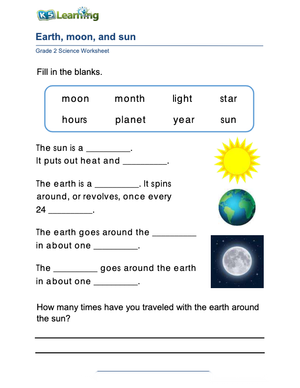
Before you print anything, decide what job the worksheet is doing. A grade 5 packet on sky patterns and a middle school scale-comparison sheet cover the same neighborhood of space, but they ask students to think very differently. The fastest way to waste a class period is to hand fifth graders a data-analysis task built for eighth graders, or to give middle schoolers a vocabulary match they finished two years ago. Sorting your space and the solar system worksheets by grade band first keeps practice tight and standards-aligned, and it saves you from re-teaching content students have already mastered.
It also helps to name the skill each sheet targets before it lands on a desk. Some worksheets build background knowledge, some ask students to reason from a pattern, and some function purely as a check for understanding. When you know which of those three roles a page plays, you can slot it into the right moment in your unit instead of using it as filler.
Grade 5: Sun Size, Star Distance, and Sky Patterns
Elementary space work lives in two NGSS performance expectations. In 5-ESS1-1, students support an argument that the sun looks larger and brighter than other stars only because it sits so much closer to Earth. Worksheets here should push reasoning, not recall, asking students to explain why a distant star and a nearby star can be the same size yet look nothing alike from a classroom window.
The second anchor, 5-ESS1-2, is all about patterns. Students graph shadow length and direction across a day, track day and night, and record how the stars visible at night shift across the seasons. Good worksheets give students real data tables to plot and a prompt to describe the pattern in their own words. That pairing of graphing plus explanation is exactly what the standard expects, so look for sheets that ask for both instead of stopping at a completed graph.
At this grade, keep the reading load light so the science thinking stays front and center. A worksheet crowded with dense text can hide whether a student actually understands the pattern or just decoded the paragraph. Short prompts, a clear data table, and room to sketch usually outperform a wall of print for ten-year-olds.
Middle School: Modeling, Gravity, and Scale Data
Middle school space systems raise the cognitive bar across three expectations. MS-ESS1-1 asks students to model the Earth-sun-moon system to explain lunar phases, eclipses, and seasons. MS-ESS1-2 shifts to gravity's role in keeping orbits stable within the solar system and galaxy. MS-ESS1-3 has students analyze real telescope and spacecraft data to compare properties like size, surface features, and orbital radius across solar system objects.
Here is the practical distinction most pacing guides miss: elementary space work is observational, while middle school space work is explanatory and quantitative. Grade 5 students describe what they see in the sky; middle schoolers use models and measured data to explain the mechanism behind it. When you scan a worksheet, check the verbs. If every prompt says identify or label, it belongs in a grade 5 review, not a middle school lesson targeting MS-ESS1-3 scale analysis. Prompts that say model, argue, or compare using the data are the ones pulling their weight.
Pair Worksheets With Earth-Sun-Moon Modeling
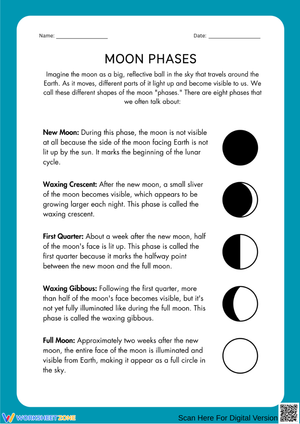
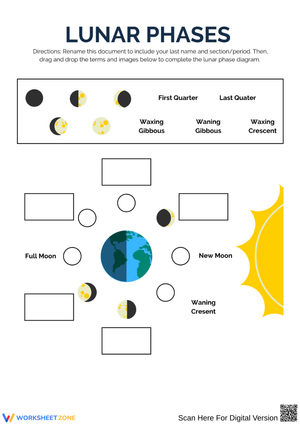
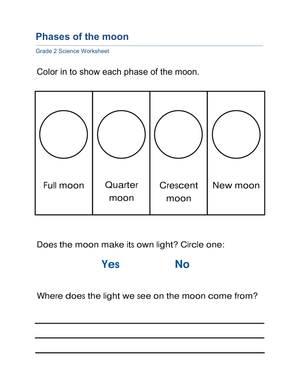
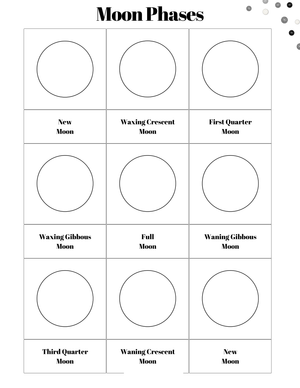
Worksheets work best as bookends around a hands-on model, not as a replacement for it. Before students build a physical Earth-sun-moon model for MS-ESS1-1, a short worksheet can surface what they already believe about why the moon changes shape. After the model, a second sheet asks them to sketch the alignment for a specific phase or eclipse and justify it. The writing they do after the model is where the standard's explanatory work actually happens.
According to the Next Generation Science Standards, performance expectation 5-ESS1-1 asks fifth graders to support an argument that the sun appears larger and brighter than other stars because of its relative distance from Earth. That single standard anchors an entire elementary unit on scale, distance, and observable sky patterns, giving you a clear finish line for every worksheet you assign.
Classroom Implementation
Here is a simple arc for building a space-science unit from worksheets without over-printing:
- Open with vocabulary only long enough to establish shared terms like orbit, phase, and rotation, then move on.
- Practice patterns with graphing sheets for 5-ESS1-2, having students plot shadow or day-length data and describe the trend.
- Model the system using an Earth-sun-moon activity, with a worksheet capturing predictions before and sketches after.
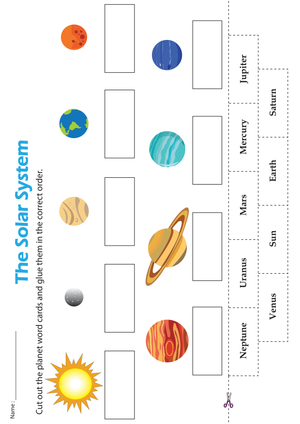
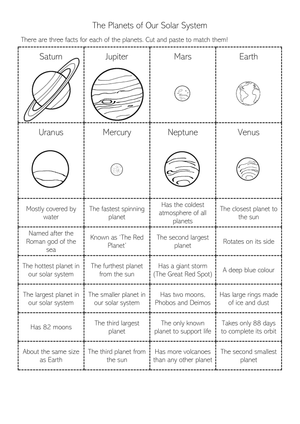
- Analyze scale data for MS-ESS1-3 with comparison tables of size and orbital radius.
- Assess with a short parallel-form worksheet you already used as a pre-check.
For small-group intervention, pull the pattern and vocabulary sheets as re-teaching tools; for enrichment, hand advanced students a raw data set and ask them to build the comparison table themselves. The same worksheet library flexes across tiers when you change the task, not the topic. That single-topic, three-task approach also keeps your prep manageable, because you are adjusting one resource rather than hunting for three separate ones.
Frequently Asked Questions
1. What grade level are solar system worksheets appropriate for?
They span roughly grade 5 through middle school. Grade 5 sheets focus on observable sky patterns and why the sun looks brighter than other stars, while middle school sheets move into modeling, gravity, and data analysis. Match the worksheet's verbs to your students' grade band before assigning it.
2. How do these worksheets align with NGSS space systems standards?
Elementary sheets support 5-ESS1-1 and 5-ESS1-2. Middle school sheets target MS-ESS1-1 modeling of the Earth-sun-moon system, MS-ESS1-2 on gravity and orbits, and MS-ESS1-3 on comparing scale properties from telescope and spacecraft data. Together those five expectations map the whole space systems arc.
3. Can solar system worksheets be used for review before a test or after a modeling lab?
Yes. Use a short worksheet as a pre-check to surface misconceptions, then reissue a parallel version after a modeling lab to measure growth. This bookend approach turns ordinary practice sheets into fast formative assessment without adding much grading time.
4. What is the difference between elementary and middle school solar system content?
Elementary work is observational: students describe patterns they can see in the sky. Middle school work is explanatory and quantitative: students use models and measured data to explain why phases, eclipses, seasons, and stable orbits happen. The verbs on the page usually give the level away.
5. How can teachers use these worksheets for small-group intervention or enrichment?
For intervention, pull pattern and vocabulary sheets to re-teach day, night, and seasonal star concepts from 5-ESS1-2. For enrichment, give advanced students a raw data set and have them build their own scale-comparison table instead of filling in a prepared one.












 Interactive Worksheet Maker
 Quiz Maker
 Word Search Maker
 Crossword Puzzle Maker
 Word Scramble Generator
 Sentence Scramble Generator
 Handwriting Worksheet Generator
 Name Tracing Generator
 Fill In The Blank Generator