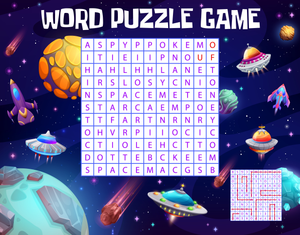
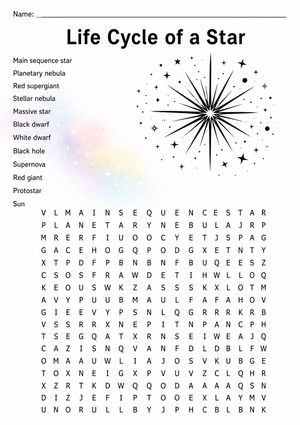
Space Word Search That Launches Vocabulary Into Orbit
A space word search can make astronomy feel closer, clearer, and more exciting for students. Space is already a topic filled with curiosity, but the vocabulary can quickly become challenging. Words like orbit, galaxy, asteroid, gravity, constellation, satellite, and telescope may appear in science readings long before students fully understand them. A word search gives learners a friendly way to meet these terms, recognize their spelling, and build confidence before moving into deeper astronomy lessons.
What makes a space word search especially useful is the way it turns big science ideas into something students can actively explore. As they scan the grid, learners are not just looking for random words. They are noticing the language used to describe planets, stars, moons, space travel, and the universe. This repeated visual exposure supports vocabulary retention, especially for students who need more time to become comfortable with academic science terms. The activity feels simple, but it quietly strengthens focus, pattern recognition, and reading accuracy.
Teachers can use a space word search at many points in a science unit. Before a lesson, it can introduce key terms students will soon encounter in textbooks, videos, or class discussions. After instruction, it can serve as a calm review activity that helps students revisit important vocabulary without the pressure of a quiz. Teachers can also extend the activity by asking students to define selected words, sort terms into categories such as planets, objects, tools, and forces, or write a short fact about each word they found.
This activity also works well because space vocabulary can be adjusted for different age groups. Younger students may search for familiar words like sun, moon, star, planet, rocket, and Mars. Older learners can work with more advanced terms such as nebula, eclipse, atmosphere, meteorite, interstellar, spectroscopy, and perihelion. Parents can use the same type of activity at home to support science learning, encourage curiosity, and start natural conversations about night skies, space missions, and how the universe works.
Worksheetzone’s space word search resources give students a focused and enjoyable way to build astronomy vocabulary. The puzzle format keeps learners engaged while supporting spelling, concentration, visual scanning, and subject-area reading. Whether used in a classroom science unit, homeschool lesson, early-finisher folder, or quiet study routine, a space word search helps students explore the language of the universe one hidden word at a time.
Frequently Asked Questions
Question 1: What age group is a space word search suitable for?
A space word search is suitable for a wide range of ages, from early elementary students learning planet names to middle school learners studying advanced astronomy. Worksheetzone provides puzzles at multiple difficulty levels, so teachers and parents can choose a grid that matches the vocabulary and skill level of their students without overwhelming or under-challenging them.
Question 2: How can a space word search support classroom lesson plans?
A space word search works well as a warm-up activity to introduce key vocabulary before a lesson or as a review tool after students have covered space topics in class. It reinforces terms like orbit, galaxy, and comet through active searching rather than passive reading, helping students internalize scientific language in a low-pressure, engaging format that fits naturally into lesson planning.
Question 3: Can parents use space word search activities at home?
Yes, parents can use space word search activities at home to supplement school learning or spark curiosity during school breaks. These activities are simple to use and give children a focused, screen-free challenge. They also open natural conversations about planets, stars, rockets, space missions, and astronomy between parents and their children.
Question 4: What space vocabulary words are typically included in a space word search?
A space word search commonly includes terms such as planet, comet, asteroid, galaxy, satellite, nebula, constellation, orbit, gravity, and telescope. More advanced puzzles from Worksheetzone may also feature words like spectroscopy, perihelion, and interstellar, giving older students or curious learners a richer vocabulary challenge tied directly to astronomy concepts.