




























Views
Downloads


Printable Feedback Loops Word Search | Grades 8–10 Science

Paste this activity's link or code into your existing LMS (Google Classroom, Canvas, Teams, Schoology, Moodle, etc.).
Students can open and work on the activity right away, with no student login required.
You'll still be able to track student progress and results from your teacher account.
Mastering endocrine feedback loops requires a firm grasp of specialized biological vocabulary. This science word search helps students in Grades 8–10 reinforce 14 essential physiological terms, connecting regulatory mechanisms like negative feedback and hormonal signaling to precise definitions. Students decode concept-driven clues before finding hidden vocabulary across the puzzle grid, strengthening scientific literacy and long-term memory.
At a Glance
- Grade: Grades 8–10 · Subject: Science
- Standard: Not standards-assessed — vocabulary enrichment
- Skill Focus: Feedback loops
- Format: 3 pages · 14 words · Answer key included · PDF
- Best For: Endocrine review, sub plans, vocabulary practice
- Time: 20–30 minutes
What's Inside
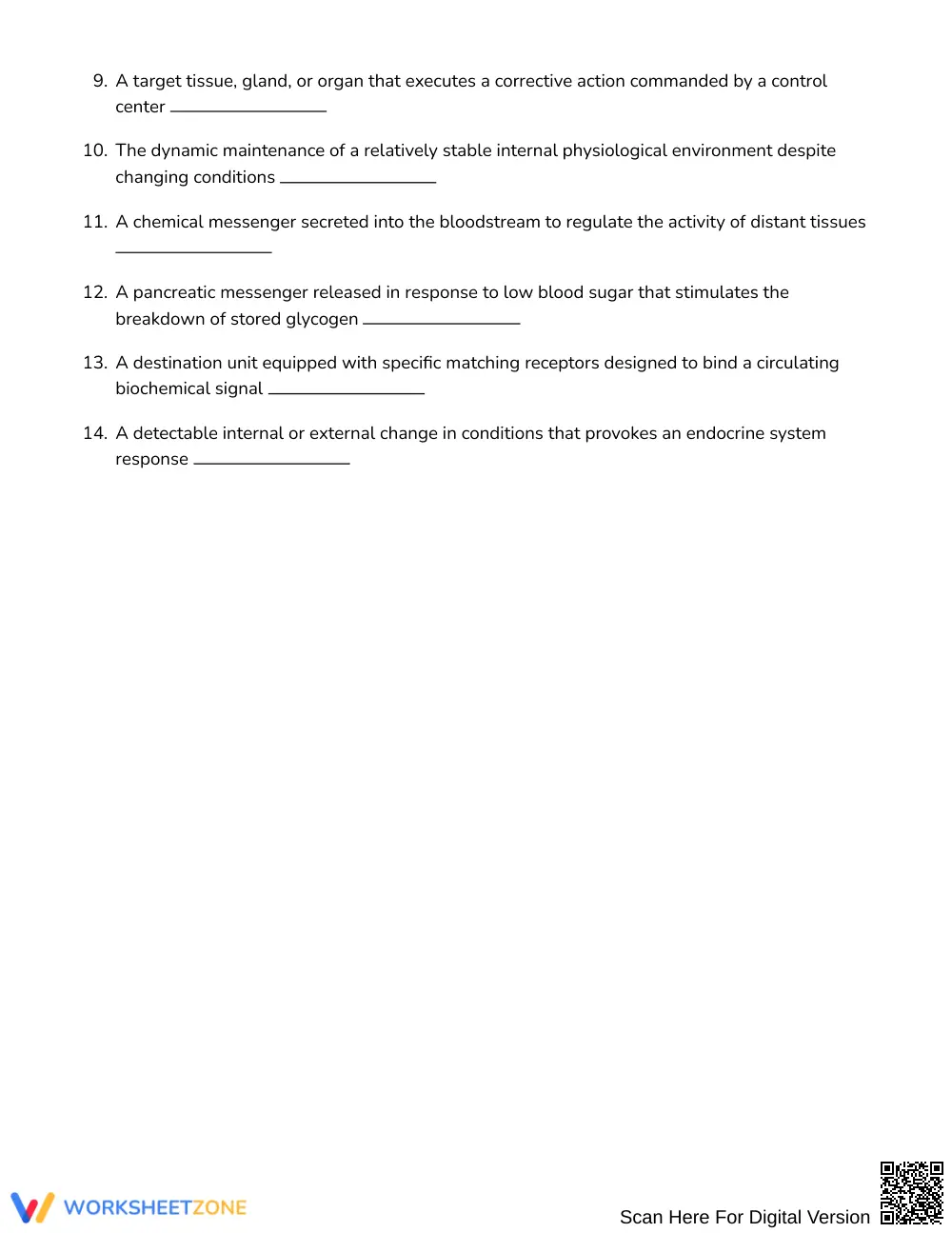
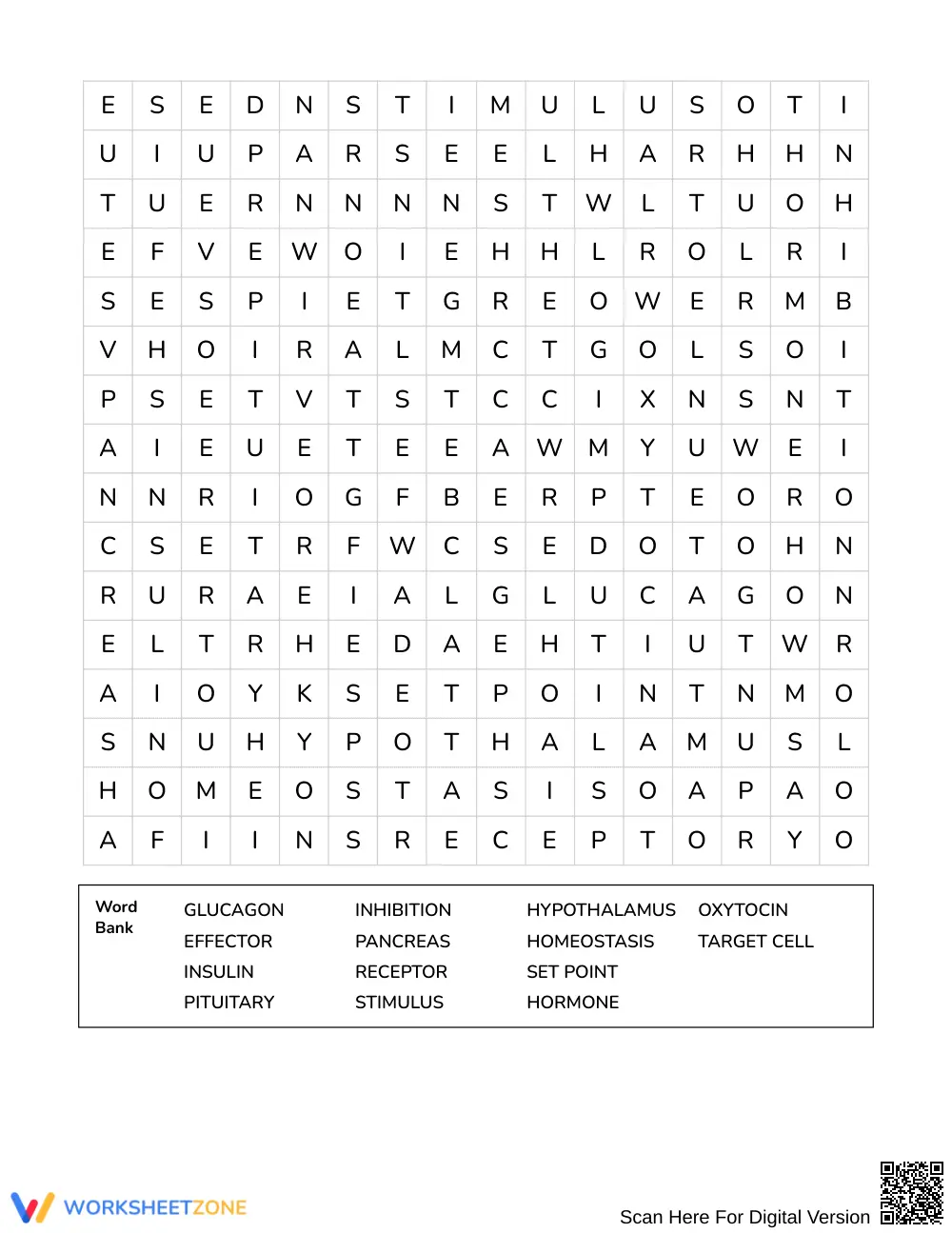
This 3-page printable science resource includes a student puzzle page, a complete clue reference sheet, and a full-size teacher answer key. Rather than relying on a simple word bank, the activity presents 14 detailed physiological definitions that students analyze to deduce target terms like homeostasis, insulin, glucagon, and receptor. The accompanying 3-page solution set clearly highlights every word placement, enabling rapid verification and effortless grading.
Puzzle Mechanics and Structure
Designed around a challenging 16 by 16 letter grid, the puzzle incorporates directional word placements restricted to northeast, east, southeast, and south orientations. This deliberate arrangement supports visual tracking and cognitive engagement without frustrating backward inversions. Learners read clue definitions describing hormonal organs, feedback loops, and target mechanisms, match each description to its scientific designation, and locate the term within the grid.
Standards Alignment
This activity serves strictly as vocabulary enrichment and is not aligned to a specific state or national curriculum standard. It directly reinforces foundational biological terminology necessary for understanding complex cellular communication and physiological regulation in secondary life science coursework.
How to Use It
Deploy this word search during an endocrine system unit immediately following direct instruction on negative feedback loops. Alternatively, assign it as a zero-prep emergency sub plan or warm-up review station. While students work, conduct a brief formative check by asking them to distinguish how insulin and glucagon act as opposing effectors. Most learners complete the puzzle within 20 to 30 minutes.
Who It's For
This resource targets students in Grades 8–10 enrolled in general science, life science, or introductory biology courses. It accommodates visual and independent learners needing low-stakes term exposure. Pair this puzzle with a feedback loop diagramming activity or an endocrine hormone anchor chart to bridge vocabulary acquisition with dynamic biological processes.
Explicit domain-specific vocabulary acquisition plays a decisive role in adolescent science achievement and conceptual synthesis. According to Fisher & Frey (2014), intentional exposure to academic terminology within contextualized learning routines significantly enhances content-area reading comprehension and knowledge retention. Secondary science curricula require students to navigate sophisticated conceptual frameworks such as endocrine feedback loops, homeostatic set points, and hormonal regulation. Integrating clue-based vocabulary tasks enables learners in Grades 8–10 to connect technical scientific definitions with operational terminology before engaging with higher-order physiological modeling. This structured puzzle activity delivers focused exposure to 14 foundational life science terms across a 16 by 16 grid without unnecessary cognitive overload. As students evaluate physiological descriptors to identify target structures and regulatory pathways, they consolidate the specialized lexicon essential for success in introductory biology, laboratory investigations, and comprehensive district assessments.


